Healing Herbs in Yemen


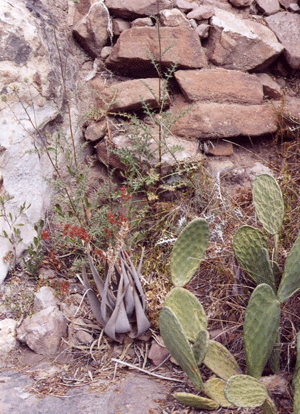
Aloe and Opuntia (balas Turkî) in al-Ahjur, central highlands of Yemen

Today I am flying on Lufthansa to Leipzig, and then on to Halle Wittenberg for a conference called “The use of herbs in Yemeni healing practices. An interdisciplinary workshop on traditional knowledge and cultural concepts in scientific perspective.“ The conference takes place September 25-26, 2009 at the Orientwissenschaftliches Zentrum , Martin-Luther-Universität Halle-Wittenberg, Germany. It has been funded by the Royal Ontario Museum Foundation, Ryerson University (both Toronto/Canada), and Martin-Luther-Universität Halle-Wittenberg, Germany. Click here for the order of the program.

The organizers are Dr Hanne Schönig (Orientwissenschaftliches Zentrum
Martin-Luther-Universität Halle-Wittenberg, homepage: http://www.owz.uni-halle.de/owz.php?pid=2) and Dr Ingrid Hehmeyer (Department of History, Ryerson University, Toronto, homepage: http://www.ryerson.ca/history/faculty/Hehmeyeri.html) and Dr Anne Regourd, Collaborateur Scientifique, Dept of Islamic arts, Musée du Louvre, Paris – France, homepage: http://www.anne.regourd.org.

The conference participants and papers are noted below: Continue reading Healing Herbs in Yemen
Bani Hushaysh Archaeology

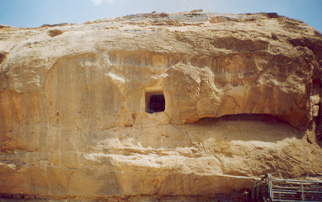
Archeological sites in Bani Hushaish suffer from vandalism

by Mansur Ali al-Muntasir, Yemen Observer, February 3, 2009

The Bani Hushaish district in the Sana’a governorate is 30 km east of the capital, and contains several important archeological sites.

Yemen has a great wealth of ancient archeological sites many of which date as far back as the pre-Islamic era and many more site which are still waiting to be discovered and documented. There is a fear though amongst the Yemen’s archeological establishment that without adequate protection and preservation much of Yemen’s historical record could be lost to natural and human damage. This article seeks to highlight the richness of Yemen’s archeological heritage and the need to preserve and document such heritage for future generations.

The most important of the discovered archeological sites is in Shibam al-Ghras, where several mummies were found. The district contains several other neglected sites, which have not yet been identified by archeological authorities. This is disturbing; as these sites have been damaged as a result of official negligence, and a lack of public awareness about their value and importance to Yemeni heritage. Continue reading Bani Hushaysh Archaeology

Satanic or Silly: Does Yale Press Censorship of Cartoons Insult Muslims?


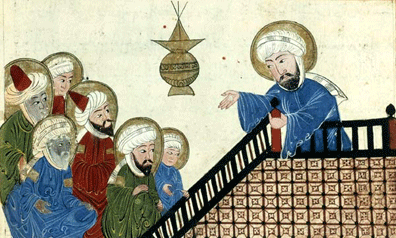
The Prophet Muhammad, 17th century Ottoman copy of an early 14th century (Ilkhanate period) manuscript of Northwestern Iran or northern Iraq (the “Edinburgh codex”). Illustration of AbÅ« Rayhān al-BÄ«rÅ«nÄ«’s al-Âthâr al-bâqiyah ( الآثار الباقيةة ; “The Remaining Signs of Past Centuries”). Source: Wikipedia article on Muhammad

Satanic or Silly: Does Yale Press Censorship of Cartoons Insult Muslims?
By Daniel Martin Varisco, Religion Dispatches, September 8, 2009

Two decades ago, the publication of Salman Rushdie’s The Satanic Verses caused a tsunami of protest in the Muslim world. The author was forced into hiding for nearly a decade after Ayatollah Khomeini called on Muslims to kill him and his publishers. Rushdie was accused of blasphemy, both for slandering the prophet Muhammad by subverting his character to Mahound (a medieval English term synonymous with the devil) and for reducing the holy city of Mecca to Jahiliya (a term used by Muslims to refer to the pagan past of Arabia). It was only a novel, but the fact that it was written by an Indian-born Muslim and published in the West was enough to frustrate even moderate Muslims.

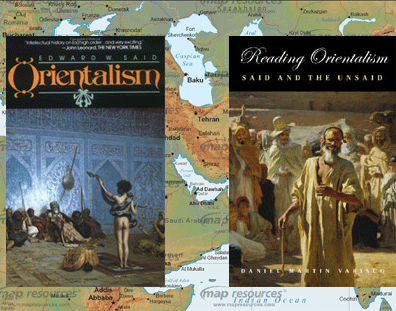
Academic books rarely cause riots in the streets, but a forthcoming study on the recent Danish cartoon controversy may come close. Continue reading Satanic or Silly: Does Yale Press Censorship of Cartoons Insult Muslims?

MECA Study Day at Hofstra

Hofstra University Announces Middle Eastern and Central Asian Study Day
A Series of Presentations Focused on Faculty Research

Who: Hofstra faculty who have conducted research on Middle Eastern and Central Asian (MECA) studies
What: MECA Study Day
When: September 16, 2009
Where: 310 C.V. Starr Hall and 117 Berliner Hall, South Campus
Why: To highlight and learn about the research Hofstra faculty have done on MECA studies

Hofstra faculty from a variety of departments such as fine art, art history, anthropology, history, comparative literature, economics, political science and religious studies will give presentations on their research in MECA studies. Topics from their research will include archeology, women’s issues, history and the contemporary Middle Eastern and Central Asian world. These talks are free and open to the public.

MECA Schedule

Western and Central Asia in the Middle Ages
9:30 – 11:15 a.m., C.V. Starr Hall, 310
Moderator: Dr. Stefanie Nanes, Department of Political Science

• Greeting by Dr. Bernard Firestone, Dean of Hofstra College of Liberal Arts and Sciences
• Opening remarks by Dr. Daniel Martin Varisco, Department of Anthropology

• Dr. Aleksandr Naymark, Department of Fine Arts/Art History
Amazing Sogdians: Masters and Creatures of the Silk Road

• Dr. Anna Feuerbach, Department of Anthropology
The Damascus Steel Sword

• Dr. Daniel Martin Varisco, Department of Anthropology
The Sultan’s Green Thumb: Yemeni Agriculture in the 14th Century Continue reading MECA Study Day at Hofstra

The Wives (make that Wife) of the Prophet

[Webshaykh’s Note: Revisionism is found in all religions. I recently came across a blog posting that seeks to restore the marital status of Muhammad to one wife at a time, although it appears to be more an attack on at-Tabari, Ibn Ishaq and Ibn Hisham. I post the commentary not because I agree with it, but as an example of the variety of views held by Muslims in representing the Prophet Muhammad.]

THE PROPHET (S) HAD ONLY ONE WIFE AT A TIME by Dr. Shabbir Ahmed, The Quran as it Explains Itself, August 30th, 2009

THE PROPHET (S) HAD ONLY ONE WIFE AT A TIME

MARRIAGE WITH HAZRAT AYESHA 622 CE:
Contrary to the Imamist propaganda, the exalted Prophet had no more than one wife at a time. And Hazrat Ayesha was a sister, not daughter of Hazrat Abu Bakr. The Prophet (S) did not marry for three years after Hazrat Khadijah’s demise in Makkah three years before Hijrah. Hazrat Ayesha was the widow of a martyr, Saleh bin Saleh Al-’Ataib. She was 48 years old at the time of marriage to the exalted Prophet. Sahaba Kiraam including Hazrat Abu Bakr strongly recommended that the Prophet (S) and she got into the solemn union of marriage. The blessed wedding took place in 622 CE when Muhammad (S) was 52 years old. Kitab-e-Dalail-e-Nabawwut Syedna Muhammad (S), by Abdul Jabbar Fatimi, written 150 years before Tabari, the first ever ‘canonized’ historian. Azwaaj-in-Nabi wal-Ashaab, by Sheikh Hammad bin Hakam. The rest is nothing but slanderous imagination of the Zoroastrian “Imam” Tabari and the Jewish biographer Ibn Ishaq and his Parsi follower Ibn Hisham. Continue reading The Wives (make that Wife) of the Prophet

Ramadan Around the Globe


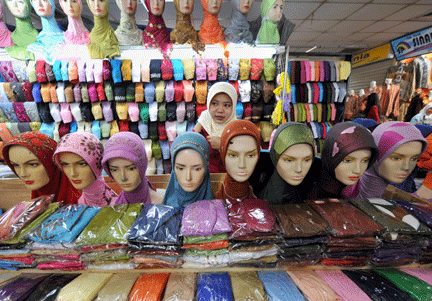
A vendor of headscarfs waits for customers in the 4th day of Ramadan at a market in Jakarta, Indonesia on August 25, 2009. (Adek Berry/AFP/Getty Images)

The Boston Globe published a series of excellent photographs of Muslims around the world as they prepared for Ramadan this year. There is a total of 39 photographs and these are well worth looking at. Click here to go to the website.