Category Archives: Countries

A Visit to Yemen in 1884: Part 1

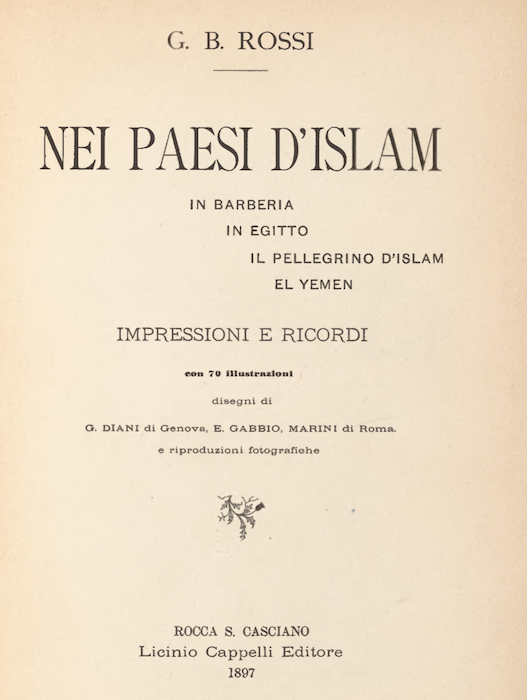
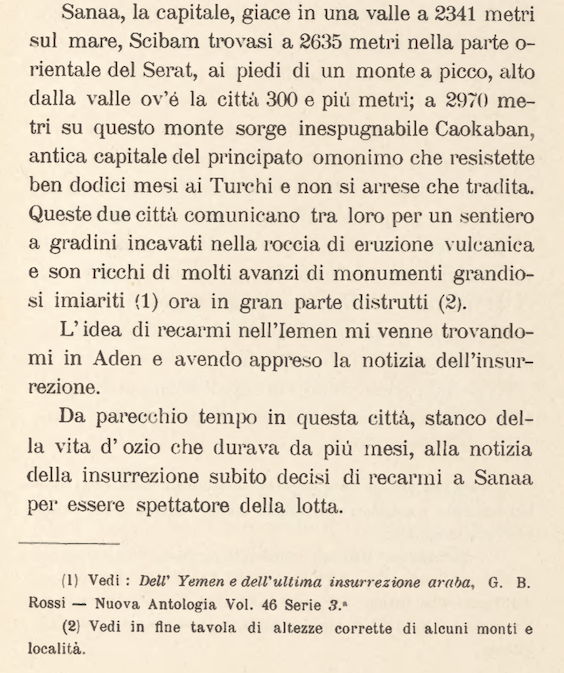
Most scholars who have read about the many travelers to Yemen in the past are well aware of the Italian Renzo Manzoni, whose 1884 El Yemen records his visit to Ottoman Yemen in 1877-1878. This travel account has even been translated into Arabic. A little more than a decade later, in 1891, another Italian visited Yemen after a journey that took him through Tunis and Egypt. His name is G. B. Rossi and his Nei Paesi d’Islam was published in 1897 with some 70 drawings. It is a popular account, drawing on earlier works of Yemen along with his own personal anecdotes about his visit, which he notes was at a time when there was tension between the Ottomans and the Imam. For a flavor of his writing, consider the following near the start of his discussion on Yemen:

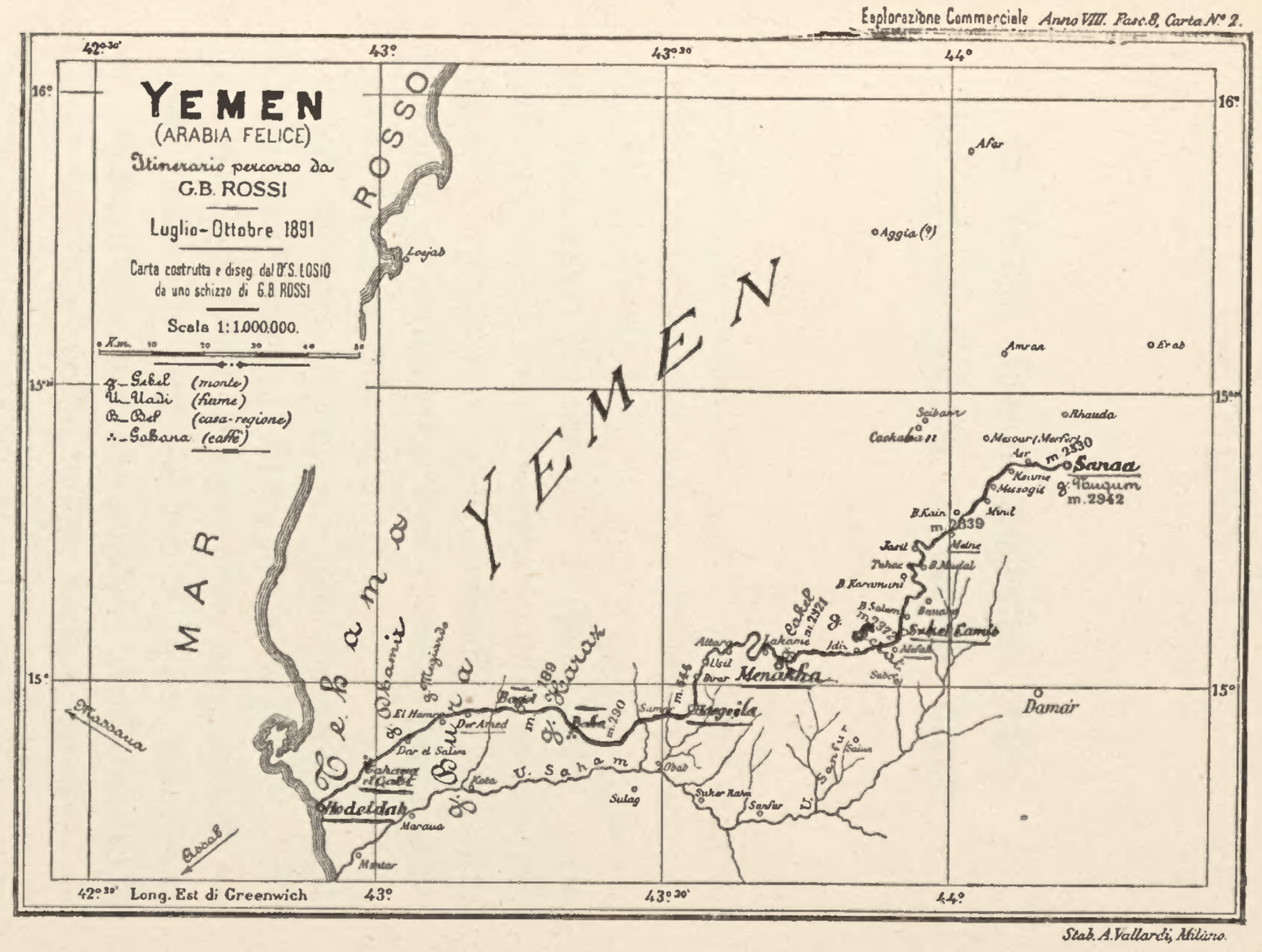
Rossi provides a map about his journey:

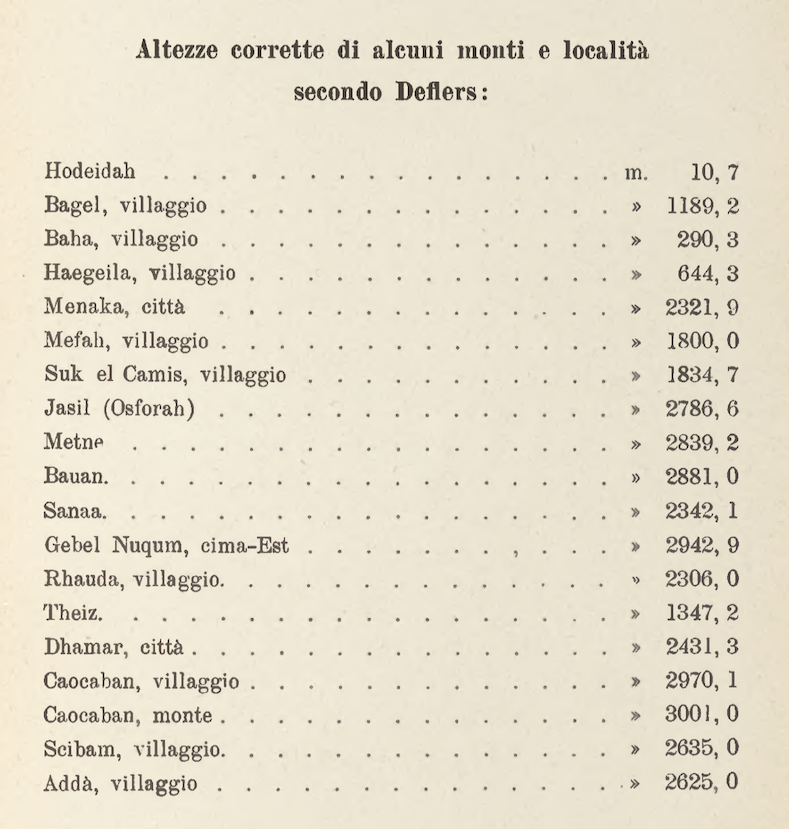
Among other items is a list of the altitudes of Yemen’s main towns at the time.

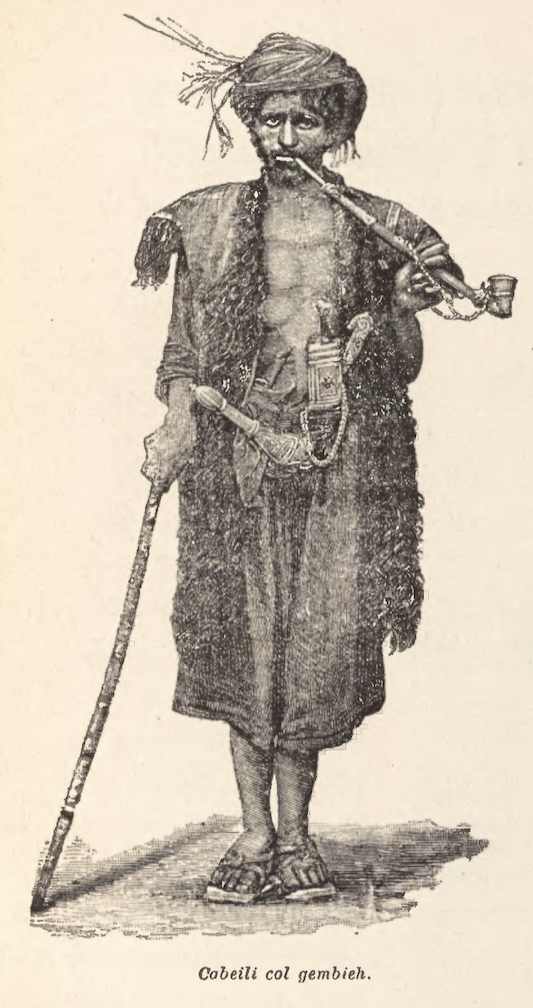
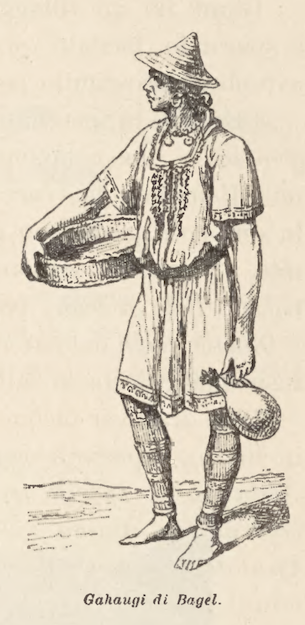
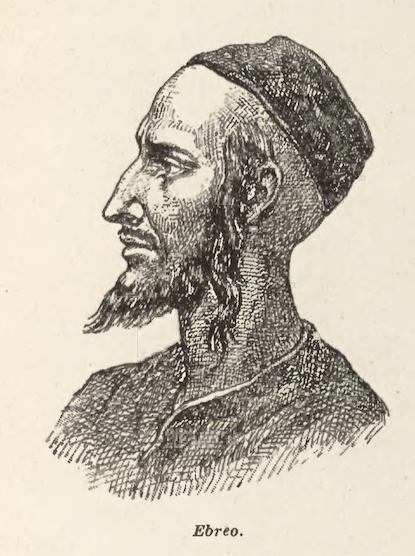
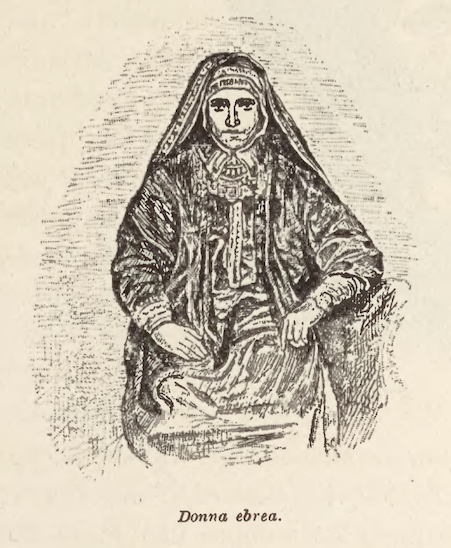
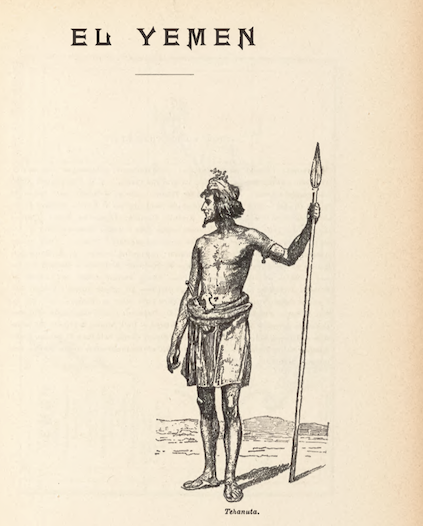
What makes this text worth looking at is the number of illustrations. I attach one below and will follow up with more posts of the illustrations.

To be continued…

Persia Once More

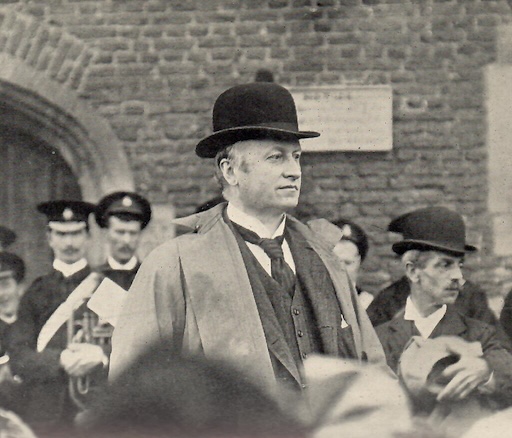
This comment could be from a current political figure about the ongoing conflict in the Middle East, but it was actually written by the British diplomat Lord Curzon in September, 1919, only a few months after the signing of the Treaty of Versailles which officially ended World War I. His reference to Asia was really about the future of Persia, where he had traveled extensively in 1889-1890.

His two-volume Persia and the Persian Question (1892) reveals his fascination for Persia, ruled at that time by the Qajar Shah Nasir al-Din. Britain held imperial control over India, then Persia’s neighbor, but Curzon thought strategically about a future alliance with the Shah. As he wrote near the end of his first volume:

I doubt that any of the war planners in Israel or the U.S. read anything by Lord Curzon, who died a century ago, before launching the war/non-war on Iran four weeks ago.  Some may not have been aware that Persia is in fact Iran. Curzon was Orientalist to the core, admiring the quaint cultural aspects he saw from his carriage ride, but disdainful of the people he actually met. He can be forgiven for not realizing a future in which oil overturned the fate of the entire region, but at least he warned about the ability of Persian soldiers. 

            At the dinner in London celebrating the treaty, Curzon added his praise:

“I have always been a sincere and outspoken friend of Persian nationality. I regard Persia as a country with a great history and a romantic past, one of the few surviving independent Muhammaden Stares of the world, which it is of vital interest not only to ourselves, but to Asia to keep alive. I know that country and the people to be possessed of marked individuality and national spirit, too ardent to be suppressed, too valuable to be submerged. Was it not natural that Persia, seeking to establish and stabilize her future, should turn to us?”

The treaty did not last long, in part because the Persian Cossacks that maintained the Shah had Russian officers. In 2021 the Shah, out of fear of Russia, made an agreement with the new Soviet Communist government. Curzon bemoaned the fact that Persia was now “marching of its own accord.”

There is a much used, and often abused, notion that history repeats itself. Given the incessant wars in the area now called the Middle East and previously hoped to be a Holy Land, war has followed war after war after war. Today it is indeed Persia once more. And Persia, with a resilient array of armed forces, is marching of its own accord.

[Quotations from Lawrence John Dundas Zetland, The Life of Lord Curzon. London: Ernest Benn Ltd, 1928.

Palestine in 2019

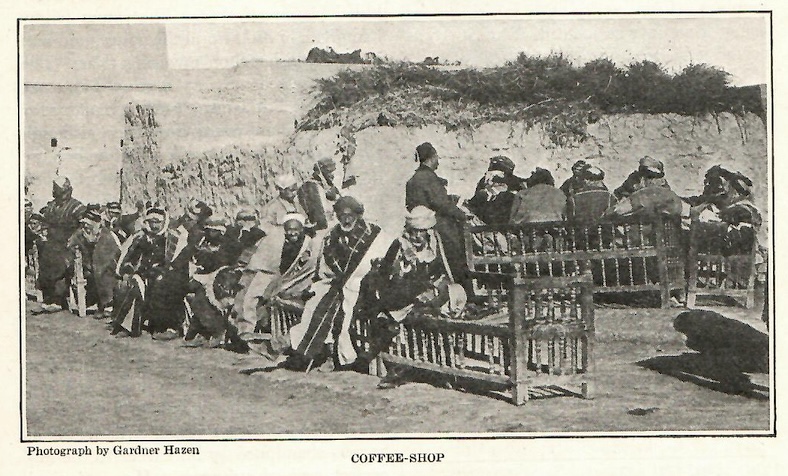
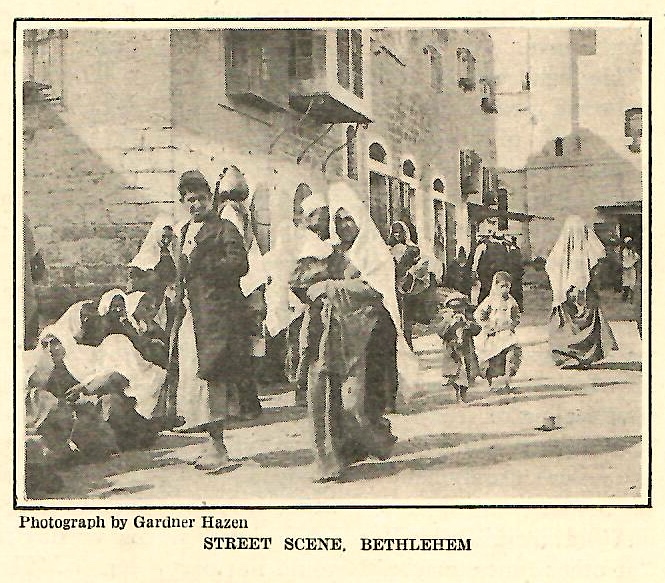
Over the years many popular magazines have published articles by visitors to Palestine. In a 1919 issue of the periodical The Century there was an article by Joseph Koven, an American Jewish author who visited Palestine. His article is very Orientalist, describing the local Arabs as dressed in rags and primitive. I cannot recommend reading the actual article, but there are several photographs and I attach two of those here.

Queers for Palestine

Since Israel’s invasion of Gaza on October 27th, launched in response to an attack on Israel by Hamas on October 7th, there have been thousands of demonstrations held worldwide. Some of these demonstrations have included LGBTQ+ groups, voicing their support for a free Palestine, calling for a ceasefire and an end to the occupation. Pundits and laymen alike have reacted to this, often portraying queer solidarity with Palestine as a contradiction, calling it “bizarre” or jokingly comparing it to “chickens for KFC.”

These reactions prompted a group of more than 300 Swedish LGBTQ people to write a response, published in the Swedish newspaper Sydsvenskan, explaining that their support for Palestine may only appear bizarre to those who view human rights as conditional. The article is published in Swedish, but what follows here is a summary in English.

The group highlights the strategic rhetorical manoeuvre of equating support for Palestine with support for Hamas, similarly to how critique of Israel is equated with antisemitism. In fact, many LGBTQ groups have criticised Hamas and brought attention to the marginalisation of LGBTQ people in Gaza. Meanwhile, those pundits who ridicule Queers for Palestine have rarely showed any interest in LGBTQ rights in the past, and only do so now in order to defend Israel against its critics rather than to defend queer Palestinians.

Furthermore, the argument that queer Palestinians can find refuge in Israel is at best a half-truth. Israel has long banned any Palestinian – regardless of sexuality or gender identity – from working or settling permanently in Israel. Only in 2022 they decided to permit LGBTQ Palestinians from the West Bank temporary work permits. These, however, are short term and need to be renewed every other month, with the intention that Palestinian LGBTQ migrants eventually move to a third country. Israel does not recognise Palestinians’ right to asylum, although a court order in January 2024 ruled that LGBTQ Palestinians may request asylum. This decision is something that the current Interior Minister wants to see reversed.

The article also responds to the claim that Israel supports LGBTQ rights. This is part of what is called “pink washing,” meaning that Israels actions are justified with reference to their LGBTQ politics. This claim does not account for how the Israeli Defence Force (IDF) has been blackmailing queer Palestinians, forcing them to act as informants under threat of being “outed” (that the person’s sexuality or identity is revealed to others without their consent). In other words, Israel has been using LGBTQ people as pawns, constituting a direct threat against their lives but also contributing to a distrust against the queer community in Palestine, worsening their situation.

Notably, same-sex relations were decriminalised on the West Bank some 37 years before Israel (1951 compared to 1988), and it was due to Israeli occupation and application of Israeli law that same-sex relations were criminalised again on the West Bank. Of course, today it is easier to live openly as a gay person in Tel Aviv than it is in Gaza or the West Bank, but it is not on equal grounds. There are also several Palestinian organisations working to improve LGBTQ rights in Palestine whose works are impeded and made immensely more difficult by Israels continued and intensified occupation.

Lastly, the article affirms that queer support for Palestinians’ right to live in peace and free from occupation is not conditional on Palestinians’ views on LGBTQ rights. It is irrelevant whether or not those suffering under Israel’s invasion and blockade of Gaza and occupation of the West Bank believe homosexuality is immoral and should be banned. Neither Israel nor any outsider may dictate which party should rule in Palestine. However, the war, blockade and occupation constitutes the biggest obstacle to the liberation of LGBTQ Palestinians. The signatories of the article say that no liberation can be achieved under war and occupation.

The full text, in Swedish, can be read here.

The full list of signatories can be read here.