el-Sayed el-Aswad
Anthropology of arts studies different forms of art in different cultural contexts. Rather than tackling merely the ethical and beatific aspects of arts, it examines how artistic forms, objects and performances represent cultural symbols, indigenous worldviews, social structures, political power, and national identities.
This article focuses on a sort of participation, connection and installation that blurs the line between the art of creative objects and the art of exceptional painting of creative objects. While John MacIntyre (an artist, armored knight and musician) represents the first, Liu Xiaodong (a renowned Chinese Neo-Realist painter) represents the second. As John sat as a subject of Liu painting, there developed a deep mutual artistic appreciation between both of them. As is shown below, the artwork signifies the spatiotemporalization of both the creative and painted objects.
In 2007, I interviewed John, tackling his work on tattooing that appeared in the essay of “Inscribing the Body: Tattoos in Traditional and Modern Cultures” in Tabsir: Insight on Islam and the Middle East (12/9/2007): https://tabsir.net/?p=409#more-409 as well as in AAA- Anthropology News (Middle East Section) 49 (4): 53-54. http://onlinelibrary.wiley.com/doi/10.1525/an.2008.49.4.53.2/epdf/
This is one of John’s latest innovative tattoo works:
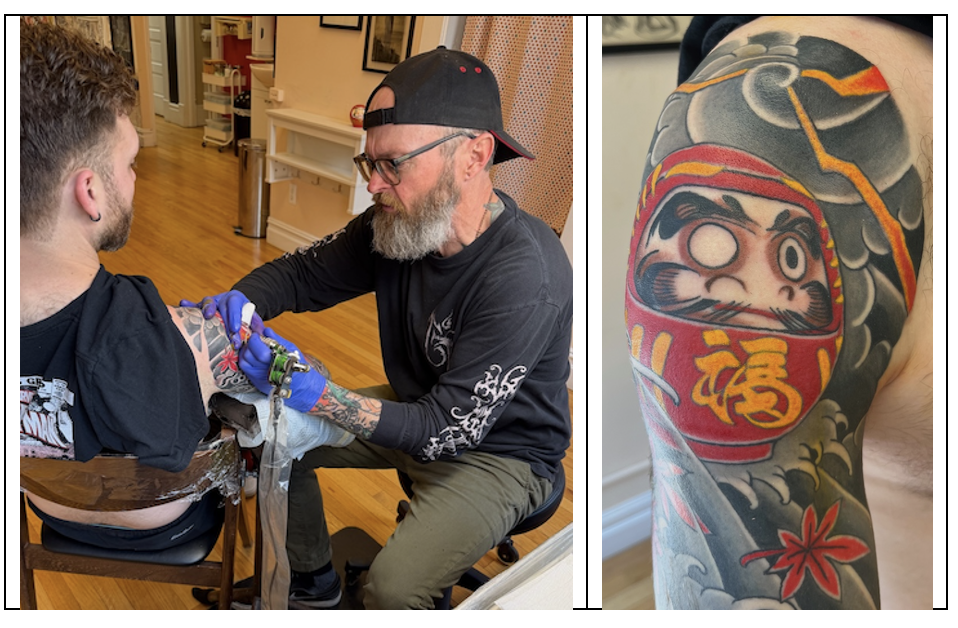
John Tattooing in Ann Arbor, MI (April 2026)
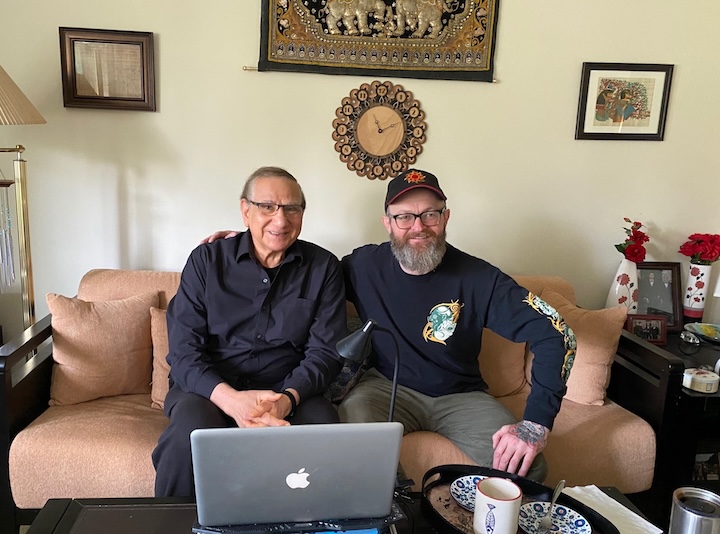
The Author with John (April 2026)
Life’s opportunities depend not only on who the individual is, but also on where the individual begins or grows up and continues his experiences. John was born in Coventry, England before coming to the USA. His early experiences provided him with the gift of intercultural communication and he has since participated in various international armored Knight combats in Denmark, Scotland, Czech Republic, and Italy. His team achieved a Gold Medal in Italy.
For almost 30 years John Macintyre has been practicing the art of tattoo both personally and professionally. In 2019 he moved from Los Angeles, where he was associated with the trendy LA Ink (TV Show) to Ann Arbor (Michigan) where he continued work as tattoo professional https://namebrandtattoo.com/john.
On July 30, 2022, I was invited by John to attend an armored knight competition (in Frankenmuth, MI) in which he was participating and enacting. According to John, the competition is known as HMB, Historical Medieval Battle, or Buhurt, derived from the French word béhourd that means ‘joust’ or ‘tournament.’ The picture, below, shows John resting after a long and challenging armored battle.
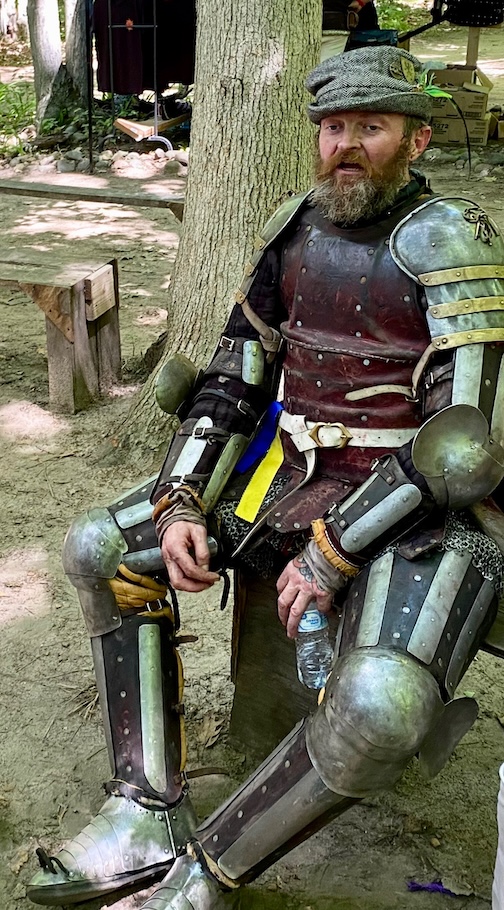
Resting Knight, John (July 2022)
On April 15, 2026, an art project, ‘Host’ (with reference to John) was launched at the Lisson Gallery (Los Angeles, USA. April 15 – June 13 2026) in which Liu Xiaodong was participating anthropologically or ethnographically in the painting of John’s artistic practices of tattooing and armored knight combating https://www.lissongallery.com/artists/liu-xiaodong.
The painting, entitled John and his Tattoos, represents John as a firm, muscular, and determined figure in both his face and body, particularly his right hand with a solid fist. It signifies cosmic-mythical symbolism with stars on the chest and fabled face on his belly.
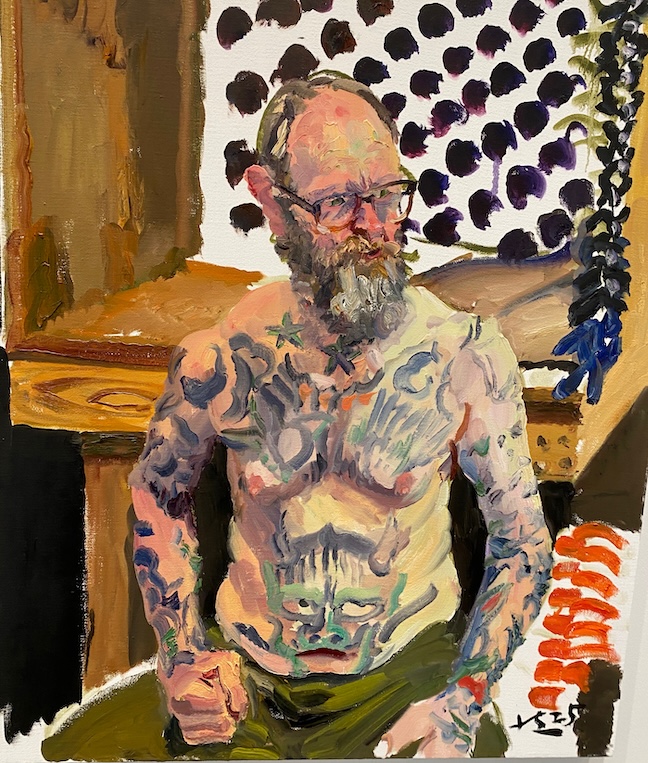
John and His Tattoos (2025)
One of Liu’s most impressive and beautiful paintings, called Ice clouds, depicts four knights (including John with his reddish-brown coat of plates) combating amidst snow and freezing ice. Here, the sport of armored knight competition signifies the culture of heroic hand-to-hand combat and related themes of strength, honor, warrior ethos, and sacrifice, as represented by dynamic, intense, ready-to-fight poses, and colorful high-contrast images of Medieval knighthood.
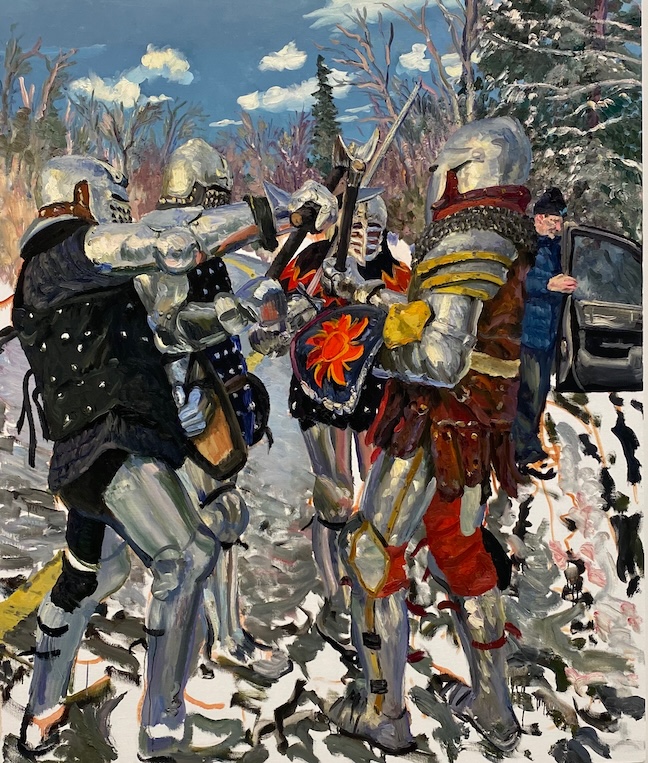
Ice clouds (2005)
As an anthropologist, I see the painting, Body, as representing an intense healing process in which John looks immersed in treating the patient. In a word, this remarkable painting reveals the profound compassion, the soothing practice of healing, the sensibility of the host-tattoo practitioner, the attentiveness of the guest-painter, the subjectivity and mutual experience of human affections, and culture-bound symbols, contextualized by the artists. For me, John was depicted as a doctor, mystic, saint, sage and philosopher descended from the archetypes of transformation.
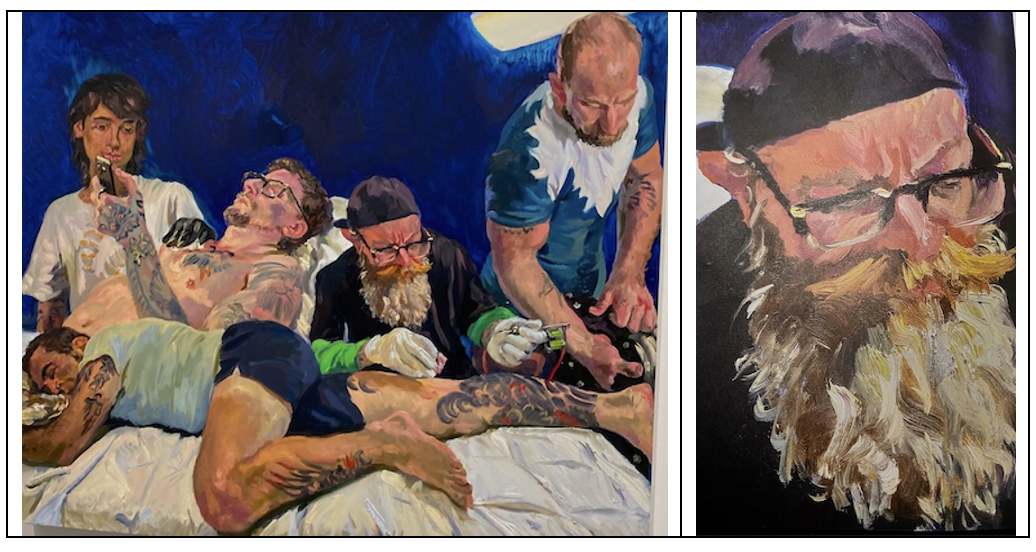
Body (2026)
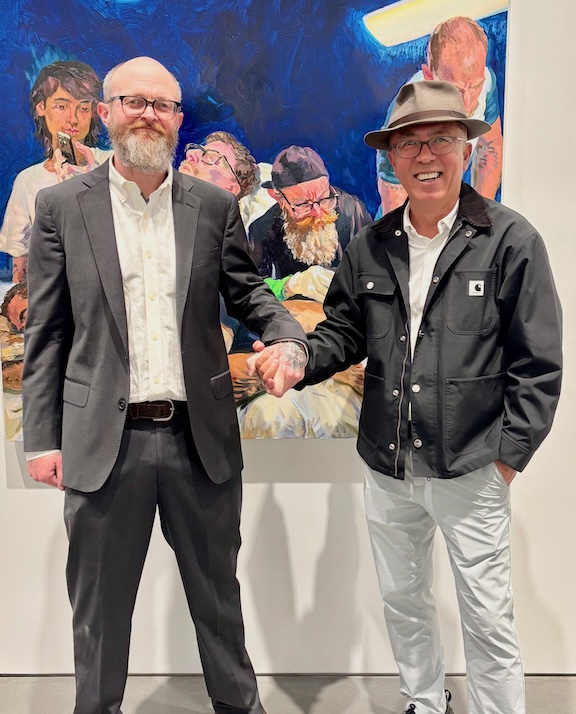
John with Liu Xiaodong
At the Lisson Gallery, there was also a documentary of John’s multiple artistic gifts including performing music (playing on guitar), which was not depicted in the painting, but a modified copy of his performance is shown here.
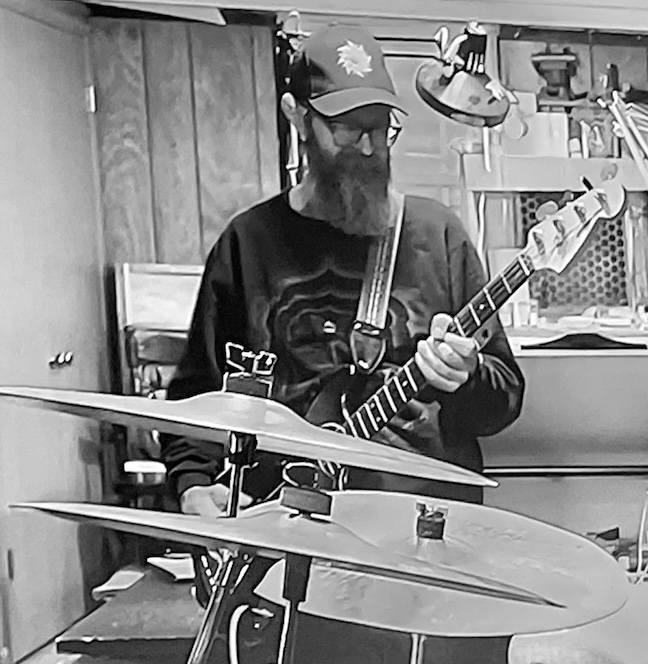
John playing the guitar
The art project, Host, successfully executed by a cooperative and innovative team led by Greg Hilty, Partner and Curatorial Director at Lisson Gallery, purported or intended to feature the city of Detroit, a city akin to the industrial region of Dongbei, Liu’s homeland. Th next step is to look for an initiative for future collaboration bringing together the artwork of both Liu Xiaodong and John MacIntyre within a platform potentially in both the Lisson Gallery and the Detroit Institute of Arts (DIA).
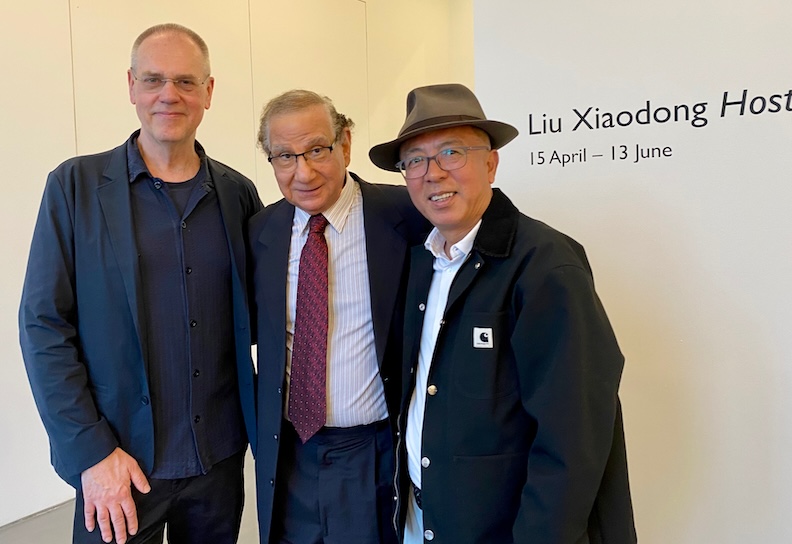
The Author (middle) with Greg and Xiaodong