Al Jazeera is reporting that most of the major army commanders in Yemen have joined the protesters. It is probably a matter of hours or days before a new government is formed.
Libya, Yemen, Egypt, Tunisia, Bahrain?
Bombs over Qaddafi’s Libya, Facebook in Yemen, and the list goes on: I am in an absorbing rather than communicating mood. There is a lot of fascinating material coming out, for example a CNN piece on social media in Yemen and the wreckage of an army column reported by Kareem Fahim on the New York Times today. and the breaking news, the always breaking news: “Yemen’s ambassador to the United Nations has resigned over the killing of 52 protesters calling for the resignation of President Ali Abdullah Saleh. “Abdullah Alsaidi has submitted his resignation to protest at the use of violence against demonstrators,” a Yemeni foreign ministry official said on Sunday.”
Yemen situation critical
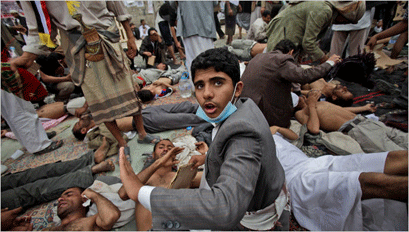
Antigovernment protesters received medical help at a makeshift field hospital after they were attacked Friday in Sana, Yemen; photo by Muhammed Muheisen/Associated Press
As reported today in the major news outlets, including The New York Times and Al Jazeera, the situation in Yemen is becoming critical. A few weeks ago I thought that President Salih would be able to ride the wave of protests, but the level of frustration and range of his enemies make that less likely with each passing day. Yesterday’s attack in Sanaa, which left at least 45 protesters dead, is a shock not only because of the number killed, but also because it suggests an overall strategy of violence rather than negotiation. Even if the killings were not ordered from the top, neither the police nor the army were protecting the people protesting or any other innocent Yemenis who happen to stray in the way of a bullet.
The details continue today, with ongoing clashes in Aden. Before that there were reports of people killed in Hodeidah. If one thing emerges from the political upheaval of the past three months, I believe it is that we should never underestimate the stimulating power of frustration to foment political change. As the world become more and more a wired village, fewer and fewer people are willing to have village idiots dominate their lives. The days of kings, sultans, dictators and presidents-for-life are measured. Their palaces must inevitably become museums to a past. Their legacies subject to the scrutiny of historians shaking their heads. Continue reading Yemen situation critical
A “no fly” in the ointment
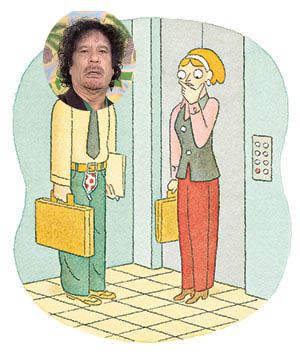
For days we have been watching the ebb and flow of frustration protests in Libya, echoing but not matching the overthrow of long-time despots in Tunis and Egypt, but seemingly less capable of driving the longest terminator of all into an exilic tent (though probably outside one of Berlusconi’s mansions rather than above a madrasa in Saudi Arabia). A week ago it looked like “rebel” forces might march on Tripoli; such was the rhetoric of liberation on the lips of those who took back the streets east and west of the capital and rattled the very tent pegs of the leader’s Tripoli holdout.
Last night, amidst reports of an escalating disaster alert at a Japanese nuclear reactor, the U.N. Security Council met to deal with Qaddadi, the colonel not known for fried chicken wings but with a distinct love of his female guard’s hidden charms. To no-fly or not to no-fly: that was the dramatic question debated. Would Russia and China resort to Cold War negativism or embrace pragmatic realpolitic and let French planes scramble to destroy the older planes the French probably supplied Qaddadi with at some point? Would international involvement lead to a land invasion? Another Iraq or Afghanistan? The pundits were all over the map. Many had their predictions; none of the crystal balls seemed very trustworthy. Continue reading A “no fly” in the ointment
The Arab Spring
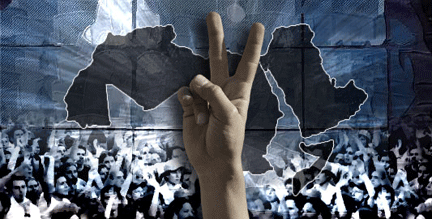
By Rashid Khalidi, The Nation, March 21, 2011 and Institute for Palestine Studies, March 3, 2011
Suddenly, to be an Arab has become a good thing. People all over the Arab world feel a sense of pride in shaking off decades of cowed passivity under dictatorships that ruled with no deference to popular wishes. And it has become respectable in the West as well. Egypt is now thought of as an exciting and progressive place; its people’s expressions of solidarity are welcomed by demonstrators in Madison, Wisconsin; and its bright young activists are seen as models for a new kind of twenty-first-century mobilization. Events in the Arab world are being covered by the Western media more extensively than ever before and are being talked about positively in a fashion that is unprecedented. Before, when anything Muslim or Middle Eastern or Arab was reported on, it was almost always with a heavy negative connotation. Now, during this Arab spring, this has ceased to be the case. An area that was a byword for political stagnation is witnessing a rapid transformation that has caught the attention of the world.
Three things should be said about this sea change in perceptions about Arabs, Muslims and Middle Easterners. The first is that it shows how superficial, and how false, were most Western media images of this region. Virtually all we heard about were the ubiquitous terrorists, the omnipresent bearded radicals and their veiled companions trying to impose Sharia and the corrupt, brutal despots who were the only option for control of such undesirables. In US government-speak, faithfully repeated by the mainstream media, most of that corruption and brutality was airbrushed out through the use of mendacious terms like “moderates†(i.e., those who do and say what we want). That locution, and the one used to denigrate the people of the region, “the Arab street,†should now be permanently retired. The second feature of this shift in perceptions is that it is very fragile. Even if all the Arab despots are overthrown, there is an enormous investment in the “us versus them†view of the region. This includes not only entire bureaucratic empires engaged in fighting the “war on terror,†not only the industries that supply this war and the battalions of contractors and consultants so generously rewarded for their services in it; it also includes a large ideological archipelago of faux expertise, with vast shoals of “terrorologists†deeply committed to propagating this caricature of the Middle East. These talking heads who pass for experts have ceaselessly affirmed that terrorists and Islamists are the only thing to look for or see. They are the ones who systematically taught Americans not to see the real Arab world: the unions, those with a commitment to the rule of law, the tech-savvy young people, the feminists, the artists and intellectuals, those with a reasonable knowledge of Western culture and values, the ordinary people who simply want decent opportunities and a voice in how they are governed. The “experts†taught us instead that this was a fanatical people, a people without dignity, a people that deserved its terrible American-supported rulers. Those with power and influence who hold these borderline-racist views are not going to change them quickly, if at all: for proof, one needs only a brief exposure to the sewer that is Fox News. Continue reading The Arab Spring
A Geography Lesson from 1879: #5: Turkey in Europe
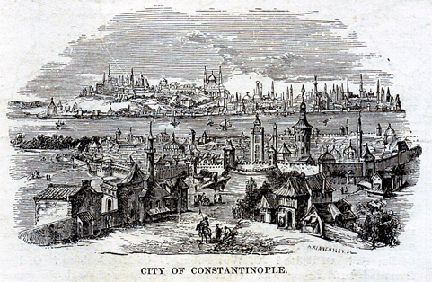
In a previous post I presented an account of the geography of Arabia and Turkey in an 1879 geography school text. Here is the discussion on the European part of the declining Ottoman Empire:
1. TURKEY, constituting the European dominion of the Ottoman Empire, comprises the middle portion of the great southeastern peninsula of Europe.
2. The Climate in some places is severe, but is healthful and favorable to the growth of all the common cereals.
3. The Soil is productive, yielding in abundance the useful grains, tobacco, and grapes, as well as the olive and mulberry. Much attention is given to the culture of plants yielding medicines and perfumes. Continue reading A Geography Lesson from 1879: #5: Turkey in Europe
The Story of Uyghur
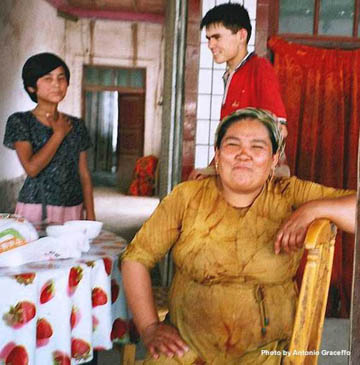
For an interesting photographic essay on the Uyghur Muslims of Central Asia, check this out: http://emphas.is/web/guest/discoverprojects?projectID=306
Review of “The Jew Is Not My Enemy”
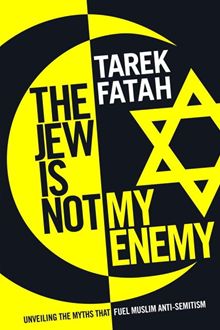
The following is a review of The Jew Is Not My Enemy: Unveiling the Myths that Fuel Anti-Semitism by Tarek Fatah, published by McClelland & Stewart
ISBN: 978-0-7710-4783-1 (0-7710-4783-5). The review is written by Ivan Davidson Kalmar and published in the Literary Review of Canada, March, 2011.
As Tarek Fatah, the author of this provocative book, puts it, “By all rational standard, Muslims and Jews should have been, and could be, partners. Their faiths are very similar (…). There were even times when Muslims and Jews prayed together around the tone covered today by the Dome of the Rock [in Jerusalem].†Certainly in the imagination of western Christians at least, Muslims and Jews were for centuries regarded as two of a kind.
From the medieaval theologians through to Hegel, Islam was considered to be a revival of Judaism (which Christians thought should have died with Christ). Though the attitude to both Jews and Muslims has generally been hostile, it was not always so. For example, Jews and Muslims were both admired by nineteenth century romantics as possessors of an eastern spirituality that inspired and could continue to inspire the Occident.
When Jews and Arabs were both classed as members of the same “Semitic†race, “Semite†was at first often meant as a compliment. It was partly in reaction to romantic accounts of the Semites that the term “anti-Semitism†was invented by a new breed of Jew-haters. And it was, in turn, largely a reaction to modern anti-Semitism that the old idea of “returning†the Jews to the Orient took hold in the form of modern Zionism. Zionism led to a long and still ongoing, bloody conflict between Jews and Muslims over the holy land of Israel/Palestine. Continue reading Review of “The Jew Is Not My Enemy”