L’Orient de Sabrina et Roland Michaud


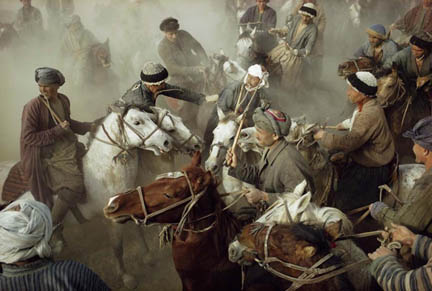
Mêlée de Bozkashi 2: Pour marquer un point il faut s’emparer de la bête décapitée et s’échapper avec, pour aller contourner un mât planté loin dans la steppe, avant de revenir jusqu’au cercle dit de justice pour y jeter la dépouille. Le souffle rauque des hommes se mêle à celui des bêtes. Les bonnets dégagent un âcre odeur de suint. Province de Balkh. Février 1968.

Although this photographic exhibition of French photographers Roland and Sabrina Michaud was over last November in Paris, their photographs are well worth admiring. Here is the description of their exhibition on the website of Photo Magazine.

Depuis maintenant cinquante ans, Roland et Sabrina Michaud, couple de photographes devenu mythique, se consacre à l’étude de l’Asie et plus particulièrement aux civilisations de l’Islam, de l’Inde et de la Chine. Ils poursuivent leur quête de beauté, de sagesse et d’absolu avec lenteur, rigueur et ferveur. Roland et Sabrina vivent à Paris sans ordinateur et sans téléphone portable. Une rétrospective leur est consacrée, du 1er octobre au 7 novembre 2010, dans le cadre du 7e festival international de photographies « L’Œil en Scène » à La Seyne-sur-Mer.


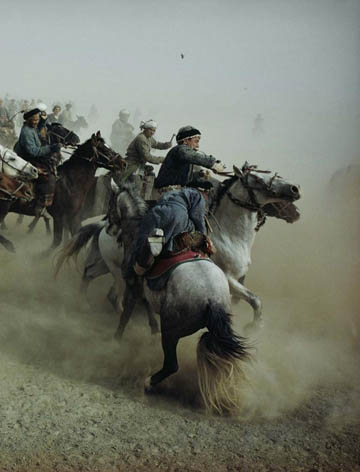
Mêlée de Bozkashi 1: Ce plan rapproché exprime l’intensité et la violence du jeu. Bozkashi signifie attrape chèvre. Province de Balkh. Février 1968.

“Today, I Am a Muslim Too” Rally


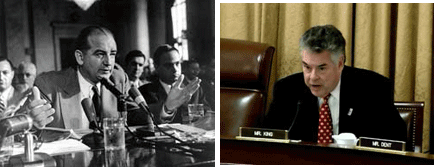
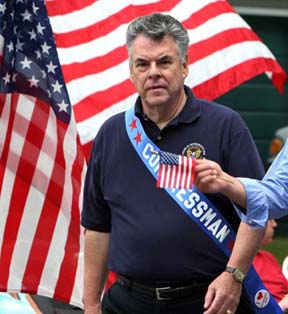
Congressman Peter King

“Today, I Am a Muslim Too” Rally
Time : Sunday, March 6 · 2:00pm – 5:30pm
Location : Times Square, New York, 7th Avenue at 42nd Street, New York, NY

Take the 1/2/3/7/A/C/E/N/R/Q/Shuttle trains to 42nd Street – Times Square. Check MTA for planned service changes: http://tripplanner.mta.info/_start.aspx

In response to the March 8th congressional hearings dubbed “The Radicalization of Muslim communities in America” led by Congressman Peter King (R-LI), members of diverse faith communities throughout New York City will join in unity and support of American Muslims.

Stand with us on March 6th to show Congress that we are all together, that we share friendship and trust and cannot be divided. Such hearings will send the wrong message, alienating American Muslims instead of partnering with them, and potentially put lives at risk by stirring up fear and hatred.

Thanks to all who are supporting the event, the list is below: Continue reading “Today, I Am a Muslim Too” Rally

Looting the Pharaohs before Mubarak


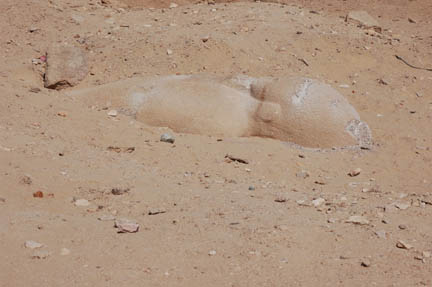
Statue of Ramses II in Aswan

The status of Egyptian antiquities today, 3 March, 2011

by Zahi Hawass, March 3, 2011

When the revolution began on January 25, 2011, and through its first week, there were only a few reports of looting: at Qantara East in the Sinai, and at the Egyptian Museum, Cairo. However, since Mubarak’s resignation, looting has increased all over the country, and our antiquities are in grave danger from criminals trying to take advantage of the current situation.

The Egyptian Museum, Cairo

On Saturday, 29 January, I entered the museum the morning after the break-in and I could see through the museum’s monitor, objects were broken and thrown all over the galleries. However, all of the masterpieces seemed to be present. At first glance, it did not seem that objects were missing and I announced that the museum was safe.

After our preliminary inventory, we discovered that eighteen items were missing. Thankfully four of these items have already been recovered. The Heart Scarab of Yuya and the body of the goddess from the statue of Menkaret carrying Tutankhamun were both found on the west side of the museum near the new gift shop, and one of the missing shabtis of Yuya was discovered under a showcase inside of the museum. The statue of Akhenaten as an offering bearer was discovered by a young protester near the southern wall of the museum in Tahrir Square. His family immediately contacted the Ministry of State for Antiquities to arrange the statue’s return to the museum. I am now waiting for the Registration, Collections Management and Documentation Department to complete its final report on what else, if anything, is missing from the Egyptian Museum, Cairo. The General Director of the museum has told me that this report will be completed by Sunday. Continue reading Looting the Pharaohs before Mubarak

THE STORY OF CRUEL PSAMTEK


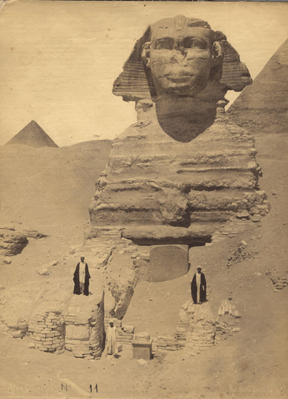
The Great Sphinx, G. Lékégian & Co.

THE STORY OF CRUEL PSAMTEK

HERE is cruel Psamtek, see.
Such a wicked boy was he!
Chased the ibis round about,
Plucked its longest feathers out,
Stamped upon the sacred scarab
Like an unbelieving Arab,
Put the dog and cat to pain,
Making them to howl again.
Only think what he would do –
Tease the awful Apis too
Basking by the sacred Nile
Lay the trusting crocodile ;
Cruel Psamtek crept around him,
Laughed to think how he had found him,
With his pincers seized his tail,
Made the holy one to wail ;
Till a priest of Isis came,
Called the wicked boy by name,
Shut him in a pyramid,
Where his punishment was hid. Continue reading THE STORY OF CRUEL PSAMTEK

The Owl’s Cry


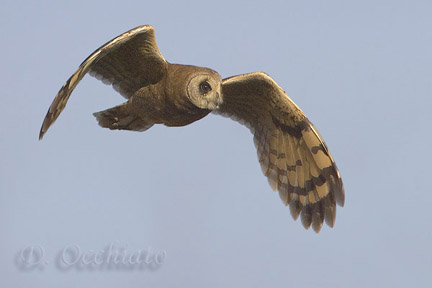
Marsh Owl, Morocco, Merja Zerga February 12th, 2006 © Daniele Occhiato

by Anoaur Majid, Tingis Redux, March 1, 2011

Now that the fever for freedom has seized the minds of Arabs and others across the world, the question of what exactly needs to be done is sure to be the next preoccupation. The list of demands is obvious across the board—end of corruption and abuse of power, free quality education and health care for all, the right to work (which is, by the way, a human right enshrined in the United Nations’ Universal Declaration of Human Rights), a social order based on respect and dignity, and several other rights that may be specific to one community but not to others.

For example, the Moroccan magazine TelQuel recommends a secular constitution for Morocco that doesn’t make Islam the official religion of the state; the absolute end of polygamy and full rights for women; the ability to discuss the royal and military budgets; better wages, unemployment benefits and social security coverage; freedom of religion; freedom of the press; prison reform and the formal abolition of the death penalty; making the darija Morocco’s national language (something I called for years ago); and so on. TelQuel lists 50 items and the reader, I am sure, could add a whole lot more.

The thing to remember, however, is that meaningful sustained reform is going to take time. Some of these objectives could be implemented in short order, others may take at least a decade, and a number of projects could easily involve the work of generations. I like to tell people that Morocco will probably be the place of my dreams after I have left this world. I know many opportunities were wasted since 1956 (the year Morocco got its independence), but I also know that no one can bend the arc of time to suit a political agenda. Most change doesn’t happen overnight, and progress depends on the seeds we plant today. In any case, now that the people’s genie is out in the streets, one thing’s for sure: There is no going back to the status quo ante. Continue reading The Owl’s Cry

A Geography Lesson from 1879: #4: Arabia and Turkey


In a previous post I continued a thread from an 1879 school geography text. At the time much of the Arab World was under the control, nominal at times, of the Ottoman Empire. This text divided the Ottoman holdings into those in Asia, discussed below, and those in Europe, to be given in a separate post.

1. Arabia is a great plateau, abounding in deserts, and possessing but few fertile districts, except along the coast. Its area is about 1,000,000 square miles.
2. The Climate is the dryest in the world, rain seldom falling anywhere, and the heat being intense, especially in the lowlands and deserts.
Arabia has been divided into three parts: – ARABIA FELIX, happy or fertile; ARABIA PETRAE, stony; and ARABIA DESERTA, desert. The fist of these divisions borders on the Persian Gulf, the Indian Ocean, and the Red Sea; the second lies on the northeastern shore of the Red Sea; and the third includes all of the central portion of the country. The cultivated tracts are generally near the mountains, from which rivers descend in the rainy season and thus enrich the soil. Numerous oases re found in the desert regions. Continue reading A Geography Lesson from 1879: #4: Arabia and Turkey

Vote for Sanaa Water


There is currently a contest for interesting sustainable living concepts in the Philips Livable Cities Award. One of these is about collecting rainwater in the Yemeni capital from rooftops. There is a short video on this that can be accessed here. You need to scroll down to the option called “Rainwater Aggregation.” Voting continues until March 24, 2011. If you vote, you might win a trip to the handing out of the award in The Netherlands.