Charles J. Adams (April 24, 1924 – March 23, 2011)


Islamic Studies building, McGill University, Montreal

[I post here a letter from Richard Martin on the passing of Charles Adams.]

Dear Colleagues,

It is with great sadness that I learned yesterday that Charles J. Adams died in Mesa, Arizona on March 23 of this year. During his final years he lived in retirement in Arizona, suffering from the steady deteriorating effects of Parkinson’s Disease, which affected his body but not his clear, sharp mind. I had the good fortune to be able to visit Charles three weeks before his demise in his retirement village in Mesa, Arizona, where he lived with a friend and companion who looked after him in recent years. We had lunch together and got out books and reminisced about the evolution of the field of Islamic Studies during our lifetime, over which he had exerted such great influence through his many student and writings. He nonetheless felt sad and helpless that in his declining state of health he was powerless to any longer be a voice in the academic study of religion in the current climate of suspicion, fear and hate about Islam in the public sphere. Continue reading Charles J. Adams (April 24, 1924 – March 23, 2011)

Oh Brother(hood)!


First, something positive: there is an excellent op-ed in today’s New York Times by Greg Johnson on the situation in Yemen.

And now for something completely different… Now the “duh” moment. Here is a headline that deserves all the possible bad things one can say about an ignorant and stupid headline:
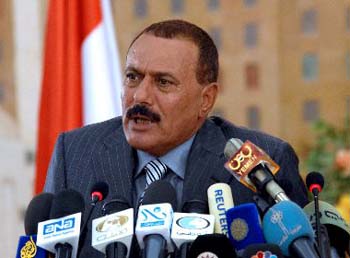
“Yemen’s Government Poised to Fall to the Muslim Brotherhood and Al-Qaeda ?” The source I consulted is the Right Side News, where “right” certainly does not make “right”. It would be quite a major event if Yemen was taken over by the Muslim Brotherhood, since it does not have any kind of presence there. Of course if most Muslims are radical and all radical Muslims are the same, it hardly matters to someone like the ludicrous ranting of someone like Robert Spencer (whose Islamophobic magazine rag is the ultimate source of this story). The article was posted Wednesday at 5:38, but over a full day later the prediction that Ali Abdullah Salih would be ousted in 24 hours was unfulfilled. Back to the drawing board or the Book of Daniel, perhaps? Is this regime change supposed to be before or after all the bible believing Christians are raptured away? Continue reading Oh Brother(hood)!

Faith Abundant

by Anouar Majid, Tingis Redux, March 16, 2011

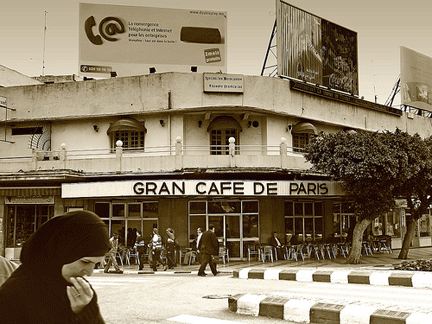
Many years ago, while sitting with a friend in a café in the Moroccan city of Tangier, I expressed my unfailing admiration for Mohamed Choukri, author of the acclaimed memoir For Bread Alone (al-khubz al-hafi) and its sequel Streetwise (the somewhat inexplicale translation of what should have been The Time of Error, or zamanu al-akhta’). I told my friend, a Ministry of Justice official on his way up to a judgeship, that what I liked most about Choukri was his literary courage (al jur’a al-adabiya). My friend, a conservative man with a classical education in Islamic Studies, dismissed such courage as mere silliness, the ranting of a down-and-out man seeking attention and literary fame. Our society, my friend pronounced, was light years away from appreciating such openness and candor. We trade in appearances, not in existential truths. We reward conformity and punish daring acts of individualism.

Things have changed since then, and Choukri is now universally acclaimed across Morocco and much of the Arab world. The die-hard Tangerian is long gone, too, as is my friend, who, one day, collapsed in Fez and never got up. Yet I now find myself asking the same question about the mesmerizing memoir of a Moroccan woman that kept me engrossed for two days straight. The more I read into Wafa Faith Hallam’s The Road from Morocco, the more I realized I was holding a book that—if all literary lights are not dimmed by convention—should become an instant classic. Continue reading Faith Abundant

Libya, Yemen, Egypt, Tunisia, Bahrain?

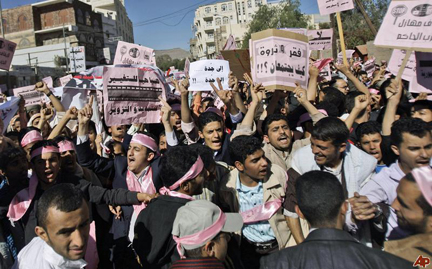
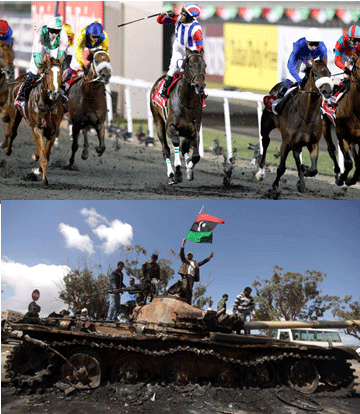
Bombs over Qaddafi’s Libya, Facebook in Yemen, and the list goes on: I am in an absorbing rather than communicating mood. There is a lot of fascinating material coming out, for example a CNN piece on social media in Yemen and the wreckage of an army column reported by Kareem Fahim on the New York Times today. and the breaking news, the always breaking news: “Yemen’s ambassador to the United Nations has resigned over the killing of 52 protesters calling for the resignation of President Ali Abdullah Saleh. “Abdullah Alsaidi has submitted his resignation to protest at the use of violence against demonstrators,” a Yemeni foreign ministry official said on Sunday.”

Yemen situation critical


Antigovernment protesters received medical help at a makeshift field hospital after they were attacked Friday in Sana, Yemen; photo by Muhammed Muheisen/Associated Press

As reported today in the major news outlets, including The New York Times and Al Jazeera, the situation in Yemen is becoming critical. A few weeks ago I thought that President Salih would be able to ride the wave of protests, but the level of frustration and range of his enemies make that less likely with each passing day. Yesterday’s attack in Sanaa, which left at least 45 protesters dead, is a shock not only because of the number killed, but also because it suggests an overall strategy of violence rather than negotiation. Even if the killings were not ordered from the top, neither the police nor the army were protecting the people protesting or any other innocent Yemenis who happen to stray in the way of a bullet.

The details continue today, with ongoing clashes in Aden. Before that there were reports of people killed in Hodeidah. If one thing emerges from the political upheaval of the past three months, I believe it is that we should never underestimate the stimulating power of frustration to foment political change. As the world become more and more a wired village, fewer and fewer people are willing to have village idiots dominate their lives. The days of kings, sultans, dictators and presidents-for-life are measured. Their palaces must inevitably become museums to a past. Their legacies subject to the scrutiny of historians shaking their heads. Continue reading Yemen situation critical