Misunderstanding Bahrain’s Shia protesters


The Shia in Bahrain have recently been distancing themselves from Iran whilst attention is diverted to Libya [REUTERS]

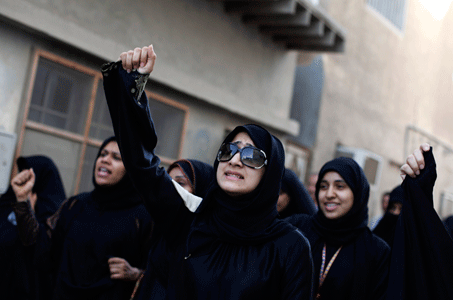
Predominately Shia protesters are calling for political reform not alignment with Iran, researchers argue.

by Genieve Abdo and Jasim Husain, al-Jazeera, April 3, 2011

Listening to the rhetoric coming out of Tehran, one might assume that Bahrain’s Shia opposition is relying on help from its co-religionists next door. But, in fact, the opposite is true: the Shia opposition wants nothing more than for Tehran to stay out of the sectarian dispute unfolding in the tiny kingdom.

The major demand of the mainstream opposition is to turn the country into a constitutional monarchy, much like those in Europe. Other selected goals include: an elected government; a free press; an unrestricted civil society; and an end to discriminatory practises against religions other than the Sunni minority, such as unequal employment practises, unfair distribution of wealth, and the elimination of all forms of administrative and financial malpractice. Continue reading Misunderstanding Bahrain’s Shia protesters

New book on Rasulid Yemen


Last month I was invited by historian Eric Vallet to a conference on the Yemeni town of Yaiz in the Rasulid era. Eric has recently published an extraordinary study of the economic system of the Rasulid sultanate in the late 13th century and early 14th century, drawing on the growing corpus of court and tax documents, many of which have been edited by the Yemeni historian Muhammad Abd al-Rahim Jazm. Anyone with an interest in Rasulid Yemen will need to start with Eric’s masterful study. Details on the text, which is in French, are below:

Eric Vallet, L’Arabie marchande. Etat et commerce sous les sultans rasûlides du Yémen (626-858/1229-1454), Paris, Publications de la Sorbonne, 2010 (Bibliothèque historique des pays d’Islam, 1), ISBN 978-2-85944-637-6. Continue reading New book on Rasulid Yemen

The Yemen Protests and the Environment


The Dragon Blood Tree is native to Socotra. It gets its name from the red sap that the trees produce, which was used in the past by the locals for healing. Kay van Damme

Foreign researchers flee Yemen leaving conservation programmes in trouble

As the protests in Yemen intensify, foreign and local biologists are worried about the future of conservation efforts on the biodiversity rich island of Socotra.

by Mohammed Yahia, Nature Middle East, March 22, 2011

Public protests in Yemen that began on 27 January have escalated, with security forces now using extreme violence to disperse demonstrators. Snipers killed over 50 people last Friday with shots mostly in the heads and chests. Several generals and soldiers have defected and now side with the protesters. As Western countries warn their citizens against travel to the country and are evacuating those already there, biologists are worried that conservation efforts in one of the region’s richest areas for biodiversity, is under threat.

Socotra Archipelago, dubbed the Galápagos of the Indian Ocean, is one such place concerning biologists. It lies about 380 kilometres south of mainland Yemen in the Arabian Sea. The main island, Socotra, is the largest Arabian island. With over 300 unique plant species, a third of the island’s flora is endemic, found nowhere else in the world. More than 90% of the reptile species on the island are unique.

“In marine habitats, the extensive coral reefs bordering the island harbour a remarkably high biodiversity and provide an important source for local inhabitants. Both local culture and nature are strongly intertwined and mutually dependent,” says Kay van Damme, an ecologist at Ghent University, Belgium, and chairman of Friends of Socotra. Continue reading The Yemen Protests and the Environment

Yemen’s future …


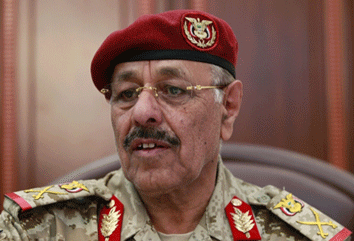
Maj. Gen. Ali Mohsen al-Ahmar

Yemen’s future hinges on its two most powerful men
By Sudarsan Raghavan, The Washington Post, Thursday, March 31, 11:25 PM

SANAA, Yemen — They are from the same village, the same tribe and the same clan. Once as close as brothers, they rose together in Yemen’s military, shared the same political vision, the same lofty desires. One is a conservative Islamist with reputed links to Osama bin Laden. The other is one of America’s closest counterterrorism allies.

For 32 years, Ali Abdullah Saleh and Maj. Gen. Ali Mohsen al-Ahmar have controlled this poor but strategic Middle East nation, the former as its ubiquitous president and the latter as its invisible yet most influential military leader. Now, they are engaged in a highly personal battle to shape the future of Yemen and their own places in history.

“They are like Siamese twins, one body with two heads,” said Hassan Zaid, a top opposition leader. “Now, each head is trying to cut off the other’s head and take control of the whole body.”

Over the past two months, the momentous events in Yemen have echoed those around North Africa and the Middle East: a populist rebellion, fueled by decades of injustice, rising up to demand its leader’s ouster.

But the twist that has emerged in the past two weeks has injected a narrative of Shakespearean proportions, one tightly focused on the two rivals, shrewd men from humble beginnings who grew wealthy and powerful amid allegations of corruption and ruthlessness, and who have now turned on each other. Continue reading Yemen’s future …

Round about Sanaa (really round about)


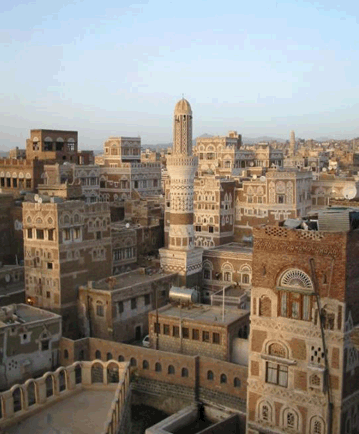
With all the protests making the news about Yemen, it is important to remember why Sanaa is such an extraordinary city. There is a fascinating 360º view of the old part of the old city of Sanaa in Yemen. Check it out at http://www.360cities.net/map#lat=13.70174&lng=50.23665&name=sanaa-sunset&zoom=5. There are also several other panoramic views of Yemen on the site, including scenes of Jibla, Shibam Hadramawt, Rayyan Beach along the Gulf of Aden coast, and of the Dragon’s Blood tree in Socotra.

My thanks to Dr. Mohammed Jarhoum for pointing out this site.

Weapons of Mass Arm Twist Dealing

As millions of dollars worth of U.S. and NATO military weapons are now raining down on the millions of dollars worth of weapons in Libyan leader Qaddafi’s recently expanded arsenal, there is a scenario that must make all the arms manufacturers of the world unite in smugness. Over a month ago Der Spiegel ran an article with the following news:

Helicopters from Italy, communication technology from Germany: When the arms embargo against Libya was lifted in 2004, the country’s dictator Moammar Gadhafi went on a shopping spree in the European Union. Now he is using those weapons against his own people — to the EU’s shame… According to an EU report, European Union member states provided the dictator with defense equipment worth €344 million ($474 million) in 2009 alone.

It must be a bit easier to destroy Qaddafi’s military machine, since the ones now destroying it are the ones responsible for creating it. One used to hear the fatalistic mantra: the Lord giveth and the Lord taketh away. It seems that the EU and NATO have replaced the Lord these days. I am not in any way defending Qaddafi, a brutal maniac who has plundered Libya for over four decades. Nor am I convinced one way or the other if the no-fly-in-the ointment strategy will work. But I recall the poignant words of author Jean Makdisi in her brilliant Beirut Fragments (Persea Books, 1990, p. 45):

“I ponder, for the ten thousandth time since this damnable war began, on the happiness of the manufacturers and salesmen of arms and ammunition. Every roar, whistle, and crash translates itself in my mind to the sound of a cash register, the tinkle of champagne glasses, and the hum of conversation at a very expensive restaurant somewhere. The glisten of shrapnel, the smoke billowing out of someone’s ruined home, the rumble of the big guns, are all echoed in my imagination as the glitter of jewelry, the smoke of cigars lazily puffed out of appreciative lips, and the rolling of drums for a hip-swinging, carefree dance. The screams of a terrified, burning child become the laughter of those who reap the gains of this havoc.”

Talk on Yemen


Abdullah Hamiddaddin will be providing a lecture entitle “Whither Yemen” on Thursday, March 31, 2011 at Columbia University in 208 Knox Hall from 12:30-2:00 pm. the discussion will be about how to frame the current struggle in Yemen, the importance of tribal politics, and the overrated threat of al-Qaeda in the Arabian Peninsula. This is sponsored by Columbia’s Middle East Institute.

For more details, click here:

Racing from Dubai to Tripoli


Top: Victorie Pisa from Japan, ridden by Mirco Demuro, middle, crosses the finish line of $ 10,000,000 Dubai World Cup race, the world’s richest horse race, followed by 2nd place Transcend , right, from Japan and 3rd place Monterosso from Great Britain, 2nd right. (The Associated Press); bottom:Libyan rebels on top of a captured tank

As I write this, the media are reporting major advances of the Libyan resistance to Qaddafi, supported in large part by the surgical air strikes of the U.S. and NATO aircraft. Qaddafi has bunkered down, vowing to fight until his last drop of blood, but as the race to Tripoli proceeds, more and more defections from his military are inevitable. It is hard to predict when this will end. In general I think most ruthless dictators are cowards at heart, which is why they need such massive security to perpetuate their narcissistic hold on power. But Qaddafi is deluded enough to go down with guns blazing, like Errol Flynn in Custer’s Last Stand.


Debate over the wisdom of U.S. involvement in the Libyan no-fly-plus zone has reached a level of feverish political overtones. Obama’s opponents, those lock-step GOP stalwarts who never challenged Bush when we foolishly entered into a ground war in Iraq, now seem concerned about the costs of tomahawk missiles (I suspect those senators with large arms manufacturers in their home states are biting their tongues as they speak). Winging it, a la Bush, is the American way in their mind and damn what any other civilized nation thinks. Actually forging a coalition with U.N. and some Arab country backing is heralded as weakness. Much of the debate swirling between the talking security expert heads is really an end-around around the end-game criticism. Continue reading Racing from Dubai to Tripoli