The Battle for Baghdad

How to Invade Iraq: The Mongol Way

By Peter Konieczny

[Paper given at the 42nd International Congress on Medieval Studies, held at Western Michigan University (2007) and online here.]

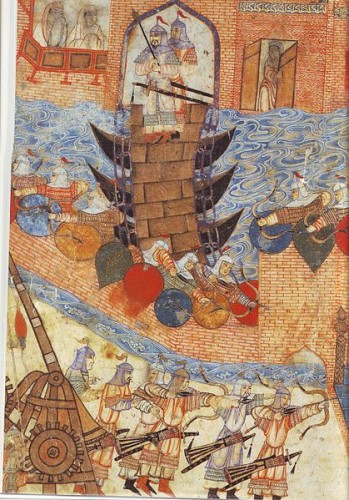
When I began researching the Mongol conquest of Baghdad, I came across an account by an Iraqi writer from the early fourteenth-century. With much excitement I found the relevant passage, and began to read it. He summed up the siege and fall of Baghdad with these words: “Even a brief mention of it would be terrible to hear – how much worse its recapitulation in detail! Things happened which I shall not record, imagine them and do not ask for a description!”

Despite this unpromising beginning, I soon found a wealth of information from contemporary writers and chroniclers, including those who were on the saw the event firsthand. For the last couple of years I have been piecing this story together, not only because the story of the first conquest of Baghdad is an interesting one in its own right, but also because it adds some insights into the present-day situation in Iraq.

Despite it being such an important historical event, the story of Baghdad’s fall has been poorly served by historians. Most Muslim historians deal more with alleged collaboration by Shi’ites with the Mongols against the Sunni Abbasid Caliphate than with anything else, while Western historians have usually focused on the most outrageous stories associated with the invasion, often repeating wild claims that millions of people were killed and that Baghdad was completely destroyed by the Mongols.

The short amount of time here prevents me from saying everything I want to say, so in some sections I am going to be very brief. Hopefully, most of you have got my handout which outlines the events and gives some chronicle excerpts. I also have a couple of overheads to show some maps of Iraq, in case someone is not familiar with the country. Continue reading The Battle for Baghdad

Death at the mosque


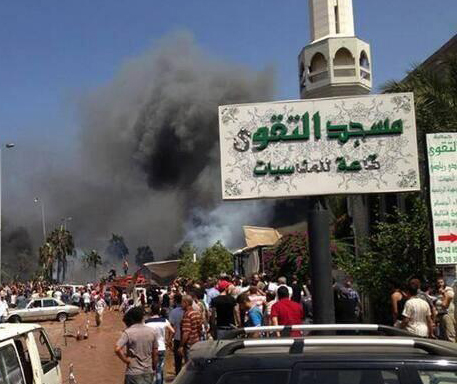
Blast at al-Taqwa Mosque in Tripoli, Lebanon

The mosque in Islam is known as a place of prayer. Since the very inception of Islam it has also been a place of death, indeed murder. It is reported that Ali, the cousin and son-in-law of Muhammad, was killed as he was praying in the Great Mosque of Kufa in Iraq by a fellow Muslim. Today in Tripoli, Lebanon, explosions at two mosques killed at least 27 people and injured hundreds. One of the blasts occurred near the al-Taqwa Mosque, where a Salafi preacher was praying, in the Abu Ali Square as those attending were leaving following Friday afternoon prayers. Another blast hit the al-Salam Mosque in the center of Tripoli. The reason? Yet another repeat of the intra-Islamophobia of one group of Muslims politically opposed to another group of Muslims.

When Ali was hit with a poisonous sword blade, he urged his sons and followers not to seek revenge on the Kharijites, the group to which the man who attacked him belonged, but to the man himself. But Ali was a better man than his followers. It seems that the attack on the Sunni mosque was tit-for-tat for the blast earlier this month in southern Beirut in the stronghold of Hezbullah. And the cycle continues, not only here, but in Iraq where it is almost a daily occurrence this summer.

There is a twisted logic here, the notion that someone who is clearly of the same religion is also someone that can be mercilessly slaughtered at prayer. Is there no one who will pray for peace and who will set aside political partisanship to work for peace? Continue reading Death at the mosque

Beyond al-Qaeda, the real Yemen


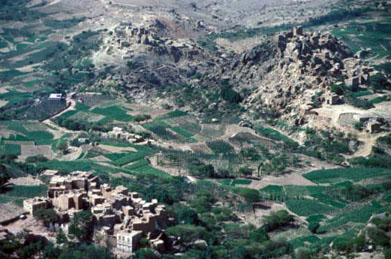
The fertile valley of al-Ahjur

by Abubakr Al-Shamahi, Common Ground News,August 20, 2013

Sana’a, Yemen – This month’s unidentified threat that led to the closure of the United States embassy and several US drone strikes around Yemen has once again shone an international spotlight on the country.

Simply put, as a Yemeni, I fear that all Yemen appears to be to the outside world is a front in the fight with al-Qaeda. But Yemen is more than terrorism and bombs, and many Yemenis are eager to ensure that this does not become the dominant narrative around the world.

Atiaf al-Wazir, a prominent Yemeni activist, voices the frustration of many Yemenis. In a piece for Your Middle East, she talks of a “country with a long history that was once hailed as Arabia Felix, land of generosity, wisdom, coffee, the first sky scrapers, the land with many queens and great architecture,” now overshadowed by “the hysteria of the decade: terrorism.”

If international observers look closer, they will find a country that has the potential to be far removed from a hotbed of fundamentalism. They will find a country undergoing an interesting political transition, one that is hugely important for the region. Continue reading Beyond al-Qaeda, the real Yemen

Medieval Muslim Women’s Travel


Two woman observing a conversation, Baghdad, Maqamat al-Hariri, Late Eleventh to early Twelfth Centuries, Bibliotheque Nationale, Paris. MS arabe 3929 fol 134, Maqamat 40, detail

Medieval Muslim Women’s Travel: Defying Distance and Dangerby Marina Tolmacheva, World History Connected

Women’s rights in Muslim societies became an especially sensitive subject of intercultural discussion in the twenty-first century. The recent Arab awakening has made understanding Islam, explaining Muslim sacred law to non-Muslims, and interpreting the internal dynamics of Islamic countries an increasingly urgent concern for educators. This paper focuses on historical evidence of Muslim women’s spatial mobility since the rise of Islam and until the early modern period, that is from the seventh until the sixteenth centuries. The Muslim accounts of travel and literature about travel created during this long period were written by men, mostly in Arabic. Muslim women did not leave behind records of their own travel, and it is only in the early modern period that some records were created by women, only a very few of which have been discovered. This means that we must rely on men’s accounts of women’s travel or draw on general descriptions of travel conditions that are applicable to women’s travel as well as men’s. Another limitation derives from the Islamic requirements of privacy and Muslim conventions of propriety: it was generally not considered good manners to discuss womenfolk or specific ladies, so medieval, and even early modern, Muslim books rarely describe living women unless it is to praise them. Historical chronicles may glorify queens, discuss important marriages made by princesses, or praise pious or learned Muslim women, but some travel books—for example, “The Book of Travels” (Safar-Nama) by the Persian traveler Nasir-i Khusraw (1004–1088)—do not speak of women at all. Some of the eyewitness evidence below explicitly related to women’s travel is drawn from the author who set the pattern of the travel account focused on pilgrimage to Mecca, Ibn Jubayr (1145–1217) and from “The Travels” (Rihla) of by Ibn Battuta (1304–1368?), who repeatedly married and divorced during his travels and sought advantage from association with prominent women met on his journeys. No such reservation was practiced in the Christian writing tradition, so occasionally observations of Muslim women on the journey may be found in the records left by European pilgrims, merchants or captives in the Near East, especially in works published after 1500. Continue reading Medieval Muslim Women’s Travel