Père Etienne Renaud: In Memoriam, 3


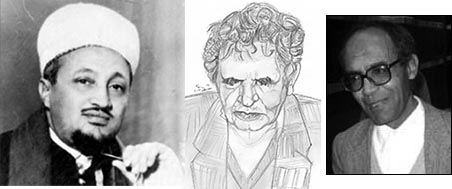
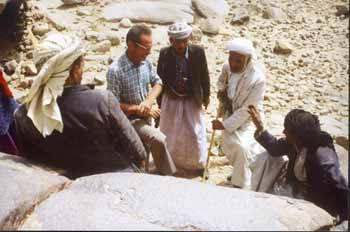
Yemeni poets Muḥammad al-Zubayrī, Abd Allāh al-Baraddūnī, Muḥammad al-Shalṭāmī, left to right

Yemeni Poetry in Translation

[This post continues a thread on the work of the late Père Etienne Renaud. The following French translations of Yemeni Arabic poetry were made by Etienne and are taken from his chapter “La vie culturelle en République Arabe du Yémen,” in Paul Bonnenfant, editor, La Péninsule arabique d’aujourd’hui (Paris: CNRS, 1982) Vol. 2, pp. 135-153.]

Nous avons refusé de vivre dans une nation
Foulée aux pieds par ses maîtres
Et nous sommes partis pour échapper à la bassesse
Fuyant la honte
Et combien de serpents rampaient autour de nous
Mais nous avons échappé à leur morsure

Muḥammad al-Zubayrī, Thawrat al-shi‘r, Cairo, 1962.

Amour et souffrance ont mêlé leurs deux âmes
Qu’est le Nord? Qu’est le Sud?
Deux coeurs qui ont rassanblé leurs joies et leurs peines
Ont été unifiés par la haine et par la souffrance,
Par l’Histoire et par Dieu.

Abd Allāh al-Baraddūnī, Fī ṭarīq al-fajr, Sanaa, n.d. Continue reading Père Etienne Renaud: In Memoriam, 3

Père Etienne Renaud: In Memoriam, 2


Père Etienne in Yemen

[In a previous post I commented on the life of Père Etienne Renaud, who rose to the position of leader of the Catholic White Fathers (Pères blanc), now known as the Missionaries of Africa. In 1987 he wrote a pastoral letter in the order’s in-house magazine, Petit Echo. This eloquent statement by a man who devoted his life to being a witness for humanity among Muslims and encouraging dialogue between Christians and Muslims deserves reading. It was originally written in French and translated into English in the same issue.]

Letter of Father General, Pére Etienne Renaud

Rome, 12 February 1987

Dear Fathers and Brothers,

Before taking up my pilgrim’s staff for West Africa, I should like to share some reflections with you.

After my election, several people asked me: “Is this going to change something in the Society’s commitment with regard to Islam?” One or another insisted more explicitly: “Is this going to increase our manpower in North Africa?” By way of riposte, I answered that a right wing government was well placed to make some left wing policy and vice-versa.

The fact remains that no one can make abstraction of his past, of all the missionary experience he has lived, and I must admit that my life in the Land of Islam, in North Africa as in Yemen, just as these last years teaching at the PISAI have deeply marked my general conception of mission.

My intention today, in this letter, is not to comment on the Chapter directives with regard to Islam, but to share with you some aspects of this conception of mission, which Islam has as it were forced me to deepen. I think that here it is a question of values important for every missionary, wherever he may be, even if they are values among others.

Respect for the other’s faith

In contact with Muslims, one is struck by the depth of their convictions, and more generally by the solidarity of the religious edifice of Islam. It is there, omnipresent. Study only reinforces this impression of massiveness, by helping us discover its centuries-old roots. Continue reading Père Etienne Renaud: In Memoriam, 2

Père Etienne Renaud: In Memoriam, 1

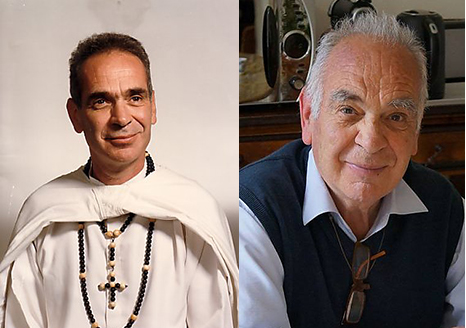
Just a few days ago I learned that a man I respected more than just about anyone else I have ever met had passed away on June 20, 2013 at the age of 76. This was Père Etienne Renaud, a man of the cloth I met in Yemen in 1978 and was able to visit in Rome in 1983. Etienne was a remarkable man, a missionary of the White Fathers (Pères blancs) teaching electrical engineering in Sanaa and ministering to the expatriate Christians in the community at the time. He was loved by all, including the many Yemeni Muslims he met, because he loved all.

His interest in Islam had evolved while serving in the French army in Algeria, after which he decided to enter the priesthood. With Arabic training in Damascus in 1968, he went to Tunisia the next year and on to Yemen in 1972. In 1980 he returned to Rome and taught Arabic at the recently formed Pontifico Instituto di Studi Arabi e d’Islamista. In 1986 he became Superior General of the order and served for six years. He visited many African countries where the White Fathers worked and spent the last several years in Marseille encouraging dialogue between Christians and Muslims.

Père Etienne was no ordinary missionary. He saw his mission as one of living his faith rather than trying to convert for conversion’s sake. In a poignant article, which I will post here in a follow-up, he noted that he was a Christian because he was born into Christianity. Although he accepted the Christian message as truth for him, he would not put himself in a position to judge another’s faith. His goal, as laudable as they come, was to be true to himself and allow others to be true to themselves, to see dialogue as an encounter that did not have to result in a zero-sum monologue. Continue reading Père Etienne Renaud: In Memoriam, 1

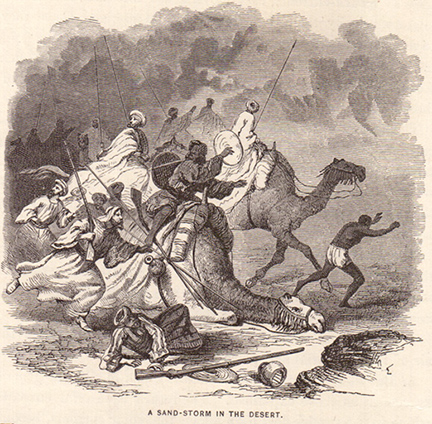
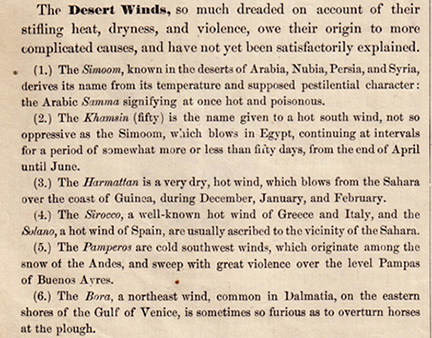
An 1873 Geography Lesson #1

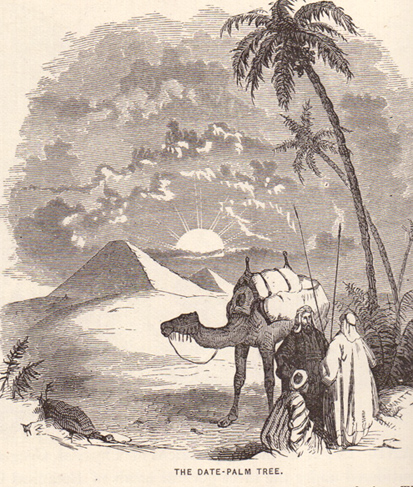
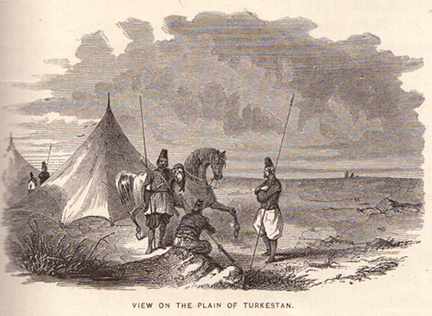
My grandmother’s aunt, Ms. Ida Hoyt, owned an 1873 geography textbook entitled An Elementary Treatise on Physical Geography by D. M. Warren (published by Cowperthwait & Co of Philadelphia). The book itself, which I recently leafed through, is falling apart, but it is worth taking a brief look at some of the lithographic images. The text itself shows how far we have come since 1873, especially for the dated views of “race” and the ethnocentric views of the time. I will start with several of the images, as shown here.

Continue reading An 1873 Geography Lesson #1

Making Music in Yemen


Photograph by Ali Abulohoom

The Yemeni Turbi

by Ali Abulohoom, Yemen Times, August 22, 2013

When he was 8 years old, Fuad Al-Qotari found a piece of wood lying around while playing with some neighborhood kids. He later learned that the object was actually a turbi, an instrument that had nearly disappeared from the Yemeni music scene after the 1920s.

Shortly after discovering his new find, Al-Qotari left Hashed district and moved with his family to the country’s capital, Sana’a, exposing him to more music. He began to follow many of the day’s most accomplished musicians and starting saving money for his own instrument.

His first instrument was the oud, and he was fascinated with its construction. “How [this] instrument was made interested me more than playing [it],” Al-Quotari said.

While he played some tunes of other musicians, his curiosity about the oud’s design was too strong. He put his instrument in water for hours and waited until it fell apart so that he could study each individual part. Continue reading Making Music in Yemen

War is still hell


The Garden of Earthly Delights by Hieronymus Bosch, ca 1500

War is hell and it was long before General Sherman figured that out. It helps to remember exactly what “hell” means. In 1741 the Protestant firebrand Jonathan Edwards gave a rather clear picture:

The God that holds you over the pit of hell, much as one holds a spider, or some loathsome insect over the fire, abhors you, and is dreadfully provoked: his wrath towards you burns like fire; he looks upon you as worthy of nothing else, but to be cast into the fire; he is of purer eyes than to bear to have you in his sight; you are ten thousand times more abominable in his eyes, than the most hateful venomous serpent is in ours. You have offended him infinitely more than ever a stubborn rebel did his prince…

Over five centuries ago, the painter Hieronymus Bosch gave an artistic rendering, as noted above. Had he known about poison gas, I suspect we would have seen a few canisters in his registers. In the hell that is war, a Dantean perspective would place the various poison gasses near the bottom level. It now seems that the United States is certain that Syria’s Assad has used poison gas, crossing the rhetorical line drawn by President Obama awhile ago. Foreign Policy is reporting new old evidence that our government is not so much concerned about the use of such poison gas as it is in who are the intended victims. We apparently knew in advance that Saddam would use such gas when we gave him logistical support to fight off the Iranians, whose country he had ruthlessly invaded. And, of course, we did nothing when he gassed the Kurds in Halabja.

The truth is that war has always been hell, since the first historical descriptions. In reality it is never the kind of supposedly heroic “give ‘m hell” bravado of John Wayne or Rambo. Gore trumps the vanity of glory. The problem is that hell is eternally present and not in some far-off ethereal realm. A further problem is that hell has no suitable escape hatch. Thus thousands have died in Syria and many more will be killed on all sides, no matter what the United States does next. The same goes for Iraq, Afghanistan, Pakistan, Palestine and now, it seems, Egypt. Even those who think that by killing someone else because they are … (fill in the sectarian blank) they will go to an imagined heaven only deserve to end up in the hell they create for their victims.

Those of us far away from the fighting, only within Youtube range, may forget how close to hell we really are. The stench of dead bodies and the devastating odorless poison that snuffs out lives lightning quick are not part of the air we currently breathe, but we should not forget that hell is not a place but an attitude, an attitude that kills. It is also an attitude for which there is no real immunity in avoiding its reality. If only we could say “to hell with war,” but then that would be a tautology.