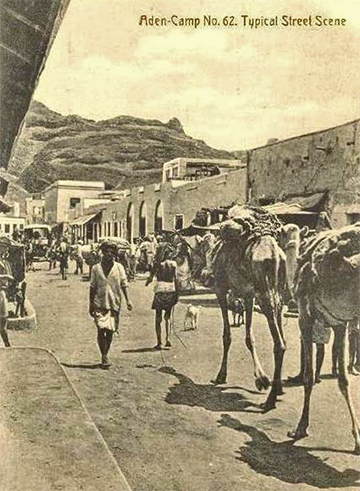
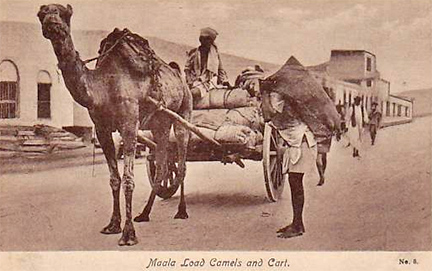
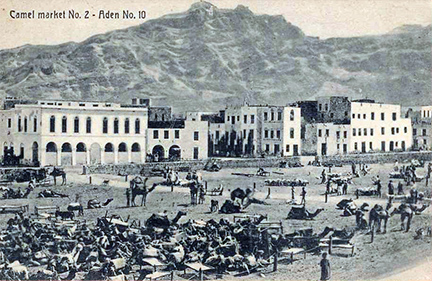
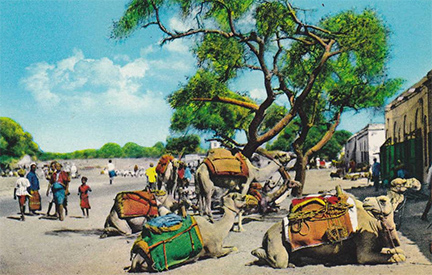
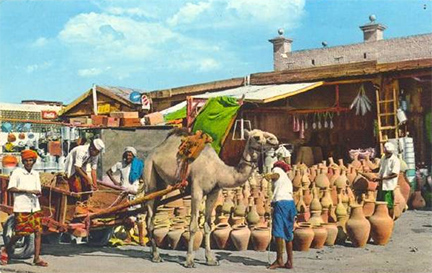
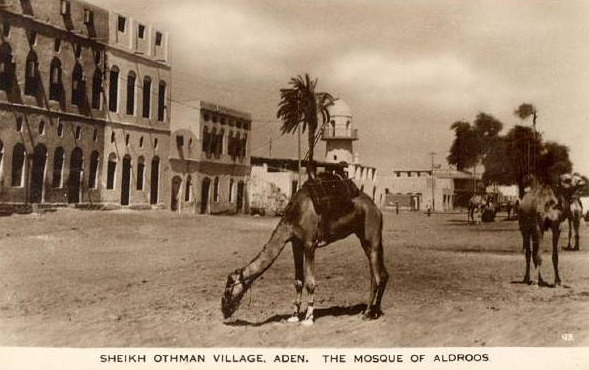
A tribute to even more camels of old Aden …
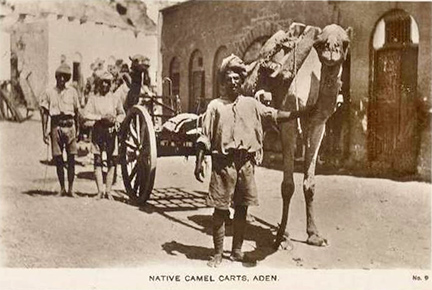
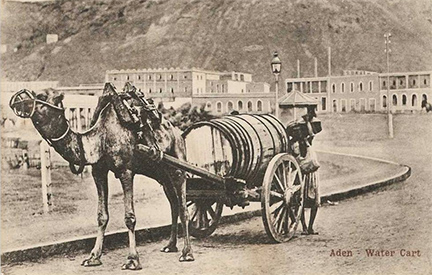
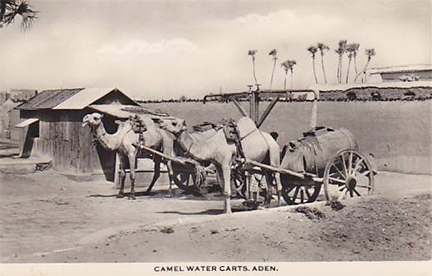
to be continued… for #5, click here.

Two woman observing a conversation, Baghdad, Maqamat al-Hariri, Late Eleventh to early Twelfth Centuries, Bibliotheque Nationale, Paris. MS arabe 3929 fol 134, Maqamat 40, detail
Medieval Muslim Women’s Travel: Defying Distance and Dangerby Marina Tolmacheva, World History Connected
Women’s rights in Muslim societies became an especially sensitive subject of intercultural discussion in the twenty-first century. The recent Arab awakening has made understanding Islam, explaining Muslim sacred law to non-Muslims, and interpreting the internal dynamics of Islamic countries an increasingly urgent concern for educators. This paper focuses on historical evidence of Muslim women’s spatial mobility since the rise of Islam and until the early modern period, that is from the seventh until the sixteenth centuries. The Muslim accounts of travel and literature about travel created during this long period were written by men, mostly in Arabic. Muslim women did not leave behind records of their own travel, and it is only in the early modern period that some records were created by women, only a very few of which have been discovered. This means that we must rely on men’s accounts of women’s travel or draw on general descriptions of travel conditions that are applicable to women’s travel as well as men’s. Another limitation derives from the Islamic requirements of privacy and Muslim conventions of propriety: it was generally not considered good manners to discuss womenfolk or specific ladies, so medieval, and even early modern, Muslim books rarely describe living women unless it is to praise them. Historical chronicles may glorify queens, discuss important marriages made by princesses, or praise pious or learned Muslim women, but some travel books—for example, “The Book of Travels” (Safar-Nama) by the Persian traveler Nasir-i Khusraw (1004–1088)—do not speak of women at all. Some of the eyewitness evidence below explicitly related to women’s travel is drawn from the author who set the pattern of the travel account focused on pilgrimage to Mecca, Ibn Jubayr (1145–1217) and from “The Travels” (Rihla) of by Ibn Battuta (1304–1368?), who repeatedly married and divorced during his travels and sought advantage from association with prominent women met on his journeys. No such reservation was practiced in the Christian writing tradition, so occasionally observations of Muslim women on the journey may be found in the records left by European pilgrims, merchants or captives in the Near East, especially in works published after 1500. Continue reading Medieval Muslim Women’s Travel
by Ed Swan, Research Intern, Quilliam Foundation
The phenomenon of antisemitism in Muslim-majority societies is usually explained in one of two ways. Either it is seen as something innate to Islam, constituting a core element of Islamic thought and scripture, and exemplified by centuries of persecution and conflict, or it is presented as a reaction to Zionism, and a break with a history of interfaith cooperation. The debate is influenced by absolutist viewpoints, which hold, for example, that the reaction to Israel in the Islamic world is purely antisemitic, or that pre-Zionist relations between Jews and Muslims constituted a utopian ideal of coexistence. The Islamic Caliphate of Al-Andalus, which existed in various forms in Iberia from the eighth to the fifteenth centuries, is often held up as the example par excellence of this coexistence. A closer look at the society of Al-Andalus helps to demonstrate that, while perhaps it was no utopia, the phenomenon of ‘Muslim antisemitism’ as we recognise it today does not have its roots in Islamic history.
Antisemitism in Muslim majority countries is well documented: a recent survey reports that large majorities of respondents in countries such as Egypt (95%), Turkey (76%) and Pakistan (76%) have an ‘unfavourable opinion of Jews’ (Pew Research Global Attitudes Project, 2008). Focusing specifically on the Arab World, where the largest majorities reported unfavourable opinions, there are a number of examples in local media that demonstrate the form of this antisemitism. European narratives play a prominent role, for example, Mein Kampf and the fabricated Protocols of the Elders of Zion continue to this day to be widely published and distributed in Arabic translation, and the latter formed the basis of a 2002 Egyptian television series syndicated across the Arab World.
These European-inspired antisemitic ideas can be seen employed as a response to the two overwhelming perceived threats to Islam: Western imperialism and Zionism. Continue reading ‘Muslim antisemitism’ and Al-Andalus: a historical perspective
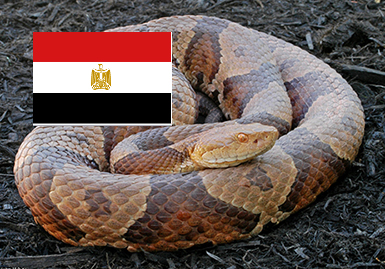
Given the events of last week in Egypt, it is hard not to reflect on these events while they are fresh. Opinions on the military crackdown, which has resulted in hundreds of innocent (obviously people protesting but not carrying weapons, including women) victims, are deeply divided. There seems to be no middle ground in the media or on the street, as far as one can see from outside the conflict area. One reason for this impasse is the level of violence attached to the level of vitriolic rhetoric from both sides. The removal of Morsi was bound to stir up the wrath of those who fervently supported the Muslim Brotherhood as all hopes for gaining power through the ballot box were shattered. The call for protests was doomed to failure as long as the military and security forces were intent on maintaining control of Egypt’s economy and protecting their base of power. In part this is due to the fact that the military never lost power and was clearly not prepared to do so, even with the changing of the guard in the officer shuffle at the top. But it is also the case that the Muslim Brotherhood had many enemies from the start, especially among those who were more secular-minded.
In a New York Times commentary Rick Gladstone quotes several scholars who argue that the aim of the military in forcefully removing the protesters with live ammunition was to provoke the expected violence by members of the Brotherhood. During the past month Egyptians have been bombarded with a propaganda message that the Brotherhood has become a bunch of bearded terrorists who must be resisted. So the strategy by Sisi and the military/security complex appears to have been to provoke violence from the protesters, knowing full well that there would be a violent reaction. The stores of a few weapons that the military claims was found among the protesters, even if planted there by the military, reinforces this scenario. The gut reaction of some supporters to blame the Copts and burn down more than 30 churches again feeds into the message that the Muslim Brotherhood is too radical. Continue reading Going for Broke (Read “Provoke”)
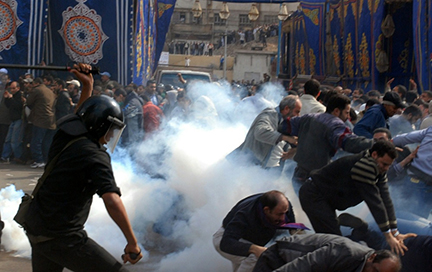
Egypt is once again under military curfew. Mubarak is gone, but the military and security system that stabilized the Mubarak regime is undeniably in control, no matter what the rhetoric about restoring democracy. The brief flirtation with a seemingly democratic election has been an abject failure, no matter who you think is to blame. There are no winners in the recent protests and crackdown that left well over 500 people dead and several thousand wounded. At this point all Egyptians are on the losing side as violence escalates. The situation today is a tragedy and is bound to get more tragic in the days ahead. Egyptians are pitted against each other in sectarian clashes, Muslim against fellow Muslim and some Muslims targeting the Copts. As many as 20 Coptic churches may already have been torched. God forbid if Egypt still had a viable Jewish population.
Blame is being hurled against all sides with breakneck speed in blogs, commentaries and twitter. But blaming is part of the problem, since it further inflames the frustration that leads to violence. Coptic churches are being burned because the Copts are said to side with the military as though it is only about politics. But the ugly intolerance that many Salafis and Muslim Brothers have preached to their own transcends politics. The military is indeed ruthless and manipulating the media with propaganda, demonizing the Muslim Brotherhood. Enough Brothers are acting out their violence to lend some credence to the claims in the eyes of many Egyptians. There is also the atrocity of pushing for martyrdom, as leaders of the Brotherhood encourage those who are protesting Morsi’s ouster to engage the military in what can only be a losing and bloody battle. Both sides are acting like spoiled children; no one is promoting a peaceful mediation, if one is still possible. Continue reading The Tragedy that is Egypt today
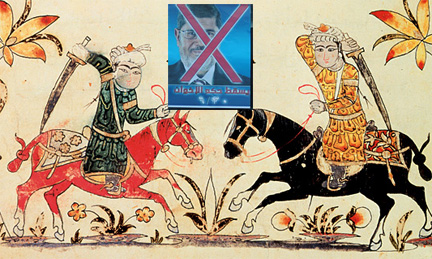
I have been reading a number of Mamluk historians recently and the turn of events in Egypt since the removal of President Morsi is an eerie reminder that the history of Egypt is more than the Nile, as Herodotus once put it; Egypt is the home of coup after coup from the Pharaohs to the Greeks to the early Muslims who founded Cairo to Fatimids, Ayyubids, Mamluks, Ottomans, Napoleon, the British and Nasser. The Nile still flows and the blood still spills out in the ongoing history of civil strife. The history of Egypt beyond the pyramids that the tourists photograph is very much about the military.
Today the Egyptian military and security forces followed through on their warning that they would clear the Muslim Brotherhood sit-ins in Cairo. The rhetoric for the past month has literally gone ballistic. The government has painted the Brotherhood as a band of intolerant terrorists, while the Brotherhood has made it seem as though they are martyrs for democracy. In all of this there must be some who wish for the days of Mubarak, just as some Iraqis long for the relative security of Saddam Hussein. The Arab Spring, which brought down dictator after dictator, has sprung a leak and a steady flow of blood is oozing out, literally hemorrhaging in the case of Syria, Iraq, Afghanistan and now Egypt.
Reports this morning from both sides in the conflict stretch the meaning of hyperbole. The government claims only 16 or so dead in all of Egypt, while a spokesman for the Brotherhood said thousands have been killed and tens of thousands injured. The truth is quite obviously in between. Continue reading Egypt Erupts