Morsi: The Arab World’s Wannabe Mugabe

I wonder if the judges who dole out the increasingly meaningless Nobel Peace Prize ever have second or third thoughts. In 2011 the Yemeni journalist Tawakkul Karman shared the prize for her visible opposition to the regime of Yemen’s Ali Abdullah Salih. The prize is symbolic to be sure, so it is not surprising that a recipient becomes hyperbolic with the international public attention. Karman was picked because of her advocacy work in Yemen, not because she was a savy expert on Middle East politics. A week ago she decided to cash in on her reputation and lend support to the sit-in followers of deposed President Morsi. The Egyptian authorities, not unsurprisingly, denied her entry for an obvious propaganda tour for the Muslim Brotherhood. Karman is shocked, it seems, that a military regime that would oust a sitting president would then deny her entry to come into Cairo and provide support for the opposition.

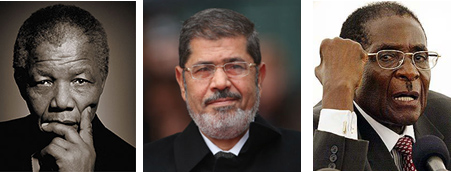
Foreign Policy has posted a commentary by Karman entitled Morsy Is the Arab World’s Mandela, with the subtitle Why we must stand and support the Muslim Brotherhood’s fight for democracy. Nelson Mandela? At a time when this fellow recipient of the Peace Prize (in 1993) is rumored to be near death’s door, this is an insult to the work of Mandela to end South Africa’s apartheid. My point is not to vilify or defend Morsi, but to compare him to Mandela is pure media hype. Continue reading Morsi: The Arab World’s Wannabe Mugabe

A dowdy pundit and an easy target

Some journalist pundits follow the Barnum and Bailey freakocentric approach to writing for the public. It really does not matter if they lean to the left or right, since it is never clear where a rational media center would be. I am actually glad that opinion page and editorial commentaries are amalgamated into the acronymical “op-ed” since it removes the genre further away from being taken seriously. There is plenty of hanging red meat around, a recent example being the New York electoral season with former governor Eliot Spitzer running for city comptroller and former congressman Anthony Weiner attempting to fill the shoes of Mayor Bloomburg. Here are two seasoned politicians with two glaring things in common: both fell from grace due to excessive sexual interests and both have wives who have not taken the route of former South Carolina governor Mark Sanford’s wife and jilted.

The tabloids are in paradise over these two. So why not the New York Times as well? I guess that is what prompted Maureen Dowd to unleash her op-edible wit and take down “Carlos Danger” AKA Anthony Weiner. In her piece for Sunday, July 28, she began with the following rhetorical volley:

WHEN you puzzle over why the elegant Huma Abedin is propping up the eel-like Anthony Weiner, you must remember one thing: Huma was raised in Saudi Arabia, where women are treated worse by men than anywhere else on the planet. Comparatively speaking, the pol from Queens probably seems like a prince.

When I puzzle over these opening lines, I am not able to forget one thing: Maureen Dowd must have learned everything she thinks she knows about Saudi Arabia from watching the movie Sex and the City 2. Continue reading A dowdy pundit and an easy target

Sex Education in Yemen


Photography by Boushra al-Moutawakel

from Yemen Times, June 24, 2013

It’s a sensitive subject in this conservative and religiously observant country. Who is talking about safe sex? In a recent online survey carried out by the organization Time to Talk, lasting 11 days—from May 11 to May 22, 2013—the organization asked 300 Yemenis that question, among others. Here are the results of their survey:

More men than women completed the survey, approximately 93 percent men and 7 percent women, all of them holding Yemeni nationality and spread over different age groups, with the largest prevalence among the 19-25 age group (28 percent), and less participation on the part of people in the age of 15-18 (6.12 percent).

The Yemeni respondents cannot be considered to be a representative sample of the Yemeni population because while there are currently as many males resident in Yemen as there are females, the number of men who voluntarily took part in our survey outnumbered the women, with an account for approximately 93 percent of all respondents.

However, almost all age groups present in the Yemeni population are well represented in our group: 19-25 (28.57 percent), 26-30 (19.39 percent), 30-35 (23.24), 36-40 (13.27 percent). The Yemeni age groups least well-presented were young people aged between 15-18 (6.12 percent) and the over 40’s (9.18 percent). Of those who responded to the survey, 54.17 percent are single and 45.83 percent are married. Continue reading Sex Education in Yemen

Not so Fast

As the month of Ramadan draws to a close, the ethical dissonance that now overshadows just about everything else in the Middle East is evident in the daily news. Muslims are dying daily from suicide bombs strapped to the waists of fellow Muslims, military bullets in Egypt and Syria, as well as sectarian violence just about everywhere. The focus during this month of Ramadan is on fasting, a temporary denial of the basic necessities (food water and sex) for a period of time under the sun. But it would be much better if the fasting extended to a moratorium on all violence.

Islam did not invent the idea of fasting, which was once a major ritual in both Judaism and Christianity. One might argue that contemporary Catholic Lent is a watered-down version, playing fast and loose with the more rigorous traditions of the past. In Islam fasting is one of the so-called five pillars, a ritual that most Muslims believe is essential for the believer. The Quran is quite clear on this:

Ramadhan is the (month) in which was sent down the Qur’an, as a guide to mankind, also clear (Signs) for guidance and judgment (Between right and wrong). So every one of you who is present (at his home) during that month should spend it in fasting, but if any one is ill, or on a journey, the prescribed period (Should be made up) by days later. Allah intends every facility for you; He does not want to put to difficulties. (He wants you) to complete the prescribed period, and to glorify Him in that He has guided you; and perchance ye shall be grateful. Surat al-Baqara (2:185)

The fact that there are exceptions (while traveling, women who are pregnant or breastfeeding or menstruating, taking necessary medicine, etc.) indicates that there has always been flexibility built into the ritual. In these cases the rule is that the fast be made up at another time in the year. Some individuals (a child before puberty, or someone who is insane or even a person who has a terminal illness) are not obliged to fast at all, nor to make up any fasting days.

But how much flexibility? What if a Muslim chooses not to fast for a reason other than those laid out in centuries of Islamic fiqh? Continue reading Not so Fast