Muslim Journeys

The National Endowment for the Humanities has a fantastic website on Islam with a variety of resources, especially valuable for teaching about Islam, but also just for browsing. The outreach part of the project is “The Muslim Journeys Bookshelf,” a collection of 25 books and 3 films, noted as “a collection of resources carefully curated to present to the American public new and diverse perspectives on the people, places, histories, beliefs, practices, and cultures of Muslims in the United States and around the world.” American libraries can apply for receipt of this collection. Available on the site are images, samples from texts, audio recordings and short film clips, web links and a bibliography.This website is worth spending a few hours on and coming back to; it is precisely what a virtual museum should be.

Here is a sample text excerpt to whet your appetite. This is from al-Jahiz, who died in 869 CE, on “The Disadvantages of Parchment”
Continue reading Muslim Journeys

On the Jews of Yemen


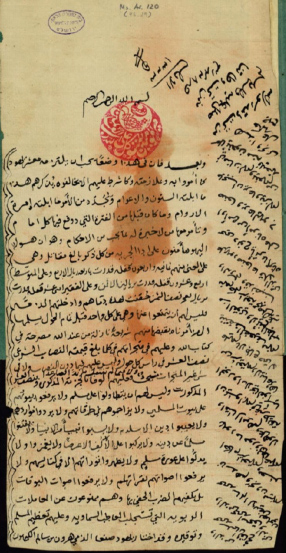
Imam Yahya’s “Niẓām al-YuhÅ«d,” ms.ar.120 from the National Library of Israel

There is a new study out on the statute on Yemeni Jews by Imam Yahya in 1323/1905 by the historian Kerstin Hünefeld. This is published in Chroniques du manuscrits au Yémen, in the July 2013 issue, which is available in download as a pdf. Hünefeld provides both an edition and an annotated translation.

Picturing the ka‘ba


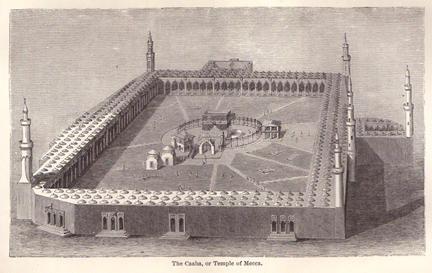
Although few Western non-Muslim travelers penetrated the forbidden zone of the ka‘ba in Mecca, illustrations proliferated by the mid-18th century. The image above was taken from the 1857 edition of Sale’s translation of the Qur’an (London: W. Tegg & Co) and reproduced in Henry J. Van-Lennep’s Bible Lands: Their Modern Customs and Manners Illustrative of Scripture (New York: Harper & Brothers, 1875). The two most famous travelers to make surreptitious trips to Mecca were Johann Ludwig Burckhardt in 1814 and Richard Burton in 1853.

Punditry: Pondering or Pandering?

Having established this blog a little less than a decade ago, I was initially excited about the possibility of responding to things I read about the Middle East and Islam in virtual “real time.” I still have several letters (the kind put on paper) to the editor that never were published where I sent them. Even if they had been eventually published, it would have been a bit late. Blogs seemed a new and accessible way to play the role of a pundit. But there are different paths for punditry. The best kind is pondering about events; the least useful is pandering to a particular point of view.

To ponder is to wonder, which requires taking risks with ideas and sentiments. Pondering goes beyond posturing, which is simply repeating a polemical mantra no matter where it falls on the left-right political spectrum. Pandering results from preaching to the choir, fixating on speaking a specific truth to power that others may not think is a valid “truth” at all. The contentious issues surrounding representation of Islam, Muslims, Arabs, Jews and the gamut of issues that smolder in the region known as the Middle East are not resolved by rhetorical crossfire. I think that sometimes there is so much speech clutter on the internet that voices of reason have little chance of being heard.

Everyone has pet issues and I am certainly no exception. The reader of my posts over the years will find that for the most part I preach tolerance of diverse views with one glaring exception: I am loathe to tolerate intolerance. A dialogue of disagreement, in my mind, is always better than a monologue of “I am right and you are wrong.” To ponder an issue, then, should be to probe it, test it, play with it, throw it around and see what falls out, make it transparent. Dogma ends all dialogue. Continue reading Punditry: Pondering or Pandering?