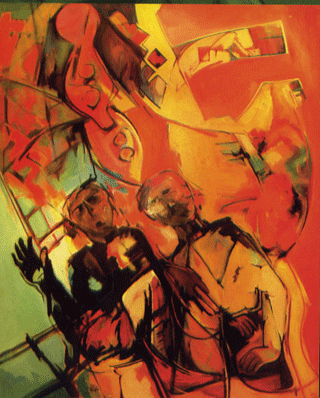
Painting by the Bahraini artist, ‘Abbas al-Mahroos (1943-2006)
Resurrecting Empire in Iraq
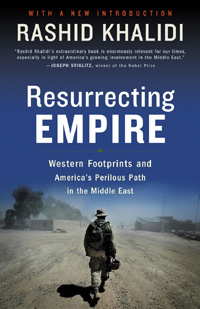
By Rashid Khalidi, Columbia University
The United States, and the world, now faces a situation of unprecedented difficulty in Iraq. There is deep resentment among Iraqis, including those grateful for the overthrow of the Ba’th regime, at the months of chaos in Iraq since the end of the war, at the unresponsiveness of the American occupation authorities, and at the slow pace of the move toward genuine self-government. American troops increasingly risk being received as are most occupation armies, and as were the British in Iraq after World War I: with hostility and ultimately with widespread armed resistance. The paralysis of the American authorities in Baghdad, which reflects the paralysis in Washington, as the administration’s factions struggle over decisions in Iraq, and the inflexible, highly ideological, and ultimately self-defeating line that has generally prevailed, have exacerbated the situation. Reliance on Pentagon-favored exiles loathed by most Iraqis, who see them as carpetbaggers, has already hurt the position of the United States in Iraq, an may lead to an even worse situation there when the inevitable backlash against their machinations sets in. This is only the tip of the iceberg, as is manifest from reporting in the non-American media on the situation on the ground in Iraq, one whose gravity has not been fully reflected in the American media—although American casualties in Iraq, and lengthy deployments of both regulars and reservists finally seem to be having an impact on American public opinion. Continue reading Resurrecting Empire in Iraq
Better Luck Next Year, Osama
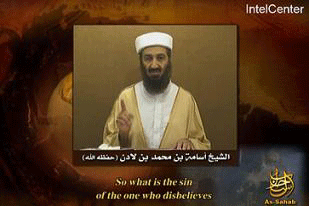
There was a time when Osama Bin Laden owned the audio and video- hungry airwaves. Each new tape brought out the usual talking heads and whetted the non-stop talking lips of the cable newstalker hosts. Could it be a fake? Does he look healthy? Where could he be? But these days the world’s number one bearded terrorist might as well be living in the Stone Age, cave or no cave for an address. Last year, may it rest in peace, Bin Laden released five new tapes, more than Beyonce and the Dixie Chicks combined (not that they would mix that well). The last message came in under the radar of the newswire at year’s end. As reported in yesterday’s The Guardian, this time the target is fellow Sunnis in Iraq who are working with the American forces. They join the Saudi regime, which Bin Laden has similarly damned as apostates headed for hell. Continue reading Better Luck Next Year, Osama
Twain on the New Year
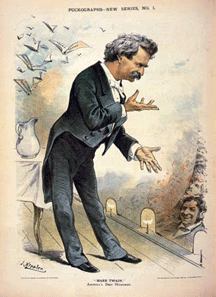
The more things change, the more they remain the same. Mark Twain did not say that, but consider his greeting from the 19th to the 20th century, published in the New York Herald on December 30, 1900:
I bring you the stately nation named Christendom, returning, bedraggled, besmirched, and dishonored, from pirate raids in Kiao-Chou, Manchuria, South Africa, and the Philippines, with her soul full of meanness, her pocket full of boodle, and her mouth full of hypocrisies. Give her soap and towel, but hide the looking glass.
Muhammad the Profit: Commerce, Play, and Entertainment in the Neoliberal Imperium
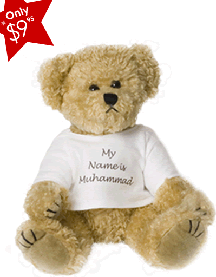
Following a link on the website www.korans.com can take you to the website www.teddybearmuhammad.com, which hawks the cute and cuddly namesake of Islam’s prophet. As the site explains, the bear commemorates the Sudanese government recently accusing 54-year old British schoolteacher Gillian Gibbons of blasphemy for “allowing” her class of 7-year old students at Khartoum’s Unity High School to choose what some considered the wrong name for the class stuffed animal. (The children named the bear after a popular classmate, not directly for the Prophet). The incident provided Sudanese politicians with an opportunity for local pandering, geopolitical bluster and a demonstration of sovereignty in reaction to international condemnation of the genocide in Darfur.
Cultural sensitivities about divine names and images are real, even when in particular instances they are feigned, exaggerated, or used as weapons in military or political conflicts. This reality is what gives their manipulation its potential power, although it also lays such manipulations open to exposure, derision, and failure. Continue reading Muhammad the Profit: Commerce, Play, and Entertainment in the Neoliberal Imperium
Who Owns the Holy Land?
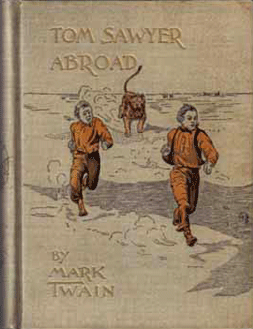
As another year draws to a close, it is hard not to think in larger terms of the course of the last century. The world has seen two world wars and far too many atrocities since 1908 to think of our technological and commercially driven age as golden. But in it all there has been humor. Believe it or not, the American writer Mark Twain was still alive one hundred years ago. His greatest books belong to the century before, from the mother of all Holy Land travelogues, Innocents Abroad, to Huckleberry Finn and his adventurous friend Tom Sawyer. Surely one of the greatest humorists ever, Mark Twain did more than tell funny stories. His work survives in part because it uses humor to remind us of the unfairness and unwavering mundaneness of life.
In Tom Sawyer Abroad Twain offers a vivid critique of the kind of Orientalism that Edward Said rightly views as a style for dominating the Orient. Continue reading Who Owns the Holy Land?
Inscribing The Body
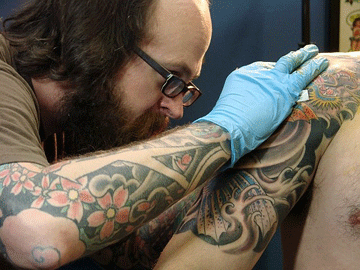
1. John MacIntyre Tattooing in Los Angeles
Inscribing The Body: Tattoos in Traditional and Modern Cultures
by el-Sayed el-Aswad
University of Bahrain
From ancient Egyptian culture, whence comes early evidence of tattooing, to contemporary art, the body has been employed as a living canvas for inscriptions and designs such as those of tattoos embodying symbols, icons, archetypes and mythological or folkloric themes. Tattoos, especially those consisting of lines and dots, have been found on preserved mummies, including that of Amunet, a priestess of the goddess Hathor at Thebes dating back to the XI Dynasty, 2000 B.C.E. Although amulets are widely used for protective, magical and ascetic purposes (and were predominantly used in ancient Egypt), they are replaceable or not permanent. Notions related to authenticity, ethnicity, gender, identity, sanctity, fertility, femininity, masculinity, class, and aestheticism, to mention a few, are inscribed permanently in various forms on the body.
Though tattooing is prohibited in Islam, because it is viewed as a factor in mutilating, maiming or altering the body’s physical features, local or traditional practices are still existent among the folk in various Muslim societies. Continue reading Inscribing The Body
Backing an Islamic Party
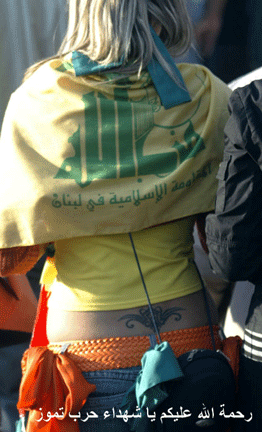
A picture is worth a thousand slogans and not just in Lebanon.