Out-of-Print CCAS Occasional Papers now Available Online

By L. King-Irani, Georgetown Center for Contemporary Arab Studies, October 22, 2007

Dissemination of information and analyses within and beyond the scholarly community is a key priority for the Center for Contemporary Arab Studies. The Center’s Multimedia, Research and Publications office publishes a prestigious Occasional Paper series featuring works by scholars, journalists, policy makers and field experts three to four times each year. This series now includes nearly 100 works covering a wide variety of subjects and perspectives on the Arab world. In addition, the series also includes transcripts of discussions among key players in the U.S. and the Arab world, such as Uncovered: Arab Journalists Scrutinize Their Profession, which features prominent Arab journalists’ analyses of press freedom and responsibility across the region. Forty of the Center’s Occasional Papers are now online.

The following six Occasional Papers have just been added to the group available in PDF format, two of them, Talal Asad’s The Idea of an Anthropology of Islam, and the late Hanna Batatu’s The Egyptian, Syrian and Iraqi Revolutions: Some Observations on Their Underlying Causes and Social Character, have been among the most popular and requested Occasional Papers over the last two decades. Continue reading Out-of-Print CCAS Occasional Papers now Available Online →

Cannons of the Past


Woman and a Fish, Asma al Fayoumi, Syria 1993

by Najeeb Nusair. Translated by Christa Salamandra and Suhail Shadoud
from Artenews, October, 2007

However much we moan and groan, however much we lament, reminisce, mull over, write, dig up, represent, glorify, venerate—even if we use the entire vocabulary of literature and science to conjure it up, the past will not return. Even if we cry, kick the ground with our feet like temperamental children, beg people, societies and nations, even if we consult scholars, historians, doctors, and feminists… the past will not return.

Instinctively we remember, as we practice our everyday cultural life, lavishly praising the past, and seeking to retrieve it in any possible way. But the past is within us; it has not and will not leave us. Asking for it to return is asking for what has fallen away, is gone, because it no longer works and has expired. The past is a gigantic mass, some of which is relatively good, and remains within us, and much of which time has consumed and flung aside, like lines in an arcane, long forgotten book. Continue reading Cannons of the Past →

Observations on the Baboons in the Garden of the “Bostan” Restaurant (2)

The infamous “Black Sambo” image.

Observations on the Baboons in the Garden of the “Bostan” Restaurant (Part Two)


[Note: These observations were first published in 1991 in Yemen Update and are archived online. The “Boston” has long since disappeared, but memories live on. For Part One, click here.]

Let me introduce you to the other guests besides myself, Flo and Eddy. At the table in front of me sat two Egyptian men who were soon joined by two Frenchmen. There was a rather abrupt shift from Cairene Arabic to French (or at least a form of French). What struck me was not the Egyptian or the French dialects, but the visual message on the back of a t-shirt worn by one of the French diners. This might have been purchased anywhere, of course, since all these designs are mumbo-jumbled internationally. First of all the color of the t-shirt was that of over-ripe banana pulp (it really was). Emblazoned on the back were four figures, each of them a replica of the racist “Black Sambo” image of Blacks in America during the “Amos ‘n Andy” era. One of these caricatures was boxing, another surfing, and so on. I suppose it was supposed to communicate nothing significant and for the most part it did here in Yemen. But I was somewhat appalled and was tempted to ask the fellow, whose back was a billboard for my face, to take off his shirt and wear it backwards (assuming only the over-ripe banana exuded on the front). Continue reading Observations on the Baboons in the Garden of the “Bostan” Restaurant (2) →

Observations on the Baboons in the Garden of the “Bostan” Restaurant (1)

Observations on the Baboons in the Garden of the “Bostan” Restaurant (Part One)

[Note: These observations were first published in 1991 in Yemen Update and are archived online. The “Boston” has long since disappeared, but memories live on.]

It was a bright and breezy Friday afternoon in Sanaa. Having only recently arrived to the Sheba Hotel, I decided to forego experiencing the haute cuisine available in my room or at poolside for a Lebanese repast at the “Bostan Restaurant”. This Levantine oasis in Yemen is located only a stone’s throw away from the great wall of the Chinese Embassy on the road that parallels Zubeiri Street. On the sign outside you are welcomed to the “Bostan Tourism Restaurant”, although the astute diner will note that on the menu cover this metamorphoses into “Boustan”. (Perhaps the menu cover was printed in Paris? The French seem to love adding the letter “u” to words that can be perfectly well pronounced without: when I see “Bilquis” my tongue utterly fails). Continue reading Observations on the Baboons in the Garden of the “Bostan” Restaurant (1) →

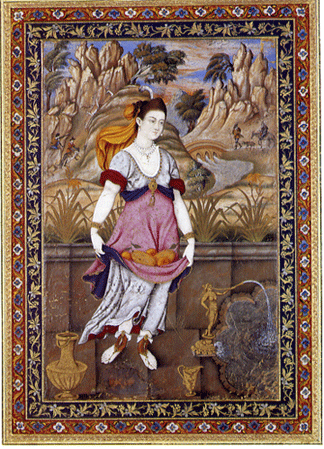
Woman by a Fountain

We are accustomed to Persian miniatures which depict the “Oriental” face, but later Persian art at times draws on Italianate style. The example above is entitled “Woman by a Fountain” and was painted by ‘Ali-Qoli Beyg Jebadar, around 1660 ce, probably in Isfahan.

Illustration from Abdolala Soudavar, Art of the Persian Courts (New York: Rizzoli, 1992), p.370.

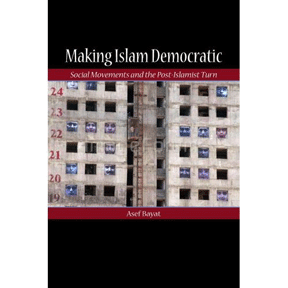
Making Islam Democratic: Social Movements and the Post–Islamist Turn

Book Review of Making Islam Democratic: Social Movements and the Post–Islamist Turn (Asef Bayat)

by Richard Bulliet
Published on NYU Center for Dialogues website

Discussions of contemporary Islam in the United States tend to be held in black and white, with the religion depicted either as a backward, dangerous and hateful force, or as a misunderstood and moderate foundation for peaceful living. Discussions in Europe range over a somewhat larger spectrum because they are often based on experiences with immigrant communities, and usually engage cultural issues in addition to security–related ones.

The most colorful and useful expositions for readers in search of a deep understanding of Islam today, however, are those based on detailed and long–term observations made in Muslim–majority countries, where interactions with Euro–American sensibilities do not confound the issue. Having said that, the drawback with such in–depth analyses is that they typically examine a single country, leaving it to readers to decide how similar or dissimilar Muslim life in Morocco, say, is from that in Bangladesh or Somalia. Continue reading Making Islam Democratic: Social Movements and the Post–Islamist Turn →

Research Fellowship on Muslim Modernities

2008 DPDF Research Field:
Muslim Modernities

Research Directors: Charles Kurzman and Bruce B. Lawrence

Islamic fundamentalists and Western Orientalists often emphasize pre-modern resonances in contemporary Muslim communities. Over the past generation, by contrast, an interdisciplinary set of scholars has come to emphasize the ways in which Islamic historical heritages are extruded, redefined, or invented through modern processes. We label this emerging field “Muslim Modernities.”

The idea of modernity was invented in Western Europe to distinguish the region from the rest of the world, including Muslim societies. Scholars disagreed about what modernity consisted of — capitalism, division of labor, rationalization, reflexivity, etc. — but broadly agreed that these were characteristics of the West and not of other societies. Increasingly, however, the study of Muslim communities has contributed to a re-thinking of the West’s monopolistic claims to modernity. Instead of measuring modernization as the adoption of Western institutions and norms, these studies have explored the development of alternative forms of modernity. These alternative forms are modern in three potentially distinct ways: their proponents claim that they are modern; they are recent, not found in “tradition,” though sometimes imposed retroactively on tradition; and they exhibit characteristics frequently associated with Western modernity, such as universalism, rationalization, and reflexivity. Continue reading Research Fellowship on Muslim Modernities →

Truth, Troops, Tooth and Clausewitz


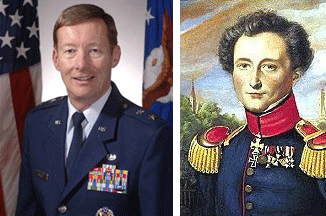
Maj. Gen. Charles J. Dunlap Jr., left; General Carl von Clausewitz, right

The surge to victory for John McCain in yesterday’s New Hampshire primary is attributed by Senator McCain to his telling the truth on a statewide bus tour. Truth and politics are seldom embedded fellows, so surely there is more at stake. It may be that the seeming success of the “surge” of U.S. troops combined with McCain’s last ditch, Chuck Norris tactic of shouting that he will get Osama on Day One in the White House was a factor in rousing New England independents to brave the snowbanks. Less American soldiers are reported dead in the daily papers, the suicide bombings in Baghdad are claiming less lives, and the economy looms larger in voter minds in the current trillion-dollar-deficit-spent free fall. The Democrats, on the other partisan hand, dismiss the Bush/McCain surge as the kind of military victory that can not win the diplomatic war in the end. Most of us would like to find some kind of truth in all the spin, but the super-media-charged primary machine surges on with truth as the main casualty.

So what do the generals say we should do? Today’s New York Times carries an op-ed commentary by Charles J. Dunlap Jr., an Air Force major general, who is about to publish a monograph called Shortchanging the Joint Fight?. In the general’s gung-ho “We Still Need the Big Guns,” he writes tooth and Clausewitz that effective counter insurgency in Iraq and future conflicts still needs to be measured in dead insurgent bodies. As he states:

Many analysts understandably attribute the success to our troops’ following the dictums of the Army’s lauded new counterinsurgency manual. While the manual is a vast improvement over its predecessors, it would be a huge mistake to take it as proof — as some in the press, academia and independent policy organizations have — that victory over insurgents is achievable by anything other than traditional military force.

Unfortunately, starry-eyed enthusiasts have misread the manual to say that defeating an insurgency is all about winning hearts and minds with teams of anthropologists, propagandists and civil-affairs officers armed with democracy-in-a-box kits and volleyball nets. They dismiss as passé killing or capturing insurgents. Continue reading Truth, Troops, Tooth and Clausewitz →