The Seller of Sweet Words

[Note: The most notable, at least in the Nobel laureate sense, Arab writer of literature is the Egyptian Naguib Mahfouz, who passed away in 2006 . Among his many novels, several of which are available in English translation by Doubleday Press, is the classic “Midaq Alley”, written more than six decades ago, but still a vibrant testament to the universality of human foibles in a literary mirror. Below is one of my favorite character descriptions in the novel. If you have not yet read “Midaq Alley”, then do so as soon as you can, and taste the sweet words (even in translation) for yourself.]

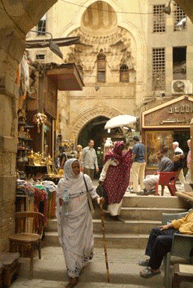
Many things combine to show that Midaq Alley is one of the gems of times gone by and that it once shone forth like a flashing star in the history of Cairo. Which Cairo do I mean? That of the Fatimids, the Mamlukes, or the Sultans? Only God and the archaeologists know the answer to that, but in any case, the alley is certainly an ancient relic and a precious one. How could it be otherwise with its stone-paved surface leading directly to the historic Sanadiqiyya Street. And then there is its café known as Kirsha’s. Its walls decorated with multicolored arabesques, now crumbling, give off strong odors from the medicines of olden times, smells which have now become the spices and folk cures of today and tomorrow…

Although Midaq Alley lives in almost complete isolation from all surrounding activity, it clamors with a distinctive and personal life of its own. Fundamentally, and basically, its roots connect with life as a whole and yet, at the same time, it retains a number of the secrets of a world now past. Continue reading The Seller of Sweet Words
While in the Other Manger …


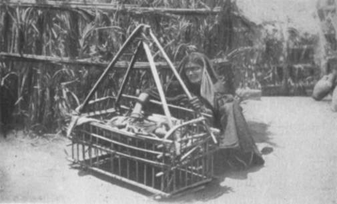
Date Stick Cradle, from Zwemer’s book.

Christmas Eve is the time for reflecting on a baby in a manger in Bethlehem, three kings bringing spices and shepherds blinded by angel light. Christians around the world celebrate this scene, but what do they think of all those other babies who were not destined to become religious icons? Back in 1902 the Christian missionary Samuel Zwemer and his wife Amy teamed up to write a children’s book about Topsy-Turvy Land. For more information on this apologetic diatribe against Islam and Arabs, click here. As the authors claim, “In Topsy-turvy Land all the habits and customs are exactly opposite to those in America or England.” And where is this mythical garden of play for good Christian children? Arabia, specifically an Arabia in which the Ottoman Empire still had steam. For a good-old-boy, old-fashioned religion view of the “Arab” child as a topsy-turvy other, this is as prime a piece of apologetic and Orientalist dismissal as you can find. So take a look in the other manger, as the evangelistic Zwemers did a mere century ago…

ARAB BABIES AND THEIR MOTHERS

An Arab baby is such a funny little creature! In Christian lands babies, as soon as possible, are given a warm bath and dressed with comfortable clothing. But in Arabia the babies are not washed for many days, only rubbed over with a brown powder and their tiny eyelids painted round with collyrium. They are wound up in a piece of calico and tied up with a string, just like a package of sugar. Continue reading While in the Other Manger …

The Kaaba’s New Kiswah


[Note: For a Youtube documentary on the Saudi Kiswah Factory, click here.]

By Manal Homeidan, Asharq Alawsat, December 17, 2007

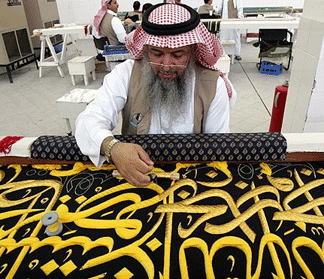
Jeddah, Asharq Al-Awsat – Following their departure from Mecca, millions of pilgrims have started to make their way to Mount Arafat. Coinciding with this unchanged ritual is the tradition of changing of the Kaaba’s ‘kiswah’, the cloth that adorns the Kaaba made of black silk and embroidered with gold calligraphy.

This event is customarily attended by the gate-keepers of the Kaaba and technicians from the Kiswah Factory, which has been manufacturing the fabric that adorns the Kaaba for the past six decades. These technicians employ a special mobile escalator so as to remove the old cloth and cover it with the new kiswah, one day before the first day of Eid ul-Adha. Continue reading The Kaaba’s New Kiswah

Iraq: The Hidden Human Costs

[Note: The following excerpt is from a book review published in the latest New York Review of Books by Michael Massing. The full article is available free online and describes two compelling memoirs of the invasion of Iraq, one by a Marine and one by a reporter embedded with the Marine’s unit. It is well worth reading for a side of the fighting usually sanitized out of reports.]

by Michael Massing, New York Review of Books, December 20, 2007

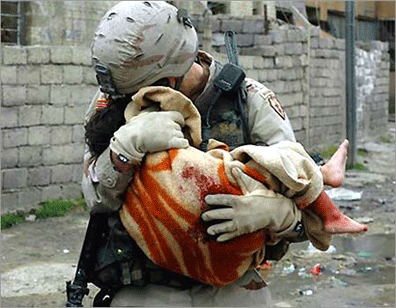
As the Marines fall back, some are clearly exhilarated at this first exposure to battle; others express remorse. “Before we crossed into Iraq, I fucking hated Arabs,” says Antonio Espera, a thirty-year-old sergeant from California. “I don’t know why…. But as soon as we got here, it’s just gone. I just feel sorry for them. I miss my little girl. Dog, I don’t want to kill nobody’s children.” Coming under heavy fire for the first time, Wright is surprised to find himself calm, but he is astonished at the fierceness of the barrage being directed at Nasiriyah. It includes high-explosive rounds that can blast through steel and concrete as well as DPICMs (Dual-Purpose Improved Conventional Munitions), cluster shells that burst overhead, dispersing dozens of bomblets designed to shred people. Continue reading Iraq: The Hidden Human Costs

Baghdad in the 80’s

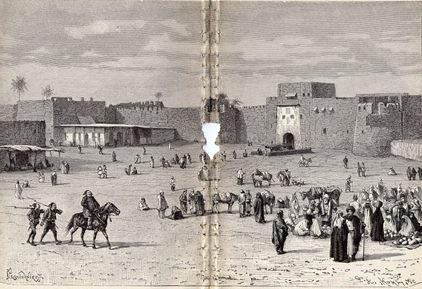
Baghdad in the 1880’s, in case you are curious.

As university libraries desperately look for space to hold old and rarely used volumes, many books fall by the wayside. My university holds an annual sale in which most of the books being discarded deserve to be. But then there are the occasional old and rare books that I cannot bear knowing will end up in a dumpster or landfill. One of these that I recently picked up for a dollar was Geographische Charakterbilder aus Asien. Aus den Originalberichten der Reisenden gesammelt von Dr. Berthold Volz mit 87 Illustrationen (Leipzig, Fues’s Verlag, 1887, 384 pages). The discursive Althochdeutsch aside, this text is a bit of print paradise for the lover of 19th century lithographs, all 87 of them. Continue reading Baghdad in the 80’s

Mass-Mediated Violence in Morocco and the US: Suicide Bombing and Shooting Sprees


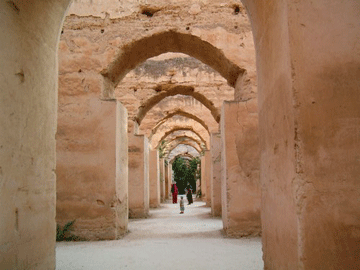
Scene in Meknes, Morocco

by Emilio Spadola
Colgate University
Dept of Sociology and Anthropology

Recently, my efforts to think on Moroccans’ quality of modern (i.e., mass-mediated) life have turned on violence both there and in the US, and, especially, to two forms of youth violence: suicide bombings and suicide shootings. In 2007 Moroccans witnessed separate bombings in Casablanca and Meknes; in separate cases Moroccan state intelligence traced other accused suicide bombers to one neighborhood in Tetouan. In the US in December an Omaha teenager with an automatic weapon shot and killed eight mall goers, then himself; four deaths shortly after in Colorado added to the long year of suicide sprees by young men: six deaths in a Utah mall in February, 33 deaths on the Virginia Tech campus in April.

Emphasizing putative differences, cultural pundits habitually link suicide bombings to the Middle East, and, specifically, to an Islamic culture of violence. And shooting sprees seem typically, if pathologically, American. They are nonetheless strikingly redolent. Yet to compare them, that is, to abstract them from their separate contexts, takes special care. In so doing one faces what Benedict Anderson calls the “specter of comparisons,” that is, the distinctly modern moment in which persons appear, like commodities and print, as serial copies. Yet it is precisely this imagined quality of commensurability—when “anyone” rather than a specific someone can be a target (of mass-mediated messages)—that marks as contemporary suicide bombing and suicide shooting. Continue reading Mass-Mediated Violence in Morocco and the US: Suicide Bombing and Shooting Sprees

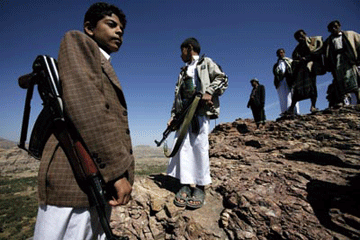
The Sad Case of Sa‘da

[Note: News about internal affairs in Yemen rarely makes the news, unless the word Al-Qaeda is associated with a local act of terrorism. But there are grievances and skirmishes that have virtually nothing to do with the West’s fear of global jihad. One of these is the ongoing violence in the north of Yemen near Sa‘da. The following report by Mohammed Bin Sallam brings us up to date on the problem.]

Al-Houthi warns of annihilative catastrophe amid indicators of fifth Sa’ada war

by Mohammed Bin Sallam, Yemen Times, December 16

The military authorities are deploying huge army units these days throughout the restive governorate of Sa’ada. The excessive presence of troops implies a government’s intention to wage a new war against Houthi supporters after Eid Al-Adha vacation.

SA’ADA, December 16 — Sa’ada is currently experiencing much scornful conducts by authorities such as the extensive arrest campaigns, demolition of homes, forcing children and women to live outdoors and the excessive deployment of troops. “Such procedures usually indicate a government’s intention to wage a war against innocent people in the war-ravaged governoratet,” Abdulmalik Badraddin Al-Houthi, field leader of Houthi loyalists said in a letter sent out to Joint Meeting Parties (JMP) and NGOs last week.

He confirmed that he and his supporters are compelled to defend themselves and confront any new attacks by the government troops against them.

“I fear any destructive consequences of such a tragic and dangerous situation in the war-torn governorate. Earlier, we sent you a letter during the fourth war urging you to intervene in the crisis, taking into account that you are concerned with what is happening in Sa’ada and that you are partners in religion, homeland and fate,” Al-Houthi said in his letter, addressed to JMP leaders. “All the Yemeni people suffer from the consequences of Sa’ada wars. Those who don’t suffer from murder and property damage are bound to face negative economic impacts because the influential groups exploit the country’s wealth and exercise property theft at the expense of starving and poor citizens.” Continue reading The Sad Case of Sa‘da