What’s Cooking in the Ottoman Empire

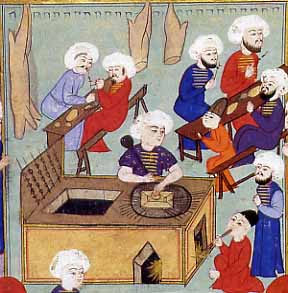
There are many cuisines in the Middle East and Central Asia and one of the great fusion examples occurred in the Ottoman Empire. In a recent book (500 Years of Turkish Cuisine) published in Turkey, Marianna Yerasimos provides a colorful survey of the various foods and drinks along with recipes and an array of images from Turkish illuminated manuscripts. Here is a sample from her introduction (with recipes to follow on future days):

“No one influence alone, central Asia, Anatolia or Byzantium, is by any means enough to explain Ottoman cuisine and its extraordinary richness in terms of ingredients and variety of dishes. As you will see in the recipes, especially in the 15th and 16th centuries, Ottoman cuisine shared ingredients, cooking methods and dish names with the Middle East. As there are inadequate sources available, it is at least for the time being impossible to definitively determine what it shared with Byzantine cuisine. There are also other veins fat and thin, which nourished Ottoman cuisine, such as Rumelia (the part of the Ottoman empire which was in Europe) and the Balkans. Continue reading What’s Cooking in the Ottoman Empire
Apostasy in Islam

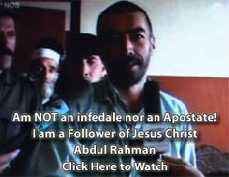
In the furor throughout the Islamic world over the publication of negative caricatures of the Prophet Muhammad in Danish newspapers, and more recently giving the name Muhammad to a teddy bear, the earlier anger about author Salman Rushdie’s Satanic Verses was rekindled. The critical difference, of course, is that Rushdie was condemned not only for blaspheming the Prophet but for leaving Islam as the faith he was born into. This issue of apostasy — leaving Islam — resurfaced a year ago in the case of an Afghan man named Abdul Rahman, who proudly claimed he had converted to Christianity. Several Islamic nations, including Afghanistan regard apostasy as a crime and impose the death penalty for this.

The issue seems to be simple; it is egregious to any modern notion of human rights and Islamophobes are quick to dredge up a long history of Islamic legal rulings that legitimize such a death penalty. In point of fact no contemporary Islamic nation state follows all the ascribed shari’a penalties to the letter of the law. Even when constitutions state that the laws are based on the shari’a, it is the state itself which takes over many of the functions once given to Islamic judges. What might have worked (and we know that laws were always unevenly applied) at some point in the caliphate is not working today. Continue reading Apostasy in Islam

Apocalypse Watch: The Man Who Knows Squat

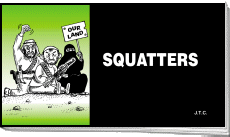
Most people find it hard to take cartoons seriously, apart from political satire and that can become a deadly issue, depending on the target. Given the recent Danish cartoon controversy it would seem that comics and religion do not mix well or at least settle well for the believers who see themselves as the target. But what about comic relief for the political struggle between Israel and the Palestinians? Fundamentalist tract artist Jack Chick, whose comic empire is dedicated to winning souls for Christ by drawing on God’s hate, has been using his pen to spread a rather nasty version of the Gospel for over 40 years. One of his more recent offerings is called “The Squatters” and it provides a virtual roadmap to apocalypse. Continue reading Apocalypse Watch: The Man Who Knows Squat

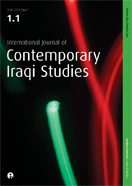
International Journal of Contemporary Iraqi Studies

The International Journal of Contemporary Iraqi Studies is a new peer-reviewed, tri- annual, academic publication, sponsored by the International Association of Contemporary Iraqi Studies, and is devoted to the study of modern Iraq. In recognition of Iraq’s increasingly important position on the editors are: Tareq Ismael and Jacqueline Ismael at the University of Calgary (ijcis@intellectbooks.com).

For those interested, the first issue from 2007 is available free online in pdf format. Contents of more recent issues are also available online. The articles in the first issue are:

The Islamist imaginary: Islam,Iraq,and the projections of empire (Raymond W. Baker)

Media and lobbyist support for the US invasion of Iraq (Janice J. Terry)

Beating the drum:Canadian print media and the build-up to the invasion of Iraq (Tareq Y. Ismael)

The United States in Iraq:the consequences of occupation (Stephen Zunes)

Toward regional war in the Middle East? (Richard Falk)

Reconstructing the performance of the Iraqi economy 1950-2006: an essay with some hypotheses and many questions (Roger Owen)

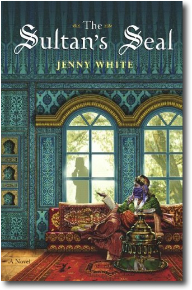
The Sultan’s Seal

“Your brush is the bowstring that brings the wild goose down.”

(Reviewed by Jana Kraus MAR 22, 2006)

Jenny White, an anthropologist and the author of numerous nonfiction works on Turkish society and politics, has written a real winner with her debut novel, The Sultan’s Seal. A historical mystery with a bit of romance thrown in, this book makes for an unputdownable read. Ms. White paints a remarkably vivid portrait of life in 19th century Turkey, from the luxurious sultan’s palaces to the most squalid slums of Istanbul, and writes intelligently of the political turmoil of the period.

Set in the ancient city “Stanbul” on the Bosphorus in the waning days of the Ottoman Empire, (1886), political intrigue, espionage and social upheaval are rife, even in the sultan’s harem. “Young Turks,” a reformist and strongly nationalist group of men, forced the restoration of the constitution of 1876. This new generation of Ottoman political thinkers were convinced that the Empire would never be truly modernized until it had adopted a democratic government and a constitution rather than undiluted power in the hands of the sultan. Gathering secretly in Istanbul, then in exile in Europe, “these reformers propagandized against the governments of Ali Pasha then, when Ali died in 1871, against the increasingly autocratic rule of Sultan Abdulaziz.” There is a tremendous struggle taking place to find a middle ground between traditional values of the non-secular East and the very different, more progressive ways of the West. Continue reading The Sultan’s Seal

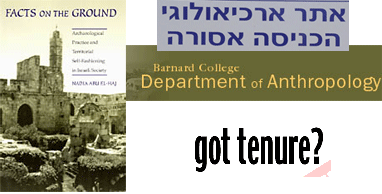
Tenure Affirmed, not Bulldozed

[Note: The recent tenure case of Dr. Nadia Abu el-Haj generated a great deal of heat in the blogosphere, but I am pleased to report that she was granted tenure based on the internal reviews and despite the external attempts to bulldoze her voice out of the academy. I had reported on this case in a post here on September 13. The details are provided in a blog item by Richard Silverstein, which I include here to bring closure to this case.]

by Richard Silverstein, Tikkun Olam, November 2, 2007

The long, arduous journey of Nadia Abu El-Haj, Barnard professor of anthropology, to tenure is finally over. The Columbia administration has approved Barnard’s recommendation and she will become tenured faculty on approval of both institutions’ boards of trustees. Thanks to Sol Salbe for noting the JTA report on this from earlier today. However, a Jewish journalist friend of mine has pointed out a typical JTA error in the copy for the story:

El-Haj is the author of “Facts on the Ground,” a book that attacks the Israeli archaeological establishment for fabricating material used to legitimize Israeli policies.

My friend called this sentence:

a complete and utter distortion of the book, which, of course, the journalist, whoever he/she might be, has not read. What he/she has read is Paula Stern’s petition or Gabrielle Berkner’s New York Sun story. On deadline, people [just] WRITE STUFF. It’s a pity The Sun gets to set the template.

Continue reading Tenure Affirmed, not Bulldozed

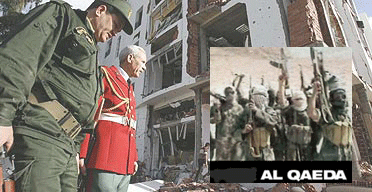
You’ve Gotta Be Al-Qaiding Me

Pick up your morning newspaper or log on to an online news source and chances are there will be reports of suicide bombings somewhere in the Middle East (or Sri Lanka). The latest example, reported only a few hours ago, is from Algeria, as published in The Guardian:

At least 47 people, including a member of UN staff, were killed in two car bomb attacks in the Algerian capital today.

A car packed with explosives rammed into the offices of the UN’s refugee agency (UNHCR) in Algiers, and another was detonated outside the constitutional court.

Official estimates put the death toll at 47, but the BBC reported that the figure was over 60. A further 43 people have been injured.

The US president, George Bush, condemned the attacks as “senseless act of violence”.

The two car bombs, in upmarket areas of the capital, happened 10 minutes apart.

The first car bomb was driven into the constitutional court building in the Ben Aknoun district, killing at least 30 people. The official Algerian news agency reported that several of the victims were students who had been travelling on a school bus.

Ten minutes later, the second car bomb was driven into the UNHCR, in the Hydra district, killing at least 15.

Farhan Haq, a UN spokesman, said the member of staff who died had been working in the office of the UN development programme, which is across the road from the UNHCR building and was also damaged in the blast.

More of the same, you might think. The story could as easily have been about Iraq or Afghanistan or Israel or fill in the increasing number of blanks. So why is all this happening, as if the pragmatic reasons are not painfully obvious? More of the same again. The media, echoing the Bush administration, has a suspect. Continue reading You’ve Gotta Be Al-Qaiding Me

Picturing Sanaa


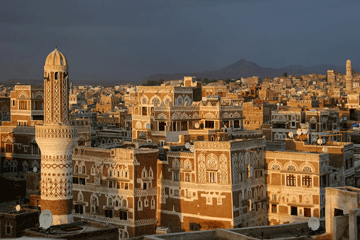
Sanaa Satellites

Photograph by Tan Yilmaz

“Sanaa at dusk, taken from the rooftop terrace of Taj Talha hotel. I was not staying there, but non-guests can go up to the terrace for the view (try doing that in elitist Dubai). I did not bother erasing the profusion of unsightly satellite dishes, there are too many. 45mm. focal length, just before sunset. The sky is as dark as it is because of a departing thunderstorm. This is taken 1 day before the last Sanaa photo I uploaded, which was from the Golden Daar hotel. The workshops shows SANAA BY NIGHT.”