MPAC and the Bad News Bear Story

I am a Canadian Muslim who has been living and teaching in Los Angeles for the past decade. My recent book, Oil and Water: Two Faiths, One God is an introduction to Islam for a North American audience. As a Muslim, I am deeply concerned about violence committed by Muslims, especially when it is done in the name of Islam. Muslims around the world have condemned the recent cases in Sudan and Saudi Arabia. For example, the Muslim Public Affairs Council (MPAC) wrote this in response to the jailing of the teacher in Sudan: “‘Jailing Ms. Gibbons is the real insult to Islam in this case,’ said MPAC Communications Director Edina Lekovic. ‘Invoking Islamic law to jail and deport her for this insignificant class project is absurd and appalling.'” Their full response can be found on their web page and is reproduced here:

MPAC Appalled by Sudanese Jailing of Teacher for Naming Teddy Bear
November 30, 2007

The Muslim Public Affairs Council today expressed its disgust with the Sudanese court decision to jail and beat a British teacher who allowed her students to name a class teddy bear “Muhammad.”

SEE: “Calls in Sudan for Execution of British Teacher” (New York Times, 11/30/07)

The hundreds of protesters, some waving ceremonial swords, outside the presidential palace denouncing the teacher and calling for her execution are falling into a pathetic trap by making a story out of nothing. The leaflets condemned Gibbons as an “infidel” and accused her of “the pollution of children’s mentality” by her actions.

“Jailing Ms. Gibbons is the real insult to Islam in this case,” said MPAC Communications Director Edina Lekovic. “Invoking Islamic law to jail and deport her for this insignificant class project is absurd and appalling.” Continue reading MPAC and the Bad News Bear Story

Where are the Moderates?


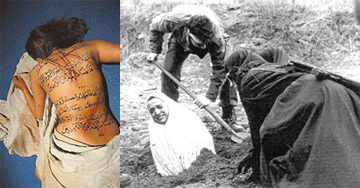
[Illustration: Ayaan Hirsi in the Theo Van Goghin film, left;alleged preparation of woman for stoning, right.]

In a New York Times op-ed published yesterday by Ayaan Hirsi Ali, a controversial Dutch Somali, a relevant and timely question is asked: Where are Muslim moderates when misogynist renderings of Islam sweep the media? She has a point in noting the relative absence of condemnation of three recent tabloid news items. There is the Shi’a woman in Qatif, raped by several Shi’a men, and herself branded (to the barbaric tune of 200 lashes) guilty by a Sunni Wahhabi court for “mingling” with a man not her husband. Then the hug-my-teddy-bear-but-don’t-mention the-prophet’s-name fiasco over a naive British teacher in Sudan, and finally the case of Taslima Nasreen, a Bangladeshi writer vilified for her feminist writings that approach the controversial barzakh of Rushdie’s Satanic Verses. So where are the moderates? For Ms. Ali they are phantom progressives, too blinded by their loyalty to the faith and fearful of telling truth to Muslim power. Here is her assessment:

It is often said that Islam has been “hijacked” by a small extremist group of radical fundamentalists. The vast majority of Muslims are said to be moderates. Continue reading Where are the Moderates?

When Iran was Welcomed into the Nuclear Club

In all the recent back-and-forth about the capabilities of Iran to produce a nuclear bomb, it is well to remember how Iran was once welcomed into the nuclear club defending the free world (well, not that free in Iran at that time), when the Shah was in now-all-too-clear power. Iran was in fact a good example for the folks pushing nuclear power plants in our own back yards. What a difference a regime change makes … The ad above would seem quite dated, but then history does have a habit of repeating itself.

Iran’s Nuclear Weapons Program Never Existed

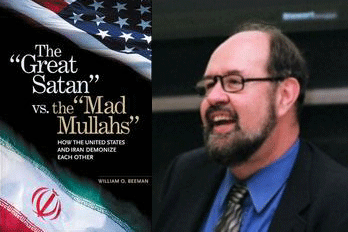
by William O. Beeman,
New America Media, News Analysis, Dec 05, 2007

Iran has never had a proven nuclear weapons program. Ever. This inconvenient fact stands as an indictment of the Bush administration’s stance on Iran.

The recently released 2007 National Intelligence Estimate that Iran “suspended its nuclear weapons program in 2003” caught the Bush administration flat-footed. In his panic, Bush grasped desperately at the idea that the weapons program may have once existed. However, the report does not offer a scintilla of evidence that the weapons program was ever an established fact. Continue reading Iran’s Nuclear Weapons Program Never Existed

The professions: from Woodstock to a novel life, in so many words


Professor Robert Leonard, right.

by Patricia Kitchen
Newsday, November 29, 2007

Fans of mystery novelist and forensic anthropologist Kathy Reichs may have noticed a new character in her most recent novel, Bones to Ashes. That would be forensic linguist Rob Potter, a Woodstock rock star-turned-linguist and onetime graduate school mentor to Reichs’ main character, Temperance Brennan.

The newcomer is based on one of Reichs’ friends, Robert Leonard, 59, a real-life former rock star-turned-forensic linguistics professor. Leonard, in fact, heads the Forensic Linguistics Project at Hofstra University. Professionals in that field analyze written and spoken language – including grammar, word choice, dialect and structure – in contracts, confessions, ransom notes, spoken threats, undercover recordings, transcripts of interrogations and other correspondence linked to crimes.

Think professor Henry Higgins meets Sherlock Holmes. Continue reading The professions: from Woodstock to a novel life, in so many words

Secrecy and Anthropology

by Elizabeth Redden, Inside Higher Ed, December 3

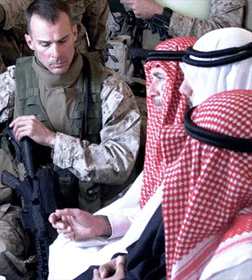
With debate over the role of anthropologists in aiding the military machine a theme threading through their annual meeting, scholars voted Friday to demand that the American Anthropological Association reinstate strict language from its 1971 code of ethics prohibiting secret research. Members at the meeting – who, for the second time in about 30 years and the second year in a row constituted a quorum in excess of the required 250 — also voted overwhelmingly to oppose “any covert or overt U.S. military action against Iran.”

The language anthropologists want reinstated on secrecy – which, the resolution’s sponsor affirmed would apply to anthropologists doing work for corporations too – stipulates that “no reports should be provided to sponsors that are not also available to the general public and, where practicable, to the population studied.” Like every item of business discussed Friday other than the resolution on Iran, the resolution on secrecy was not filed for consideration 30 days in advance, as is required under association rules, and so will be submitted to the association’s executive board on an advisory basis only.

But Friday’s vote only strengthens a recommendation contained in a new report from the AAA Commission on the Engagement of Anthropology with the U.S. Security and Intelligence Communities, which suggests that the membership or ethics committee “should consider” reinstating those same sections (1.g, 2.a, 3.a, and 6) of the 1971 code. The report centers on whether the association’s ethical standards bar ties to the military or intelligence agencies. The commission’s short answer: Not necessarily, although more scrutiny is needed. Stressing the diversity of roles anthropologists can play in military and intelligence apparatuses, the panel determined that while certain interactions would violate the ethical code, members also “see circumstances in which engagement can be preferable to detachment or opposition.” On issues of secrecy, for instance, the commission offered one particularly complex dilemma as illustration: “Some situations might be counterintuitive for most of us: consider a situation in which a research project is kept secret from the scholarly community, but not from the local population or community under study – as when an anthropologist employed by a government agency helps a special operation to get medical supplies to a remote town in northern Afghanistan.” Continue reading Secrecy and Anthropology

The Ninth International Symposium on Comparative Literature

Call for Papers
The Ninth International Symposium on Comparative Literature
November 4-6, 2008
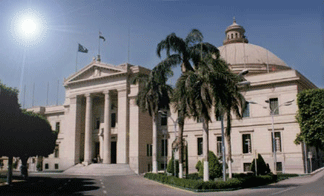
Department of English Language and Literature, Cairo University
“Egypt at the Crossroads: Literary and Linguistic Studies”
Deadline for abstracts: March 15, 2008

Because of its geographical, historical, and cultural placement, Egypt has been—since time immemorial—both literally and metaphorically at the crossroads. Enjoying the strategic location that it does—at a meeting point between Africa and Asia, facilitating contact between the two continents and Europe, and at a juncture between the Mediterranean and the Red Sea—Egypt is a rich amalgam of diverse cultural heritages: Ancient Egyptian, Greek, Roman, Persian, Coptic, Islamic. Influenced by all these and, in modern times, the French and British, the inhabitants are in the happy position of being hybrid—African, Arab, Mediterranean—but indubitably and inimitably Egyptian. It is, perhaps, this unique situation that inspired the Egyptian geographer Gamal Hamdan (1928-1993) to write of Egypt as having a “natural gift” which may explain “the secret of Egypt’s survival and vitality through the ages and in spite of the ages.” Continue reading The Ninth International Symposium on Comparative Literature

A Man, A Sign, a War

Yesterday afternoon on a crowded Connecticut Avenue roundabout in our nation’s capital, Washington, D. C., a man stood holding a sign. The sign read “Bring our Troops Home” on one side and “End the War” on the other. He was not simply holding the sign, but slowly twirling it back and forth so both messages came across. I would guess his age was late 50s or early 60s and he was well-dressed, a man who would fit comfortably on Wall Street. He was not your stereotypical t-shirt labeled liberal icon, so who was he and why was he standing there? I will never know. My 30 seconds of peripheral vision, waiting for the traffic to clear, allowed only a glance. But today when I close my eyes I see him standing there. Continue reading A Man, A Sign, a War