Peaks of Yemeni poetry he summons


[The following is Najwa Adra’s review of two books by anthropologist Steven C. Caton, who conducted ethnographic fieldwork in Yemen in 1979-1981. It was first published in
Yemen Update, #48 (2006):46-50.]


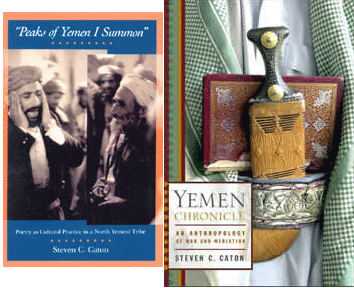
“Peaks of Yemen I Summon”: Poetry as Cultural Practice in a North Yemeni Tribe
, by Steven C. Caton
Berkeley, University of California Press, 1990
ISBN # 0-520-06766-5
351 pp., illus., maps, hardcover

Yemen Chronicle: An Anthropology of War and Mediation
, by Steven C. Caton
New York, Hill and Wang, 2005
ISBN-13: 978-0-8090
341 pp., maps, no illus., hardcover (also available in paper)

Reviewed by Najwa Adra

“Peaks of Yemen I Summon”: Poetry as Cultural Practice in a North Yemeni Tribe and Yemen Chronicle: An Anthropology of War and Mediation, published 15 years apart, should be read as two complementary parts of a whole. They document Steven Caton’s field research on tribal poetry in Khawlan at-Tiyal in 1979-81. Together, these books are important contributions to theory in anthropology, the ethnography of Yemen, and perhaps literary theory and political science as well. The first book is a technical discussion of tribal poetry as cultural practice; the second is a personal, reflexive description of the author’s experiences in the field. It provides rich contextual data that shed light on, and help support, the author’s argument in the first book. Continue reading Peaks of Yemeni poetry he summons
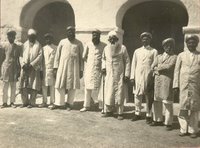
Ann Lambton

Professor Ann Lambton: Persian scholar
From The Times, July 23, 2008

Ann Lambton, known as Nancy to her friends, devoted the greater part of her life to Iran and the study of Iran. Iranians who knew her thought she was either a saint, a scholar, a spy or all three. She was tough, physically and mentally, and almost an ascetic. She was a walker, a climber, a horsewoman and a squash player. She was a scholar who wrote some of the standard works on Iranian language, agriculture, land tenure and history. She was involved in some of the most dramatic of 20th-century Iranian political events. She was a devout Christian.

Lambton was the second child of the Hon George Lambton, fifth son of the 2nd Earl of Durham; and of Cecily, daughter of Sir John Horner. Her father trained racehorses, including George V’s, at Newmarket, and she was a good horsewoman herself. Her mother did not believe in education and kept her at home. She had almost no formal schooling and spent her youth in her father’s stables until she became too tall to be a jockey (a younger sister, Sybil, died in a riding accident in 1961). Continue reading Ann Lambton

Holy Men and Social Discourse in Colonial Benaadir

Renewers of the Age: Holy Men and Social Discourse in Colonial Benaadir
by Scott Reese (Leiden, Brill, 2008)

Studies of nineteenth and twentieth century Islamic reform have tended to focus more on the evolution of ideas than how those ideas emerge from local contexts or are disseminated to a broad audience. Using the urban culture of southern Somalia, known as the Benaadir, this book explores the role of local ʿulamāʾ as popular intellectuals in the early colonial period. Drawing on locally compiled hagiographies, religious poetry and Sufi manuals, it examines the place of religious discourse as social discourse and how religious leaders sought to guide society through a time of troubles through calls to greater piety but also by exhorting believers to examine their lives in the hopes of bringing society into line with their image of a proper Islamic society.

Table of contents
Chapter 1– Introduction— The Ê¿Ulamāʾ as “local intellectuals”
Chapter 2– Religious History as Social History
Chapter 3–Saints, Scholars and the Acquisition of Discursive Authority
Chapter 4–Urban Woes and Pious Remedies: Sufis, Urbanites and Managing Social Crises in the Nineteenth Century
Chapter 5–When is Kafāʾa Kifayah? – Sufi Leadership, Religious Authority and Questions of Social Inequality
Chapter 6–The Best of Guides: Sufi Poetry, theological writing and Comprehending Qadiriyya popularity in the Early 20th Century

Scott S. Reese, Ph.D. (1996) in History, University of Pennsylvania, is Associate Professor of Islamic History at Northern Arizona University. He has published extensively on Islam in Africa including the edited collection The Transmission of Learning in Islamic Africa (Brill, 2004).

Exiled Egyptian activist sentenced

Al-Jazeera, August 2, 2008

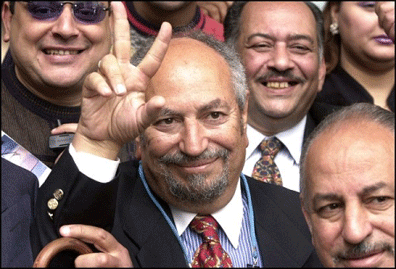
Saad Eddin Ibrahim, an outspoken critic of the Egyptian government, has been sentenced to two years in prison.

The sociologist and human rights activist, who is currently in the United States, was convicted for “tarnishing Egypt’s reputation,” the country’s official MENA news agency said.

Shady Talaat, Ibrahim’s laywer, said the ruling by a Cairo court was flawed and that he would use his right to appeal. Continue reading Exiled Egyptian activist sentenced

Hula-Hoop for Peace

Move over Barack. Lawyer and activist Melody Moezzi is organizing an event to coincide with the Democratic National Convention in Denver and all you will need besides a commitment to peace in the Middle East is a hula hoop. Here is how she describes it.

I am an Iranian-American. I have two homelands: the United States and Iran. I am not half-Iranian. I am not half-American. I am 100% Iranian and 100% American. Thus, peace, particularly between the US and Iran, is not simply a political issue for me: It is deeply personal. Any attack on Iran by the United States would constitute the eruption of an internal civil war within me and so many other Iranian-Americans. It would be a conflict that I am not certain my soul could withstand, and it would be a conflict that would result in the loss of my countrymen on both sides. Indeed, I am not taking up peace as a cause because I am some delusional hippie (far from it) and have nothing better to do (I assure you, I do). I am doing this for unabashedly selfish and painfully practical reasons: I do not want my family, my countrymen, or my generation to die or struggle at the hands of others. I have presented my “home,” which includes all my biases and underlying intentions here, so if this is too much for you, then HHP is likely not your ball of wax, or more specifically, your ring of plastic. Continue reading Hula-Hoop for Peace

Music in the World of Islam

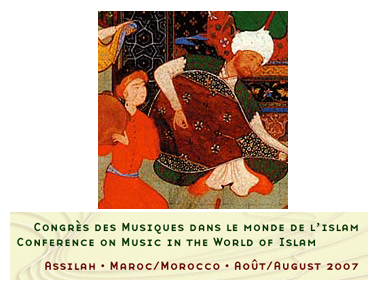
A year ago from August 8-13 an international conference on “Music in the World of Islam” was held in Assilah, Morocco, jointly sponsored by The Assilah Forum Foundation (Assilah, Morocco) and the Maison des Cultures du Monde (Paris, France). The papers from this conference are now available in pdf format online. Music and dance are described for Afghanistan, Algeria, Andalusia, Azerbeijan, Bangladesh, Bosnia, Central Asia, East Africa, Egypt, Ethiopia, India, Indonesia, Iran, Iraq, Kurdistan, Kuwait, Liberia, Malaysia, Morocco, Russia, Syria, Tajikistan, Turkey and Yemen.

A description of the conference is described by its main organizer, Pierre Bois: Continue reading Music in the World of Islam

Flowers and Virtue

[The following commentary discusses a recent attempt in Yemen to create religious police, such as are found in Iran, as an intrusion on Yemeni values and rights in the modern state.]

The paradox of “Mashaqir” and the religious police

Dr. Mohammed Al-Qadhi, Yemen Times

I think the best response to the establishment of a religious police force, under the banner of promoting virtue and curbing vice, is the mashaqir (traditional flowers women put on either side of their head) function run by the House of Folklore. I was extremely thrilled with spiritual joy with the function that revived in everybody nostalgia for a simple and pure life for both men and women free from extremism and fanaticism. The mashqour, a singular form of mashaqir, is a symbol of chastity and freedom women enjoyed in an ordinary rustic life. It also stands for an abused femininity now by a puritanical interpretation of life where everything is devilish and hellish and a male-dominated and masculine culture that considers women inferior to men.

See the paradox between a group of fundamentalist clerics that want to kill life and a function organized by Arwa Othman, director of House of Folklore, that wants to revive and breathe life into the society and women through restoring the culture of the mashaqir. Continue reading Flowers and Virtue