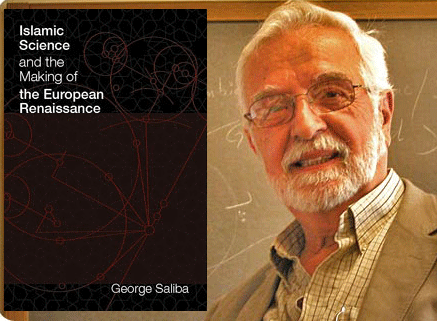
Saliba on Europe and Islamic Science

[On Rorotoko, historian of science George Saliba discusses the writing of his recent book, Islamic Science and the Making of the European Renaissance (Cambridge: MIT Press, 2007).]

This book started almost ten years ago. Initially, I wanted to know what were the conditions under which a civilization could produce science afresh.

I was trained in ancient Semitics, and mathematics, but I was always interested in these rumors that the general reader knows about, that the great invention of science was a really Greek project. And that everything else is either a shadow or a continuation of the classic antiquity.

Growing up, you assimilate these paradigms. You begin to think that these are the normal things. But then, trained in mathematics, and beginning to read a little bit of what was produced in the Islamic civilization, in science, I grew curious. I grew curious because I began to note that some of the science produced was not a shadow of the Greek project. It was more re-focusing of light, a new way of looking at things, which the Greeks did not know.

I began to also wonder about a fact that many a student of history and general reader would know. That there was this period of fantastical effervescence in the classical Greek tradition, say from the 4th century BC to the 2nd century AD. All the major names that we can think of happen to be in this period, all the major classics, in every discipline you can think of, from Plato to Aristotle to Ptolemy to Euclid to Diophantus to Galen to Dioscorides. And all comes to an end by the 2nd century. Then nothing happened. And then, all of a sudden, we begin to hear, in the 9th century, of the crazy caliphs of Baghdad who are spurring this and that, translating this and that, incorporating all of the Greek material. Continue reading Saliba on Europe and Islamic Science
Following Seward’s Folly: #1 Brits and Hindoos


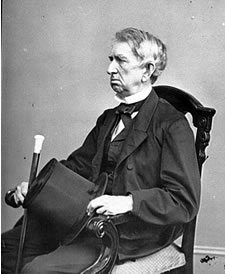
Portrait of William H. Seward, Lincoln’s Secretary of State, ca. 1865; photo by Matthew Brady

William H. Seward (1801-1872) is remembered primarily, to the extent anyone but a historian would bother to remember him, for his folly. An ardent opponent of slavery, this staunch Yankee republican might well have received the presidential nomination in 1860 instead of Lincoln, but he went on to serve as Secretary of State to both Lincoln and the first President Johnson. It was in 1867 that he pushed through the purchase of Alaska from Russia for 7,200,000 dollars, a sizeable sum for a nation coming out of a costly civil war. Horace Greeley in the New York Tribune wrote in criticism that Alaska “contained nothing of value but furbearing animals, and these had been hunted until they were nearly extinct.” Little did the man who famously said “Go west, young man” know that one day a young woman named Sarah Palin would come to power in this once Russian icebox. In 1870 Seward left politics and went on a trip around the world with his adopted daughter, who kept a record of the trip and published this in 1873. From New York to San Francisco to Japan and China to the straits of Malacca, Ceylon and British India to Egypt and Palestine and Europe and finally returning home to Auburn, New York in October of 1871: this was the folly the old man followed shortly before his death. Continue reading Following Seward’s Folly: #1 Brits and Hindoos

M F Hussain’s Aesthetic View on Islam


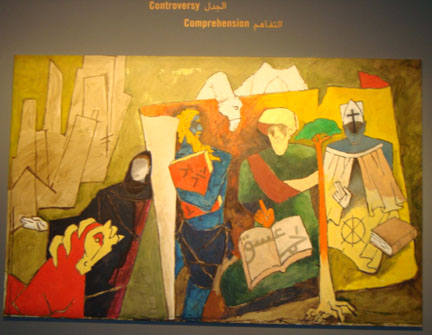
Hussain’s painting courtesy of Dr. Bruce Lawrence

One of the most famous, and at times infamous, painters in modern India is M.F. Hussain, who was born in 1915 and currently resides in London. He is perhaps best known for the controversy over his nude paintings, especially one that depicted “Mother India” and caused such a major backlash that he removed it from view. Less known, perhaps, are his paintings about Islam. Bruce Lawrence recently sent me several illustrations of paintings by Hussain on Islamic themes. Several of these were commissioned by Sheikha Mouza of Qatar for the Islamic museum in Doha. The picture above portrays the three monotheisms as “People of the Book.” As a painter it is clear that Mr. Hussain is less interested in promoting a particular religion than in celebrating the human spirit through his art.

Here is Bruce’s description of the painting above (this is an excerpt from a volume on Hussain, edited by Sumathi Ramaswamy and to be published by Routledge in October 2010): Continue reading M F Hussain’s Aesthetic View on Islam

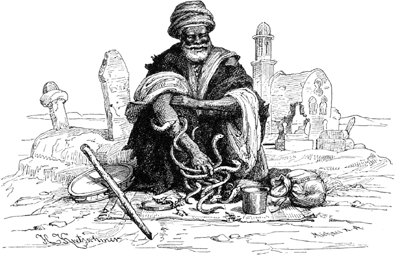
Ibn Taymiyya on Snake Oil

[Webshaykh’s Note: The Muslim World has made some of their articles available, perhaps only for a limited time, to non-subscribers. In the latest issue (Volume 99, Issue 1, Pages 1-20, 2009) there is an interesting article by Yahya Michot (“Between Entertainment and Religion: Ibn Taymiyya’s Views on Superstition”). I attach here a brief excerpt from the article.]

One day, Ibn Taymiyya was asked to answer the following questions in a fetwa: “Are there, in this community, virtuous persons whom God keeps absent to people’s eyes? They are only seen by those by who they want to be seen. Even if they are among people, they are, in the state which is theirs, veiled to these people’s eyes. And also, are there, on Mount Lebanon, forty men absent to the eyes of those who look there? Every time one of them dies, they take somebody else among the people, who absents himself with them just as they are absent. All those, the earth hides them. They perform the pilgrimage. They accomplish in an hour distant trips that would normally take a month or a year. There are some among them who fly like birds, speak of hidden things before they happen, eat bones and clay and find this nourishing and sweet, etc.”27 Continue reading Ibn Taymiyya on Snake Oil

Al-Qaeda in Yemen

[Salon Magazine recently published an interview with Gregory Johnsen on the recent attacks against alleged al-Qaeda sites in Yemen. Here is a brief excerpt from the interview. The whole piece can be found at salon.com.]

Glenn Greenwald: My guest today on Salon Radio is Gregory Johnsen, who is an expert on Yemen; he’s a Ph.D. candidate in Near Eastern Studies at Princeton University and has advised the U.S. and British governments on issues relating to Yemen. Thanks very much for joining me today.

Glen Greenwald: How would you characterize what is being called al-Qaeda in Yemen in that spectrum, and how significant of a threat it is really to the United States, not within Yemen, but outside of Yemen and in the homeland?

Gregory Johnsen: Well, let me talk about it this way, if I can. This is the second incarnation of al-Qaeda in Yemen. Immediately after September 11th, we had what I like to term the first phase of the war against al-Qaeda. This lasted essentially from, say, the USS Cole attack in 2000 and really the September 11th attacks in 2001, up through November 2003. So, in this phase, the US and Yemeni governments partnered very closely. There was the drone strike in November 2002 that I mentioned earlier, and this was largely, at least for al-Qaeda, a reactionary war. Continue reading Al-Qaeda in Yemen

Resolving the New Year


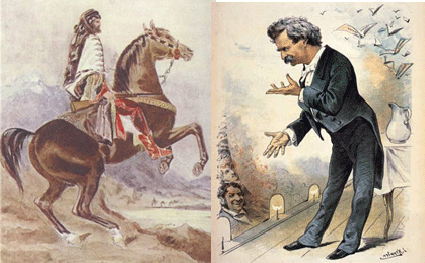
Wilfrid Scawn Blunt, left; Mark Twain, right

There is a curious annual custom inherited in many of our families, but one I am resolved not to take too seriously this year. I refer to the half-drunk notion of making resolutions for the new year (which I see no sound reason to capitalize, as my German blood is very far removed), as though the arbitrary turning of the calendar is a time to reflect on what went wrong over the last 365 days and pretend that things should go better in the next eighteen and a quarter score days. I have heard the rural urban tale that the pin-up 19th century cowgirl sharpshooter Annie Oakley started the custom of sending out Christmas Cards, but I am not sure which genius came up with penning new year’s resolutions, unless it was Johnny Walker in one of his more sober moments. Most people, and I surely fall into this anomalous category, do not remember the resolutions made a year ago. But then most godfearing redneck Americans could not repeat the 10 Commandments in order to save their souls, unless perhaps they were dead drunk. So my re-solution, since it is the defacto one I have been following for quite a few years, is to resolve to forget any resolution before I even make one. This saves me from having to make up a resolution, which is the same as making as silly a resolution as I can imagine.

I am not the first person to take aim at this impotent cultural pastime which has long since ceased to have any influence on what people really do. Mark Twain said it well over a century and a half ago:

New Year’s Day–Now is the accepted time to make your regular annual good resolutions. Next week you can begin paving hell with them as usual. Continue reading Resolving the New Year

A Moorish Girl and an Irish Poet


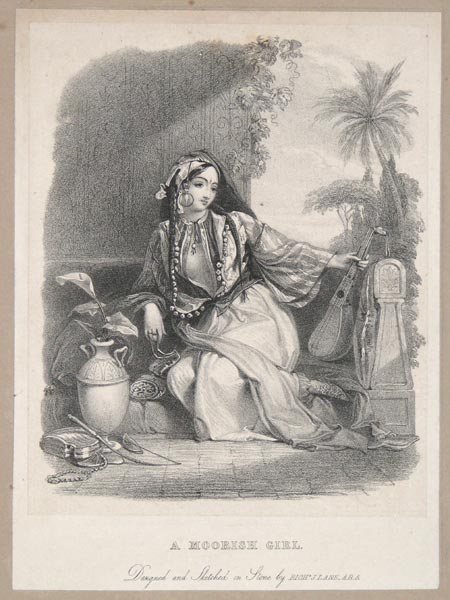
A Moorish Girl, ca. 1828

The image here is entitled “A Moorish Girl” and was designed by Richard James Lane. This lithograph was published in London by Engelmann, Graf, Coindet, & Co., ca. 1828. This would have exemplified the romanticized image conjured in Thomas Moore’s immensely popular Lalla Rookh, written in 1817. Often dismissed as a kind of quasi-pornographic Orientalist doggerel, the poem is a delightful read as a flight of fancy. The entire poem is online in an attractive format. Here is a sample excerpt:

Alas, poor ZELICA! it needed all
The fantasy which held thy mind in thrall
To see in that gay Haram’s glowing maids
A sainted colony for Eden’s shades;
Or dream that he, –of whose unholy flame
Thou wert too soon the victim, –shining came
From Paradise to people its pure sphere
With souls like thine which he hath ruined here!
No– had not reason’s light totally set,
And left thee dark thou hadst an amulet
In the loved image graven on thy heart
Which would have saved thee from the tempter’s art,
And kept alive in all its bloom of breath
That purity whose fading is love’s death!–
But lost, inflamed, –a restless zeal took place
Of the mild virgin’s still and feminine grace;
First of the Prophets favorites, proudly first
In zeal and charms, too well the Impostor nurst
Her soul’s delirium in whose active flame,
Thus lighting up a young, luxuriant frame,
He saw more potent sorceries to bind
To his dark yoke the spirits of mankind,
More subtle chains than hell itself e’er twined.
No art was spared, no witchery; –all the skill
His demons taught him was employed to fill
Her mind with gloom and ecstasy by turns–
That gloom, thro’ which Frenzy but fiercer burns,
That ecstasy which from the depth of sadness
Glares like the maniac’s moon whose light is madness!

Teaching at the margins

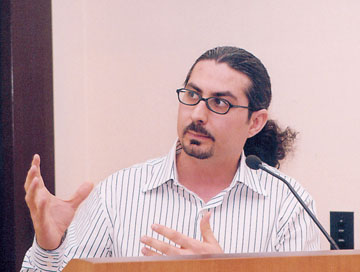
[Webshaykh’s note: Dr. Omar Dewachi, a recent graduate in anthropology from Harvard University, writes about his experiences teaching medical anthropology in Beirut. Here is the first paragraph of his essay, which can be uploaded in full as a pdf at http://www.alterites.ca/dernier.html.]

Teaching at the Margins: Experiences of Anthropology and Medicine in a Middle Eastern Setting

by Omar Dewachi, Altérités 6(2):129-135, 2009

For the last four years I have been teaching the Social Preventive Medicine (SPM) course to first year medical students at the American University of Beirut (AUB) in Lebanon. Around eighty students attend this core course, which is part of the teachin of public health within the medical curriculum. During the course of these years I have attempted to use the SPM as a platform to introduce theories and methods in medical anthropology to medical students. As both a medical doctor trained in Iraq – and an anthropologist – trained in the United States – this task has presented me with many challenges, as well as, offered me insights into tensions between the two fields. These experiences are the subject of this essay, which attempts to explore teaching at the margins of anthropology and medicine in a Middle Eastern setting. While situated at different margins, I reflect on how this course became an interesting site for exploring the complex task of teaching medical anthropology in a non-western context, while, at the same time, raising a set of paradoxes that are particular to teaching medical anthropology in a post-colonial setting. My attempt here is not to generalize my experiences or to reify the dichotomy of East and West; rather it is to situate them within their social-political, economic and historical realities.

To read the entire article in pdf, click here.