Grinding a Greater Axis of Evil


“Yemeni protesters staged a demonstration in the southern part of the country on Thursday after a raid against Qaeda militants”: Photograph from Agence France-Presse for The New York Times

In the midst of two unfinished major wars, the United States has quietly opened a third, largely covert front against Al Qaeda in Yemen. Eric Schmitt and Robert Worth, The New York Times, December 27, 2009

Terrorism takes a toll far beyond the lives lost everyday, even when a plot is thwarted. On Christmas day a 23-year-old Nigerian named Umar Farouk Abdul Mutallab attempted to set himself off as a human bomb on a Northwest Airlines flight from Amsterdam to Detroit. On the surface he hardly fit the profile of a crazed militant fresh out of a training camp in the hills of Pakistan. His father was a recently retired chairman of First Bank of Nigeria and he is an engineering student at University College London. But it now seems that his father was so concerned about his son’s politics that he warned the U.S. embassy about him just a month ago. Initial reports indicate that the explosives were said by Mutallab to be provided by al-Qaeda in Yemen. Based on this claim certain U.S. politicians, most notably Senator Joseph Lieberman of Connecticut, have called for Yemen to be added to the growing terrorist axis of evil. “So I leave you with this thought that somebody in our government said to me in the Sana’a, the capital of Yemen. Iraq was yesterday’s war. Afghanistan is today’s war. If we don’t act preemptively, Yemen will be tomorrow’s war. That’s the danger we face.” Lieberman told Fox News.

Lieberman is actually calling for Yemen to become today’s war, but the key to his thinking is best summed in another line from the same interview: “We’ve got to constantly be thinking like the terrorists here.” Well, Joe, this is the problem. You are thinking like the terrorists when you suggest going into a country you know nothing about and dropping bombs. Unfortunately, it appears we have already started doing that. Continue reading Grinding a Greater Axis of Evil
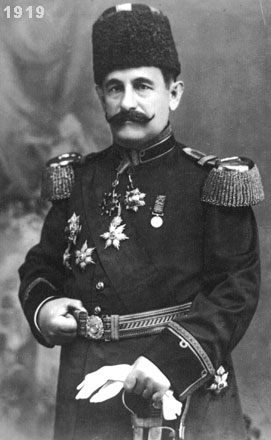
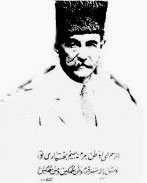
Mustafa Pasha Yamolki: From Istanbul to Suleymaniya

Mustafa Pasha Yamolki: his life and role in the Kurdish nationalist movement

by Dr. Rebwar Fatah, Kurdish Media, 2005

A king is just like a chess king today in the world.

From a poem by Shukri Fazli, Kurdish intellect, journalist and poet

There are countless Kurdish figures that have been denied due credit for contributing to the cause of their people. Mustafa Pasha Yamolki is but one. Attempting to name the others would risk missing some and history already excels at this.

Therefore, this article seeks to reveal some unknown details of Yamolki’s life and to reintroduce him after an absence that is unjustified for a human of such stature. It was a significant, but worthwhile, challenge to discover information about Yamolki. I depended heavily upon his immediate family, whose acquaintance I treasure a great deal.

Prior to his death on May 25, 1936 in the Alwazyrya area of Baghdad, Mustafa Pasha Yamolki asked to have this verse of poetry etched into his grave:

Etirsm ey weten bimrim, nebînim bextiyarî to

Binwsin ba leser qebrim, weten xemgîn u min xemgîn.

Which can be translated to:

My homeland, I am scared that I may die without seeing your happiness

Etch into my grave that my homeland and I are both sad.

Continue reading Mustafa Pasha Yamolki: From Istanbul to Suleymaniya

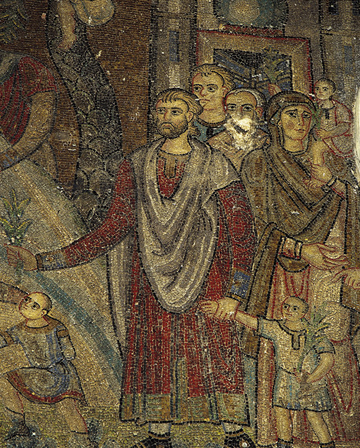
Church of the Nativity


Fresco from the Church of the Nativity in Bethlehem

The Basilica of the Nativity in Bethlehem

In 1099 a detachment of Crusaders commanded by Tancredi took possession of Bethlehem. The night of Christmas 1100 Baldwin, brother of Godefroy de Bouillon, was crowned the first king of Jerusalem in the Basilica of the Nativity, the only early Christian church in Palestine still intact on the arrival of the Crusaders. Subsequently, the Crusaders, after having fortified the sanctuary together with the surrounding monasteries, added a bell tower to the front, restored the double side entry to the Grotto under the presbytery of the basilica and built the Augustinian convent with the cloisters to its north. Between 1165 and 1169 the walls were decorated with mosaics, thanks to the collaboration between King Amalric of Jerusalem and Emperor Manuel Comnenus of Constantinople. The authors of the project were Ephraim a monk, painter and mosaicist assisted by Deacon Basilius. From the descriptions of the pilgrims we are able to determine the entire mosaic decorative cycle. The Nativity decorated the apsidiole of the Grotto, the Tree of Jesse, father of King David and progenitor of Jesus, the inner wall of the facade. On the walls a procession of Angels facing toward the Grotto at the top was followed, at the centre, by texts in Greek and Latin of the Councils in designs of the cities in which they were held, and by busts of the Ancestors of Jesus at the bottom. Scenes of the Gospel decorated the walls of the trilobate transept. Remnants of the Unbelief of St. Thomas, the Ascension, the Entry of Jesus into Jerusalem and a lone figure from the scene of the Transfiguration. Still in the crusade period the shafts of the columns were decorated with encaustic paintings from the Old and New Testaments and with Saints from the east and the west identified by texts in Greek and Latin.

Source: Holy Land of the Crusaders

Arabic Talismania

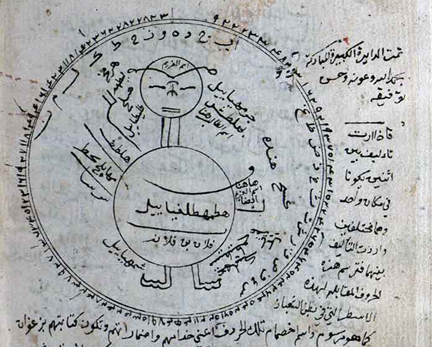
I have had always had a fascination with the variety of astrological, magical and prognosticative manuscripts available in Arabic. Living in the post-Enlightenment modernity era, we scholars tend to think of astrology as a quaint feature of past pre-scientific thinking and now abandoned the New Age enthusiasts. There are, however, thousands of Arabic manuscripts that are magical, in more than the usual sense. These offer a window, however mysterious, into the concerns and fears of the past. I recently came across an extraordinary website, Digital Occult Manuscripts, which has uploaded images of numerous Arabic occult texts. I cannot find information on who puts out the project, but it is an amazing source of documents (although usually just a few pages of each manuscript) and a joy just to browse through. Here is one of the images, a talismanic man from a 12th century text by al-Ghazali.

Illustration from السر الرباني في العالم الجثماني / al-Sirr al-Rabbani fi Al-‘alam al-Juthmani
Author: Abu Hamid al-Ghazali / أبو حامد الغزالي
Year: 505 Hijri / 1111 Gregorian
Language: Arabic
Writing style: Talik
Number of pages: 130 page

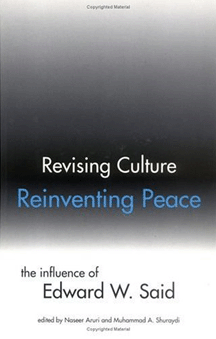
The Influence of Edward W. Said

[Webshaykh’s note: I recently came across a book review I had written several years ago, but which was never published by the journal which solicited it. As the issue is still relevant, even after publishing my critical assessment of Said’s Orientalism two years ago, I present the review as written in 2001.]

Revising Culture, Reinventing Peace: The Influence of Edward W. Said. Edited by Naseer Aruri and Muhammad A. Shuraydi. New York: Olive Branch Press, 2001. Xvi, 190 pages. ISBN 1-56656-357-7

Review by Daniel Martin Varisco

“Indeed, anywhere that intellectuals with a progressive or internationalist outlook gather on this planet, there is an awareness and appreciation of the indispensable contributions that Said has made to the life of free and independent inquiry, and beyond this, to a whole style and method of thought that takes ideas and cultures seriously as crucially linked to structures of oppression and processes of emancipation.”

If this accolade from Richard Falk’s glowing introduction to a volume of papers under the influence of Edward Said sounds good to you, this is a book you will probably enjoy. If you are looking for something new, that has not already been said or that has even a modicum of critical distance, you may want to skip this recent addition to what has become a virtual cottage industry of Saidiana. Continue reading The Influence of Edward W. Said

An Archic Sonnet


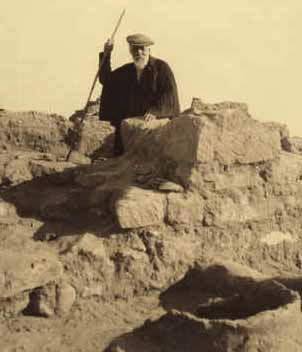
Sir Flinders Petrie, Egyptologist

An Archic Sonnet

To know what man was, ere he wrote his name,
Inscribed the laws and precepts on the rock,
And sacrificed the best lamb of the flock,
We dig the mound, and wander o’er the plain.
To learn the mysteries of the past, we fain
Would search for hidden slabs, and keep in stock
The Relics we so love. Oh, to unlock
The door, and gain an entrance to the same! Continue reading An Archic Sonnet

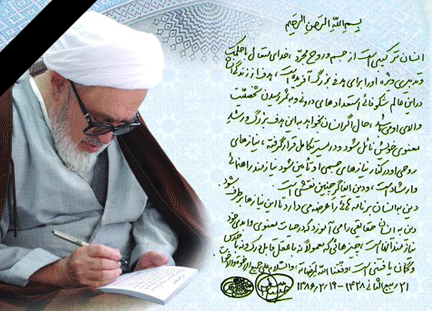
Grand Ayatollah Hossein Ali Montazeri Dies


Image of the Ayatollah from his Persian website

One of the most vocal opponents of the hardliners in the Islamic Revolution and of the recent election fixing by President Ahmadinejad was the Grand Ayatollah Hossein Ali Montazeri, who has died at the age of 87. Reports of the funeral in Qum are based on eyewitnesses, since the government of Iran has forbidden journalists to cover the burial. The New York Times has a lengthy article by Robert Wirth with the following general information:

Ayatollah Montazeri was widely regarded as the most knowledgeable religious scholar in Iran, and that gave his criticisms special potency, analysts say. His religious credentials also prevented the authorities from silencing or jailing him. Last month, he stunned many in Iran and abroad by apologizing for his role in the 1979 takeover of the American Embassy in Tehran, which he called a mistake. Iran’s leaders celebrate the takeover every year as a foundational event of the Islamic revolution. Continue reading Grand Ayatollah Hossein Ali Montazeri Dies

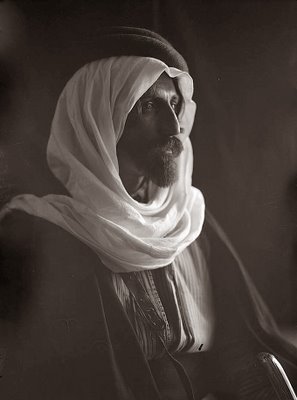
Poetry out of Arabia

[Webshaykh’s note: Dr. Saad Sowayan, as the post below will explain, has been collecting, analyzing and documenting the oral poetic traditions of the Arabian Peninsula, especially his native Saudi Arabia, since his graduate research. He has now completed two major works, available for reading on the internet, but still in search of an appropriate publisher. I invite readers to look over his impressive documentation and analysis and communicate with Dr. Sowayan any ideas that may help forward his project.]

by Dr. Saad Sowayan, King Saud University

After 10 years of continuous hard work, I managed to finish the two books, which, taking the size and importance of each, I consider to be my lifetime projects.
A) Legends & Oral Historical Narrative from Northern Arabia (1131 pages)
B) The Arabian Desert: Its Poetry & Culture Across the Ages: An Anthropological Approach (820 pages).

The first work, as its title says, is a collection of Bedouin narratives and poems relating to tribal genealogies, camel marks, tribal territories, water wells, sheikhs, warriors, tribal judges, tribal poets, personal histories, as well as narratives relating to raids and counter raids amongst tribes and other events. All of these are told by competent narrators & reciters in the various tribal dialects and all go back to pre and early 20th century. I have been engaged in taping this voluminous material during the span of the 4 years extending from 1982 up to 1985. Since 1995 I have been engaged in archiving, indexing, transcribing and editing this taped material which came to a total of several hundred hours of recorded interviews. Legends & Oral Historical Narratives from Northern Arabia (1131 pages) is the result of this effort very carefully transcribed and edited in Arabic script with full voweling tashkeel. The work comes with a very detailed table of contents and an introduction explaining the nature of the material along with some linguistic remarks and explanation of the transcription method I used. All in all, the work is a primary source on Arabian nomadic tribal culture, oral literature and vernacular language. This work constitutes a compliment to the works of P. Marcel Kurpershoek published in English by Brill in Leiden. Continue reading Poetry out of Arabia