Broken Taboos in Post-Election Iran

by Ziba Mir-Hosseini, Middle East Report Online, December 17, 2009

The on-camera martyrdom of Neda Agha-Soltan, the 26-year old philosophy student shot dead during the protests after the fraudulent presidential election in Iran in June, caught the imagination of the world. But the post-election crackdown has two other victims whose fates better capture the radical shift in the country’s political culture. One victim was the protester Taraneh Mousavi, detained, reportedly raped and murdered in prison, and her body burned and discarded. The other is Majid Tavakoli, the student leader arrested on December 8, after a fiery speech denouncing dictatorship during the demonstrations on National Student Day.

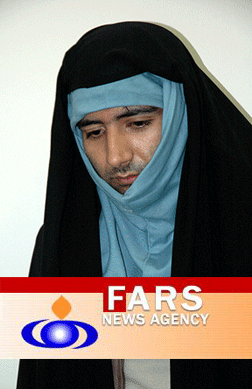
Following his arrest, pro-government news agencies claimed Tavakoli had been caught trying to escape dressed as a woman and published a series of photographs showing him wearing a headscarf and chador — a common version of the “modest” garb (hejab) mandated for women by the Islamic Republic. Attempts at flight in such gender-bending disguises are a classic trope in Iranian political history. The best-known instance was when the first president of the Islamic Republic, Abol-Hasan Bani-Sadr, after his deposition in 1981, allegedly fled the country in women’s dress — the Fars News Agency put a photo of him in a scarf next to that of Tavakoli. But in pre-revolutionary Iran clerics, too, such as Ayatollah Bayat, are said to have evaded the Shah’s authorities by concealing themselves beneath chadors, which pro-government media outlets now choose to ignore. Continue reading Broken Taboos in Post-Election Iran

Mr. Peabody and Sherman Rewrite Middle East Policy

For those of us who grew up on the Rocky and Bullwinkle show, Mr. Peabody and his not-so-bright sidekick Sherman taught us the “real” story behind history. Mr Peabody has long since retired and I suspect Sherman is still working on his B.A. somewhere, but a new episode has appeared that explains how we got into the mess in Iraq. If, as Napoleon is credited with saying, history is a pack of lies agreed upon, one might as well agree with this as with the multiple official versions.

Check it out on Youtube.

Burn those Scofield Bibles, baby


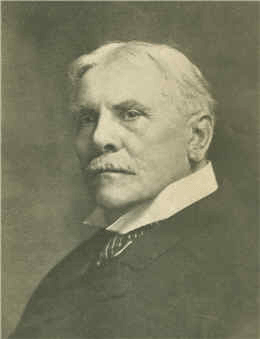
Cyrus Ingerson Scofield, 1843-1921

[Webshaykh’s Note: As someone who grew up on the Scofield Bible, I offer this critique from the peanut gallery.]

Zionism’s un-Christian Bible
Scofield Bible made uncompromising Zionists out of tens of millions of Americans.

By Maidhc O. Cathail, Middle East Online, November 25, 2009

The Boycott, Divestment, Sanctions for Palestine campaign should widen its scope to target non-Israeli companies who contribute significantly to the oppression of Palestinians. As part of this broader strategy, priority should be given to one of the most egregious offenders, the prestigious British publisher, Oxford University Press. As unlikely as it may seem, the world’s largest university press is responsible for one of the greatest obstacles to justice for Palestinians – The Scofield Bible.

Since it was first published in 1909, the Scofield Reference Bible has made uncompromising Zionists out of tens of millions of Americans. When John Hagee, the founder of Christians United for Israel, said that “50 million evangelical bible-believing Christians unite with five million American Jews standing together on behalf of Israel,” it was the Scofield Bible that he was talking about.

Although the Scofield Reference Bible contains the text of the King James Authorized Version, it is not the traditional Protestant bible but Cyrus I. Scofield’s annotated commentary that is the problem. More than any other factor, it is Scofield’s notes that induced generations of American evangelicals to believe that God demands their uncritical support for the modern State of Israel. Continue reading Burn those Scofield Bibles, baby

More than just (a) war


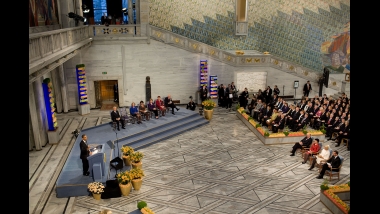
President Obama speaking to the Nobel Prize Committee

As the season has arrived in which “Peace on Earth” fills the airwaves and resonates from church choirs, the recent choice of President Obama for the Nobel Peace Prize becomes ironic as well as iconic. The icon is obvious, as no president since John F. Kennedy has elicited such fanfare at his entry into office. As the chairman of the Nobel committee, Thorbjorn Jagland, introduced President Obama, it was clear that in part the real choice was the man who pledged to reverse the isolationist and publicly entrenched private sectoring of George W. Bush. Had our previous president not been the bearer of two made-for-Hollywood wars in the guise of a nebulous “War on Terror,” Obama would have had to wait his turn. The irony is manifold. American dissatisfaction with the costly war in Iraq led to a political surge for the Democrats for a change; the man who pledged to end the war mongering is still saddled with the two wars he did not start. On the home front, the financial tsunami he inherited now tarnishes virtually every attempt to pull the economy out of its cross-the-boards harm from the combustable engine of Wall Street to the reckless drivers on Main Street.

The liberals and centrists who voted to give hope a chance have all too soon decided not to give it much of a chance. Those who actually prefer to call themselves liberals no doubt hoped that Obama was just politicking when he touted centrist positions to secure some of those Red State votes. But the man from Illinois, who kicked off his run with the symbolic capital of an earlier president-to-be from Illinois, is decidedly centrist, the mad ravings of vanity pouting Glenn Beck and publicity whoring Sarah Palin notwithstanding. If you want to probe the postmodern meaning of irony, just listen to what President Obama said about war in being honored as a man of peace: Continue reading More than just (a) war

Like a Virgin, but not for the very first time

Virginity, at least when it comes to the female of the species, is one of the most critical ethical melting points of societies in which females are burdened with a symbolic honor that denies their own control over their own bodies. The Virgin Mary in Christian theology remains a virgin, since the heavenly father of Jesus had no earthly form with which to impregnate her. Much is made in the media today about honor killings in Mediterranean societies, and in areas where more conservative forms of Islam merge with patriarchal ideology, like Pakistan and Afghanistan. Since the self righteous males who guard their sisters hymens but frequently dally with the hymens of other men’s sisters or daughters are not likely to go feminist and vote pro-choice, women must either remain strict virgins (and hope that they are not one of those women who are born with perforated hymens quite naturally) or find some chicken blood. But now the Japanese and Chinese have a more sanitary solution: a kit that allows a woman to insert an artificial hymen in only five minutes.

Where do you find such a product? It is widely sold in the Middle East, but those in America have only to click on Gigimo.com to find a Japanese kit available for $29.90 (or “suggest a price”). Continue reading Like a Virgin, but not for the very first time

Lane at your fingertips


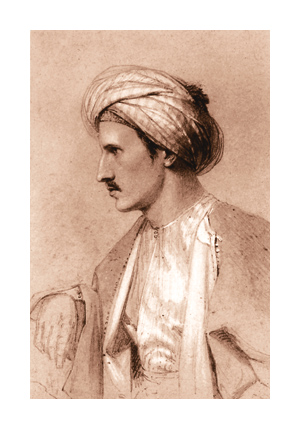
The Arabist Edward Lane

No Arabist library, for an English speaker, is complete without Edward Lane’s Arabic-English Lexicon, despite the fact it was never finished. There are several reprints out there, but now the original is available to read online. If you want to look up a word, go to http://www.tyndalearchive.com/TABS/Lane/. The text is in pdf but can be searched by root, although the server is somewhat slow to respond.

For an interesting article on the travels of Edward Lane, check out the Saudi Aramco World article.

Richard Antoun, 1932-2009


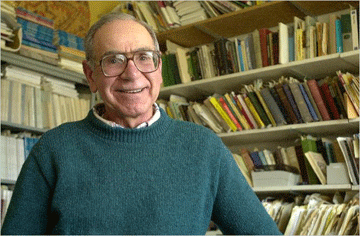
Richard Antoun

Last Friday, like many of my fellow anthropologists, I was attending the annual meeting of the American Anthropological Association in Philadelphia. I was excited to be back in Philly, where I went through the graduate program in anthropology in the 1970s. At a session on Saturday I heard the alarming news that emeritus Prof. Richard Antoun had been killed the day before. Following on the continual newsworthy but ethically unworthy chain of killings in the media spotlight, this was all the more a shock since it involved someone whose work I knew and whom I had met at previous professional meetings.

Details are emerging about who did it, but the “why” is no doubt locked away in the mind of the graduate student who committed the crime. I attach information from a memorial presented on EphBlog:

Student Held in Killing of New York Professor

A 46-year-old Binghamton University graduate student from Saudi Arabia was charged on Saturday with killing a retired anthropology professor, a specialist in Islamic and Middle Eastern studies, with whom he had worked, the authorities said. Continue reading Richard Antoun, 1932-2009