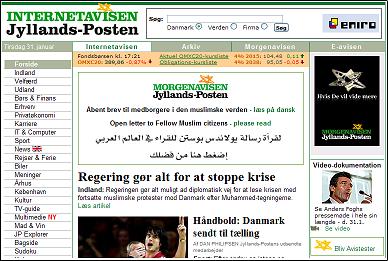
More on the Danish Cartoons

What the Danish Cartoon Controversy Tells Us About Religion, the Secular, and the Limits of the Law
By Winnifred Fallers Sullivan, Religion Dispatches, January 7, 2010

Review of: Is Critique Secular? Blasphemy, Injury, and Free Speech by Talal Asad, Wendy Brown, Judith Butler, and Saba Mahmood (University of California Press, 2009)

This very rich little book seems to me a very good place to begin the new decade. It is smart, informed, thoughtful, urgent—and properly unsettling. It is also very difficult to read quickly or to summarize in short order. It is well worth the effort.

The principal essays, by anthropologists Talal Asad and Saba Mahmood, take the Danish cartoon controversy as a starting point. They review the contexts of the publication of the satirical cartoons of Mohammed in Jyllands-Posten, a Danish newspaper, and the angry responses that ensued; they ask us to take seriously the fundamental incoherence of the assumptions about religion that underlie the dominant narratives of those events (dominant narratives that were repeated again this week in the stories about a recent attack on one of the cartoonists.) The book also includes an introduction by political scientist Wendy Brown and a response to the essays by philosopher Judith Butler. Continue reading More on the Danish Cartoons
With Kitto Illustrating Bible History

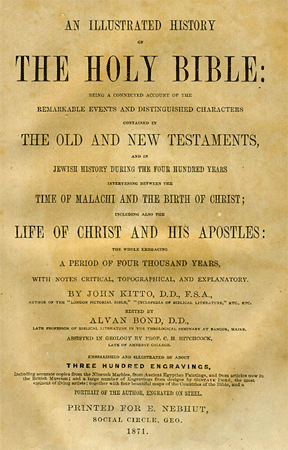
As a child I spent many inquisitive hours leafing through the books in my grandmother’s parlor bookcase. One that especially attracted my attention was John Kitto’s An Illustrated History of the Holy Bible (Social Circle, Georgia: E. Nebhut, 1871). Rev. John Kitto, recognized on the title page as author of the London Pictorial Bible, the Cyclopedia of Biblical Literature, ETC, ETC, retells the entire history of the Old and New Testament, from creation to the destruction of Jerusalem. Kitto was born into poverty in 1804 in Plymouth, England and due to an unfortunate accident ate age thirteen became entirely deaf and was forced into the poor house at the age of fifteen. This is quite an inauspicious beginning for a waif who went on to be a respected theological scholar. Through the local humanitarian efforts of several men in Plymouth, Kitto became a lay missionary to Malta and then for three and a half years in Baghdad. “While residing in that city,” writes Alvan Bond in the preface to Kitto’s book, Cairo “was visited by the plague, the terrific ravages of which swept off more than one-half the inhabitants in two months. Amidst this fearful desolation he remained calm and active at his post.” Once back in England he married and produced a travel account and several pictorial histories of the Holy Land. In 1844 the University of Giessen conferred upon him the degree of D.D. His ill health forced him to seek help in the spas of Germany, where he died after a mere half century in 1854. Continue reading With Kitto Illustrating Bible History

Toronto Talks

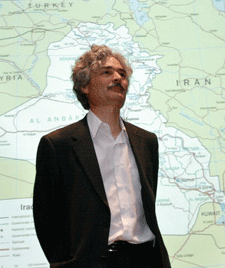
If you are reading this post today, Wednesday, I may very well be in the air on my way to Toronto, where I will be giving two lectures. Anyone who is interested is invited to attend.

Thursday, January 14th, 2010

Interdisciplinary Perspectives on Science
presents:

Daniel Martin Varisco (Hofstra University)

Star Gazing through Religious Phrasing: The Origins of a Lunar Zodiac in Early Islamic Astronomy

At Ryerson University in ENG LG14, George Vari Engineering and Computing Centre, 245 Church St. from 6:00pm to 8:00pm.

One of the most important astronomical time-keeping calendars from the Arabian Peninsula is the so-called anwâ’, which early Muslim astronomers equated with the tradition of 28 lunar stations (manâzil al-qamar). Through a study of this calendar in pre-Islamic Arabic poetry and Arabic lexical texts and by comparison to ethnographic accounts of existing Arabian star calendars, I argue that the system described in the evolving Islamic science of astronomy is one that did not arise in the Arabian Peninsula but was the result of cleansing the magical elements out of the earlier star lore and modeling this on the lunar zodiac of Sassanid Iran and India.


Refreshments will be served after the discussion.

The second talk will take place at the University of Toronto on Friday, January 15:

Anthropology Colloquium Series

Daniel Martin Varisco (Hofstra University)

The Culture Concept without a Textual Attitude: Reading against Orientalism and between the lines of Culture and Imperialism

Friday, January 15th, 2010. 2-4pm. Room 246.

Department of Anthropology, University of Toronto, AP 246, 19 Russell St.

My paper for the University of Toronto is available online as a pdf.

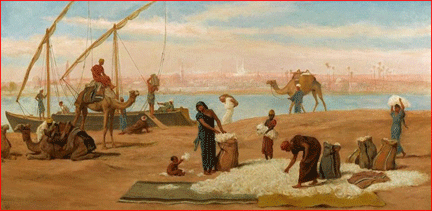
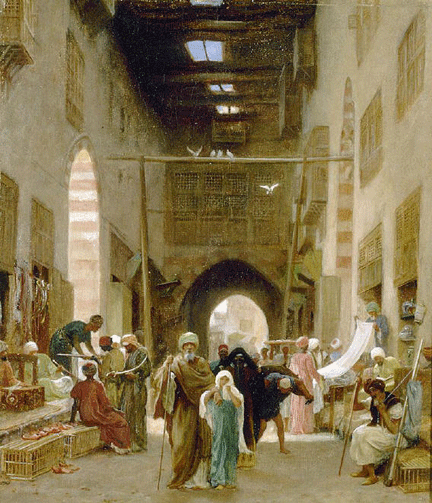
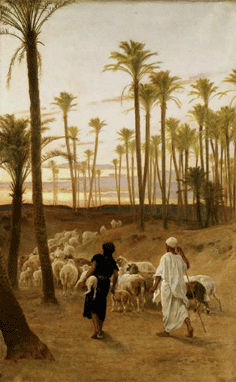
The Art of Frederick Goodall


Unloading Cotton on the Nile, painting by Frederick Goodall, mid 19th century

Attention to Orientalist paintings often ignores the lesser artists, some of whom provided valuable descriptive renderings of people and scenes. One of these is the Englishman Frederick Goodall (1822-1904), who moved to the Coptic quarter of Cairo in 1858, sharing space with Carl Haag, a drawing master for Queen Victoria. They spent much time in Bedouin camps, as well as busy suqs, where they were often treated with suspicion. After seven months in Egypt, Goodall had produced 130 oil paintings. He returned to Egypt in 1870 to make more paintings, this time with his two sons. They stayed at the house of the Egyptian archaeologist Mariette-Bey, near Sakkara. To blend in with the context Goodall grew a beard and at times dressed in white with a red fez. His work provides a meticulous “ethnographic” view of Egypt at the time.


Cairo Bazaar, 1891


The Palm Grove, 1894

On our terrorism problem

by Stephen M. Walt, Foreign Policy, January 8, 2010

Declaring that “the buck stops with me,” President Obama announced a set of new directives in response to the foiled bombing of Northwest Flight 253 by the now-infamous “underpants bomber.” The list of presidential orders is mostly unexceptionable, and may even make a repeat performance less likely. Of course, if al Qaeda is even remotely strategic, trying an exact repeat of this attempt would be silly. Instead, they’ll study the new procedures, look for holes in them, and try some new variation. The good news is that air travel will still be incredibly safe, and no sensible person should alter their normal travel plans because they are worried about the “terrorist threat.”

What’s missing from Obama’s list of new initiatives is any sense that U.S. foreign policy might need some rethinking too. There are several dimensions to the terrorism problem, only one of which are the various measures we take to “harden the target” here at home. Why? Because bombing airliners and other acts of terrorism are just tactics; they aren’t al Qaeda’s real raison d’être. Their goal, as veteran foreign affairs correspondent William Pfaff recently reminded us, is trying to topple various Arab governments that al Qaeda regards as corrupt and beholden to us and establish some unified Islamic caliphate. As Pfaff notes, this is a fanciful objective, but still one that can cause us a certain amount of trouble and grief. And if they can get us to act in ways that undermine those governments (even when we think we are trying to help them), then their objectives are advanced and ours are hindered. Continue reading On our terrorism problem

Karim Ben Khelifa in Yemen


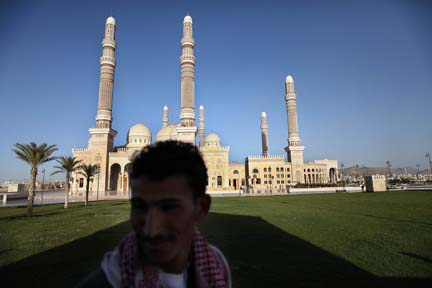
The newly built presidential mosque, which cost an estimated $60 million; photography by Karim Ben Khelifa

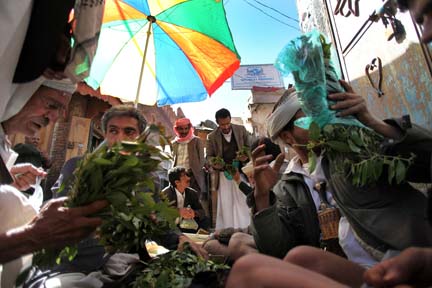
Much of the reporting on recent events in Yemen is pathetic. A rare exception is the work of photojournalist Karim Ben Khelifa, who is currently on assignment in Yemen. Thus far he has posted two sets of photographs, one on the Wall Street Journal, and the other for the New York Times. Check out these websites for superb photographs, two of which I reprint here with the permission of the photographer.


Qât market in Sanaa, Yemen; photography by Karim Ben Khelifa

Following Seward’s Folly: #2 Hopeless Arabia


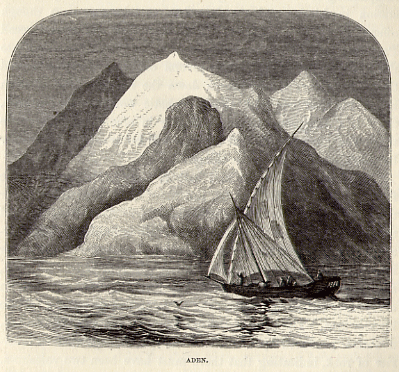
Illustration from Seward’s Travels (1873)

William H. Seward, the American Secretary of State who is forever linked with the “folly” of acquiring Alaska from the Russians, spent a year traveling around the world near the end of his life. In a previous post I recorded his comments on the British rule in India, as reported by his daughter. On April 27, 1871 the Seward party neared the Yemeni port (and British fueling station) of Aden. Here is how the approach is recorded by Ms. Seward:

April 27th. – After eight months travel in the incomprehensible East, with its stagnant civilization, we are now passing into another region still more incomprehensible and hopeless.

On the right hand is Yemen, once ‘Arabia the happy,’ and still known in poetry as a land of light and beauty, but now the dwelling of Arab hordes, who are sinking every day deeper into barbarism. On the left, wee are passing Somali, that part of Africa which stretches from Mozambique to Abyssinia. Continue reading Following Seward’s Folly: #2 Hopeless Arabia

IBLA tragedy

Institut des Belles Lettres Arabes (IBLA) in Tunis caught fire on January 5 and Father Gian-Battista Maffi was killed by the flames. Here is the information posted on the mission website:

Yesterday afternoon, Tuesday the 5th January, about 14.30, there was an explosion in the library of the Institut des Belles Lettres Arabes (IBLA), Tunis. Following the blast, a fire broke out and in spite of the rapid intervention of the city’s Fire Brigade, our confrere Gian-Battista Maffi, 54 years, who was in the library, could not be rescued. He was burnt to death, his body charred.

Police from the forensic laboratory are at work to try to determine the causes of the explosion and the fire.

We join in the sorrow and grief of Gian-Battista’s mother, family and friends. Let us pray for our deceased confrere, for all his confreres in Tunisia and Italy, and for the members of the Pre-Capitular Assembly preparing to begin its work tomorrow the 7th January at Tunis.

José Cantal, Provincial of the Maghreb, is on the spot. He is in the process of organising the funeral at a date yet to be fixed.