On the loss of his grandfather


King Hussein with Queen Noor, 1985; Photograph by Carol Spencer Mitchell

[Webshaykh’s note: Carol Spencer Miller (1954-2004) worked as a photojournalist in the Middle East, covering the crises there for some of the major American and european journals and newspapers. She had access to the elites, including King Hussein and Yassir Arafat, as well as ordinary people. Although she died before publishing her reflections on this experience, her book has been edited by her sister as Danger Pay: Memoir of a Photojournalist in the Middle East, 1984-1994 and is now available as an intriguing first-person memoir of events that seem to recycle more than disappear from the news cycle. I provide here a second excerpt about her interview with King Hussein about the murder of his grandfather in which he himself was almost killed.]

On the Loss of His Grandfather

CS: What do you remember about the day your grandfather was assassinated?

KH: (He is silent for a moment,) You want me to go through the whole experience? I remember it very vividly … very vividly. (He is silent again.)

My grandfather was everything to me – a father, an example – who a few days before had asked me a strange question, which I’ve tried to live up to ever since. He asked me to ensure that his work was no lost and that I would continue to serve the Arab nation and this country as he had done. That particular day, I went with him to the city of Nablus because people insisted that we spend the day with them. We had the intention to go pray at the Al-Aqsa Mosque. I remember being in the uniform that he insisted I wear that morning. It was the only one that I had. I remember the meeting that he had in Jerusalem with certain Palestinians that fateful Friday. I remember him speaking about his relations with some of them. The fact that his differences with people were not always of a personal nature, but were matters of policy and approach. I remember him speaking of death and that he wished he would go while he was still in possession of his faculties and the best way in his view would be from a bullet from an unknown assailant. Continue reading On the loss of his grandfather


IUAES Conference in Turkey

The 2010 IUAES Inter-Congress Antalya, Turkey

The Ahi Evran University Department of Anthropology is proud to announce to you the 2010 IUAES (International Union of Anthropological and Ethnological Sciences) Inter-Congress to be held October 3-6 2010 in Antalya, Turkey.

Since our approval to host the congress, preparations and arrangements have been conducted in collaboration with various anthropology departments, professors, and graduate students across Turkey. Our collaborative efforts promise to bring a diverse, exciting, and informative Inter-Congress.

Turkey’s location at a point where three continents of the old world are closest to each other and where Asia and Europe meet has served as a crossroads that is one of the few areas that has been continuously inhabited since the dawn of mankind. The archeological richness is a telling measure of the human history of cultural interaction, conflict, and integration that shape the region. Since the founding of the Turkish Republic in 1925 anthropology as a discipline has assumed an important role in understanding and theorizing cultural exchanges between ethnically, linguistically, and religiously diverse Anatolian peoples and their neighbors; we are honored to strengthen this legacy with IUAES. Continue reading IUAES Conference in Turkey

God is my co-sniper

Not since Tammy Faye Baker embroidered Bible verses on her underwear has there been as eye-opening a scriptural scandal as the recent revelation that an American manufacturer routinely engraves Bible verses on U.S. military gun sights. As reported earlier this week, the Michigan-based corporation Trijicon has supplied the gun sights used by American marines to aim at and shoot the Taliban and their sympathizers in Afghanistan. The company may now be in quite a few critics’ sights given the new publicity. The Wikipedia entry already details the controversy. But the main company website has nothing to say. In the detailed descriptions of the gun sights on the website the biblical abbreviations are nowhere in sight. But it does say that “Trijicon self-luminous night sights are proven to give shooters five times greater night fire accuracy- with the same speed as instinctive shooting.” Five times, got it? Try MARK 6:38 (do look this up) and don’t forget the fishes. It may very well be that the procurement officers never noticed the addition of gospel acronyms after the serial numbers, but the company is not shy about its Christian views: “We believe that America is great when its people are good. This goodness has been based on biblical standards throughout our history and we will strive to follow those morals.”

The actual verses are not inscribed, only the chapter and verse in code. It appears that all of the verses are from the New Testament, so at least it cannot be claimed to be a Zionist plot (or perhaps it could be said to be a very clever Zionist plot…). I have no idea how many verses have appeared on the 800,000 units contracted for $660 million by the U.S. Marine Corps. I suspect that MATT 5:44 (do look it up) is not one of them. Perhaps the Sermon on the Mount is not part of what the company defines as “biblical standards.” Continue reading God is my co-sniper

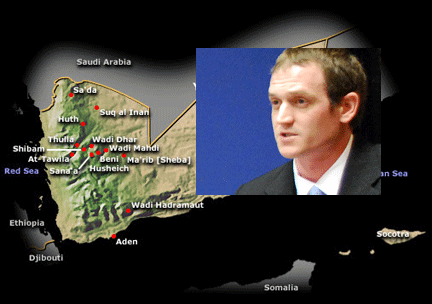
Greg Johnsen on al-Qaeda in Yemen

Welcome to Qaedastan
by Gregory D. Johnsen, , Foreign Policy, January/February, 2010

In 2010, Yemen will celebrate the 20th anniversary of national unification. But it won’t be much of a party: This could well be the year Yemen comes apart.

Even the brutal 1994 civil war failed to threaten the structural integrity of this country chronically teetering on the verge of disintegration as much as the current crises, all of which may be coming to a head in 2010.

Yemen has so many dire problems that it’s easy to be overwhelmed. Al Qaeda is growing in prominence, a Shiite rebellion is expanding in the north, and the threat of secession is renewed in the south. There’s a brewing fight over what comes after President Ali Abdullah Saleh, age 67, who has ruled Yemen for 31 years; the country’s elites are locked in a closed-door struggle to take power once he departs. Finally, and perhaps most intractably, Yemen is an environmental and resource catastrophe in the making. The country’s water table is nearly depleted from years of agricultural malpractice, and its oil reserves are rapidly dwindling. This comes just when unemployment is soaring and an explosive birthrate promises only more young, jobless citizens in the coming years. Continue reading Greg Johnsen on al-Qaeda in Yemen

On Yemen (and some a bit off)


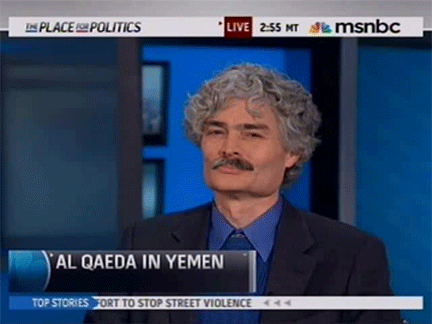
Varisco interviewed about Yemen on MSNBC, January 16

For the past week or so, just before the terrible human tragedy in Haiti, Yemen was once again a front page news story in the Western media. This time it was not about qât, nor about the rhino horn used in Yemeni dagger hilts, but the issue was exotic nevertheless. Yemen is newsworthy because of the recent attempted suicide mission of a Nigerian who met with members of the relatively recently reframed Al-Qaeda in the Arabian Peninsula. At first, the political talking heads were eager to brand Yemen as a lawless tribal haven for the next stop of our continuing war on terror. Joe Lieberman added Yemen to his own version of the axis of evil, which I have previously commented upon. But then late last week Yemeni officials announced that six al-Qaeda figures had been killed in an airstrike, and on Saturday three more had been arrested near the Saudi border.

On Saturday, on my return from delivering two lectures in Toronto, I went straight from the airport to MSNBC, where I was interviewed (if that term works for about two minutes of air time) about the recent strikes on al-Qaeda in Yemen. Earlier in the week, I sat down for an extended interview on the current situation in Yemen with Karla Schuster of Hofstra University, an interview which can be seen on Youtube. Continue reading On Yemen (and some a bit off)

Following Seward’s Folly: #3 Confederates in Cairo


Illustration of Cairo from Seward’s Travels (1873)

William H. Seward, the American Secretary of State who is forever linked with the “folly” of acquiring Alaska from the Russians, spent a year traveling around the world near the end of his life. In two previous posts I posted the comments he and his daughter made about India and Aden, but their trip continued up the Red Sea to Egypt. While in Cairo, Mr. Seward received the esteemed protocol of a traveling diplomat, but in Cairo there came a most civil surprise:

The Americans in Egypt are a mixed though interesting family. The Khédive is reorganizing his army on the Western system of evolution and tactics. Continue reading Following Seward’s Folly: #3 Confederates in Cairo

How I Almost Became a Terrorist


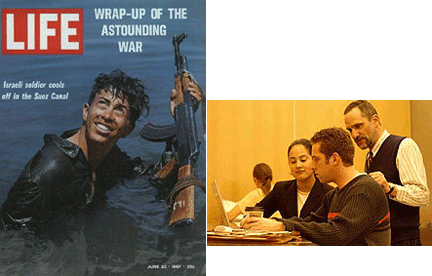
left, 1967 cover of Life Magazine; right, Dr. Alan Singer in the classroom

How I Almost Became a Terrorist
Not Everyone Who Opposes U.S. Policy is a Fanatic

By ALAN J. SINGER, CounterPunch via Maiz Centeotl Chicomecoatl, January 7, 2010

In May 1967 I was a seventeen-year old high school senior and a not particularly religious Jew. I was born in New York City, as were my parents, although my grandparents were immigrants from Eastern Europe. My family strongly identified with the state of Israel and at the time my stepmother was visiting her brother who had emigrated there to fight for independence after serving in the U.S. army during World War II.

The survival of Israel as a Jewish state was important to my identity and the identity of my friends and family members. My friends, siblings, cousins, and I grew up in the shadow of the Holocaust and we had family members who were murdered. Jews had been victims for two thousand years but the survival of Israel meant we would be victims no more.

As the crisis in the Middle East intensified Americans were evacuated. My father and I spent a night at Kennedy Airport waiting for my stepmother to return home. The next morning two friends and I went to the Jewish Agency to sign up to go to Israel as volunteers in the event of war. We hoped to fight but said we would do anything that was needed.

On June 5, 1967 Israel launched a preemptive strike. The Third Arab-Israeli War lasted six days and ended with a resounding Israeli victory. American volunteers were not needed so we never went. But we would have gone and we would have fought for the survival of Israel and of Jews, whether the United States government gave permission, looked the other way, or even if it tried to stop us.

I am no longer a Zionist and I have not supported Israeli policy, especially the occupation of the West Bank and Gaza, since the 1973 Arab-Israeli War. I now see Israel as the aggressor in the region, but that is not the point. Continue reading How I Almost Became a Terrorist