Know Your Customers First

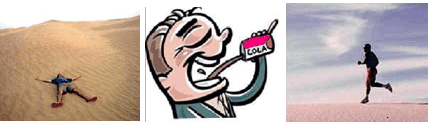
A disappointed salesman of Coca Cola returns from his Middle East assignment. A friend asks him: “Why weren’t you successful in Saudi Arabia? The salesman explained, with a sigh: “When I got posted in the Middle East, I was very confident that I would make a good sales pitch as our cola is virtually unknown there. But, I had a problem. I didn’t know how to speak Arabic. So, I planned to convey the message through three posters, like this:

Continue reading Know Your Customers First

Islamic Folk Astronomy #2

Time Reckoning

Era means a definite space of time, reckoned from the beginning of some past year, in which either a prophet, with signs and wonders, and with a proof of his divine mission, was sent, or a great and powerful king rose, or in which a nation perished by a universal destructive deluge, or by a violent earthquake and the sinking of the earth, or a sweeping pestilence, or by intense drought, or in which a change of dynasty or religion took place, or any grand event of the celestial and the famous tellurian miraculous occurrences, which do not happen save at long intervals and at times far distant from each other. Al-Bîrûnî (1879:16)

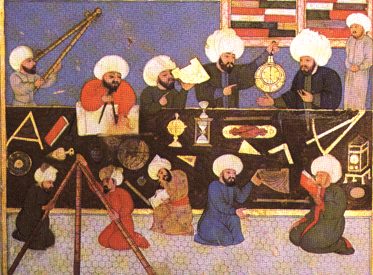
Time is relative. Given the modern world’s reliance on formalized calendars and machines that define time for us, it is easy to forget that the expansion of Islam occurred at a time when telling time was not dependent on a formal science of astronomy. How time is measured is not only a practical issue but also reflective of the desired interval of duration and the precision in defining it. Simple observation of the sun rising and setting, as well as its location, can easily yield calendars to determining hours, days, months and years. Similarly, the moon’s phases made it a useful measure for the Islamic lunar calendar. Observations of movements by the stars, as well as the planets, also provided practical ways of measuring units of time both short and long. Continue reading Islamic Folk Astronomy #2

Why does this land make me quiver?

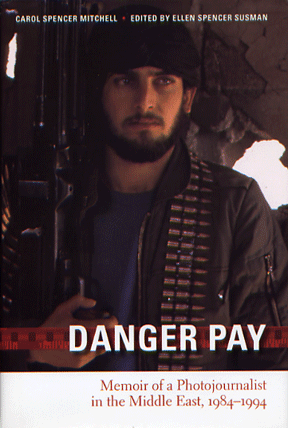
[Webshaykh’s note: Carol Spencer Miller (1954-2004) worked as a photojournalist in the Middle East, covering the crises there for some of the major American and european journals and newspapers. She had access to the elites, including King Hussein and Yassir Arafat, as well as ordinary people. Although she died before publishing her reflections on this experience, her book has been edited by her sister as Danger Pay: Memoir of a Photojournalist in the Middle East, 1984-1994 and is now available as an intriguing first-person memoir of events that seem to recycle more than disappear from the news cycle. I provide here an excerpt about her feeling of disorientation reporting on the Israeli/Palestinian issue.]

It grows increasingly unclear to me why people call this a “Westernized” country. the phones don’t work, the press is censored, there are guns everywhere. I am perpetually uneasy. How, I wonder, can anyone relax when wherever you look, there is someone toting or pointing a machine gun? they casually rest across shoulders, carried by anybody who wants to. Will I get used to the sight of civilians wearing sandals, shorts, T-shirts, and Uzis. in movie theaters, at the supermarket, at shopping malls, and at bars? They aren’t frightening as much as disconcerting.

This is a difficult country to get accustomed to. There are bomb shelters in homes and children’s playgrounds, security at every store, the ever-present notion of “security reasons,” the way people dress, as if they don’t give two hoots about appearance (they don’t). Restaurants and movies open on Fridays are stoned by the ultra-Orthodox Haredim. Continue reading Why does this land make me quiver?

Arab Music on American Soil

Arab Music on American Soil: How Music blends Arab Heritage with American Culture

by el-Sayed el-Aswad, United Arab Emirates University

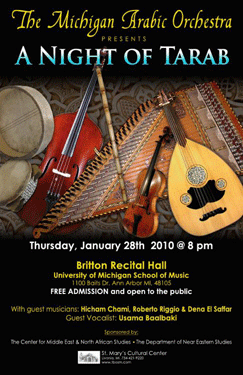
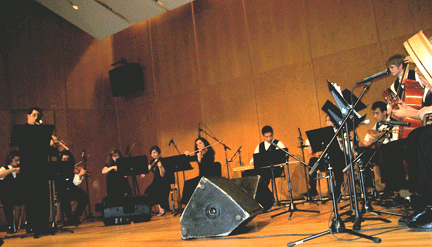
Music is the key not only to understanding various ways of cultural expression and social communication, but also to comprehend peoples’ views of their identities and heritages. In her book, Philosophy in a New Key (1942), the American philosopher, Susanne Langer, states that music is a highly articulated mode of expression symbolizing intuitive acquaintance of patterns of existence or life that regular language cannot express. For her, music represents the composer’s knowledge of the morphological and symbolic forms of emotional life. Such statements were embodied in the behavior of both the musicians and audience participating in A Night of Tarab, organized by the Michigan Arabic Orchestra, on Thursday, January 28, 2010 at Britton Recital Hall, University of Michigan, Ann Arbor.


Michael Ibrahim, playing the flute (nay), with the ensemble

Continue reading Arab Music on American Soil

Islamic Folk Astronomy #1


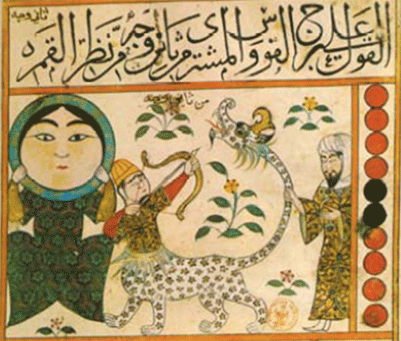
from Ibn Balkhi’s manuscript on astronomy, 850 CE

It was He that gave the sun his brightness and the moon her light, ordaining her phases that you may learn to compute the seasons and the years. He created them only to manifest the truth. He makes plain His revelation to men of understanding. Yûnus 10:9 (Dawood 1968:64)

When the Quran was revealed in seventh century Arabia as the basis for Islam, references were made to the sun, moon and stars as evidence of the creative power and practical foresight of God. The idea that God, or a particular god or goddess, had created the visible heavens was not unique. Creating stories about astronomical phenomena is as old as the first civilizations that appeared in the ancient Near East. Some of these survived, in highly edited variants, in the scriptures of Judaism and Christianity. As Muslim science evolved, a variety of religious and scientific knowledge from classical Greek texts, as well as Zoroastrian and Hindu sources, was encountered. While the influence of these classical and textual traditions on Islamic astronomy has been the focus of much previous study on the history of Islamic science, little attention has been paid to the oral folk traditions of peoples who embraced Islam. How ordinary Muslims viewed the same heavens visible to educated scientist or illiterate shepherd is the subject of this chapter. For practical reasons the focus here will be on the Middle East, especially the textual information on the pre-Islamic Arabs of the Arabian Peninsula and contemporary tribal groups in the region.

What is Islamic Folk Astronomy?

It is unfortunate that many times the idea of “folk astronomy” is understood mainly by what it is not. Continue reading Islamic Folk Astronomy #1

Following Seward’s Folly: #4 The Dome of the Rock


Illustration of Cairo from Seward’s Travels (1873)

William H. Seward, the American Secretary of State who is forever linked with the “folly” of acquiring Alaska from the Russians, spent a year traveling around the world near the end of his life. In three previous posts I posted the comments he and his daughter made about India and Aden, and Egypt. The journey continued to Palestine and the city of Jerusalem:

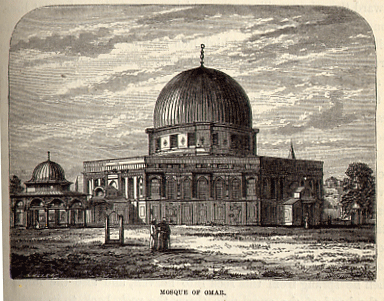
Yussef Effendi, with the brother and secretary of the pacha, attended us to the Mosque of Omar. It is only within the last five years that this mosque, scarcely less sacred in the eyes of Mussulmans than the Church of the Holy Sepulchre is in ours, has been opened to Christian travelers. Even now a careful, though somewhat disguised surveillance, is practiced over them. The mosque stands in an area enclosed with a high, parapeted wall, overlooking the vally of Jehoshaphat, and confronting the Mount of Olives. This occupies one-sixth of the land of the entire city. On the eastern side of this wall is a gate-way, built of marble, called by the Mussulmans the “Golden Gate,” which they are fond of representing as the “gate of the temple called Beautiful,” but its modern architecture does not support that claim. It is only interesting from the tradition that it was closed with the Roman conquest, and has never been reopened. The so-called Mosque of Omar is not single. It consists of two distinct mosques, placed at some distance from each other – the one here named Kubbet-es-Sukhrah, or “the Dome of the Rock,” commonly called the Mosque of Omar, and the Mosque-el-Aqsa. Though differing entirely from the Church of the Holy Sepulchre, the Mosque of Omar is not less unique and peculiar in its sacred antiquities. Twelve hundred years ago, on the surrender of the Greek Patriach, the Caliph Omar demanded to be shownt he site of the Jewish temple. He was taken to the sacred rock, he knelt and prayed over it, and he built over it a mosque, which, with subsequent repairs, is the present “Dome of the Rock,” or Mosque of Omar. In architectural design and execution it rivals the finest in Cairo and Constantinople. Continue reading Following Seward’s Folly: #4 The Dome of the Rock

Eurabian Follies

Eurabian Follies
The shoddy and just plain wrong genre that refuses to die

by Justin Vaïsse, Foreign Policy, January/February, 2010

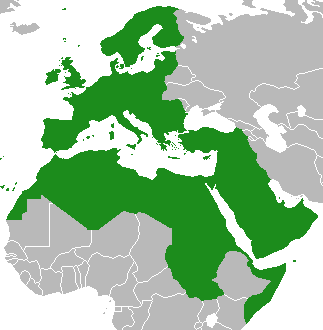
By 2050, Europe will be unrecognizable. Instead of romantic cafes, Paris’s Boulevard Saint-Germain will be lined with halal butcheries and hookah bars; the street signs in Berlin will be written in Turkish. School-children from Oslo to Naples will read Quranic verses in class, and women will be veiled.

At least, that’s what the authors of the strange new genre of “Eurabia” literature want you to believe. Not all books of this alarmist Europe-is-dying category, which received its most intellectually hefty treatment yet with the recent release of Christopher Caldwell’s Reflections on the Revolution in Europe, offer such dire and colorful predictions. But they all make the case that low fertility rates among natives, massive immigration from Muslim countries, and the fateful encounter between an assertive Islamic culture and a self-effacing European one will lead to a Europe devoid of all Western identity.

For the rest of this much longer article, click here.


Justin Vaïsse is senior fellow at the Brookings Institution’s Center on the United States and Europe and co-author of Integrating Islam: Political and Religious Challenges in Contemporary France.