Dro[w]ning life, liberty and the pursuit of not being targeted


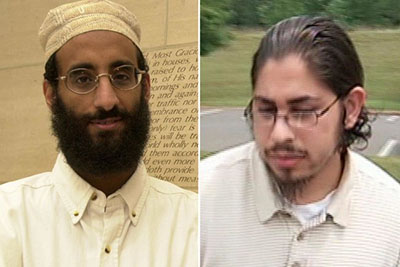
Anwar al-Awlaki, left, an operative in Al Qaeda’s Yemeni branch, was targeted in a strike that also killed Samir Khan, the creative force at a militant Web magazine. Both were Americans; Left, Linda Spillers for The New York Times; right, WBTV, via Associated Press

Today’s New York Times features a major article by MARK MAZZETTI, CHARLIE SAVAGE and SCOTT SHANE entitled “How a U.S. Citizen Came to Be in America’s Cross Hairs.” Actually the article discusses how three American citizens were the victims of drone attacks in Yemen in late 2011. The primary target was Anwar al-Awlaqi, who is described in the article as “the firebrand preacher, born in New Mexico, who had evolved from a peddler of Internet hatred to a senior operative in Al Qaeda’s branch in Yemen.” He was a socially mediated firebrand, far better known for his English than having an impact on recruiting terrorists in Yemen. Killed in the same after-breakfast attack was Samir Khan, “the creative force behind Inspire, the militant group’s English-language Internet magazine” and someone (basically a propaganda journalist) who was not considered important enough to specifically target. The article continues: “The next month, another drone strike mistakenly killed Mr. Awlaki’s 16-year-old son, Abdulrahman, who had set off into the Yemeni desert in search of his father. Within just two weeks, the American government had killed three of its own citizens in Yemen. Only one had been killed on purpose.” The 16-year old fell victim to a botched targeting:

Then, on Oct. 14, a missile apparently intended for an Egyptian Qaeda operative, Ibrahim al-Banna, hit a modest outdoor eating place in Shabwa. The intelligence was bad: Mr. Banna was not there, and among about a dozen men killed was the young Abdulrahman al-Awlaki, who had no connection to terrorism and would never have been deliberately targeted.

The drone issue has recently resurfaced, most notably in Mr-Rand-Paul-goes-to-Washington’s 13 hour filibuster. Continue reading Dro[w]ning life, liberty and the pursuit of not being targeted →
Central Asian and Middle Eastern Numismatics Seminar


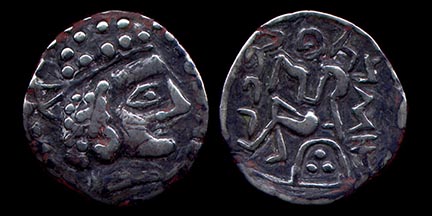
‘Great Ruler of Sogdiana, of the Tchao-ou Race’/Alram’s ‘Imitationsgruppe V’
Yueh Chih Principality of Sogdiana AR Tetradrachm, 130 BCE – 80 CE

The Fifth Seminar in Central Asian and Middle Eastern Numismatics in Memoriam Boris Kochnev will be held at Hofstra University on Saturday, March 16, 2013.

This seminar is free and open to the public. Hofstra is located in Hempstead, NY, easily accessible from NYC by the Long Island Railroad. For directions click here or here. The seminar will be held in Breslin Hall, room 112. For more information, contact Aleksandr Naymark or Daniel Martin Varisco.

Seminar Program:

10:00 am
Daniel Varisco (Hofstra University)
Opening Remarks

10:15
Vadimir Belyaev (Zeno.ru, Moscow) and Aleksandr Naymark (Hofstra University)
Archer Coins from South Sogdiana (1st – 3rd centuries C.E.)

10:45 pm
Pankaj Tandon (Boston University)
Notes on Alchon Coins

11:15 pm
Waleed Ziad (Yale University)
The Nezak – Turk Shahi Transition:
Evidence from the Kashmir Smast (mid 7th c. C.E.) Continue reading Central Asian and Middle Eastern Numismatics Seminar →

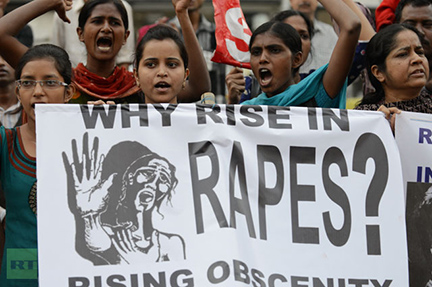
Rape and the Gender Gape

For International Women’s Day, it is important to reflect on issues that are of significant impact on women around the world. Let’s start with a beginning, the Genesis one. The original creation story familiar to Judaism, Christianity and Islam starts out with man alone. Not only is the first man not like other animals, which he has no problem naming, but he has no family: no nurturing mother, no moral father, no brothers or sisters. He was formed as a lump of clay with breath and a spirit connection to the divine. Even the presence of God, his creator father figure, was not enough for this lonely man. Surely this garden paradise was hell for the man alone.

So God put Adam to sleep, extracted a rib and fashioned a woman to be his mate. But again this was still a fool’s paradise with no other human beings around the first pair. No doubt it was less boring, but there seem to have been few challenges for the couple, since everything they needed (except clothes which were not yet fashioned) were at hand. Yes, they had each other, but apparently only as a brother and sister might. Until that fruitful day when Eve bit into the knowledge of good and evil, it must have been boring beyond belief. Disobedience by the pair, something quite normal for all children who could hardly know better, led to a disaster for the first couple, their children and all children ever after. So the story goes. Hell would now shift from the lonely boredom of Paradise to the sweat and blood reality of a world where both had to work for a living.

The gender gap, foretold in the curses on Adam and Eve, has many variants, but the vast majority of societies give the male precedence. Post Eden became a man’s world, where brother kills brother and the line of begats is male to a fault. One assumes all this begetting involved sex, but the opening chapters of Genesis are strangely silent about sex. One can understand the desire not to draw attention to the original incest, but one wonders about the libido of these descendants of Adam and Eve. By the time of Noah sex is a serious issue, one in which the “sons of God” saw that the “daughters of men” were “fair”, at least in the sense of fair game. So when we are told “And God saw that the wickedness of man was great in the earth, and that every imagination of the thoughts of his heart was only evil continually” (Genesis 6:5), we have finally arrived at and beyond what might be called the gender gape. Continue reading Rape and the Gender Gape →

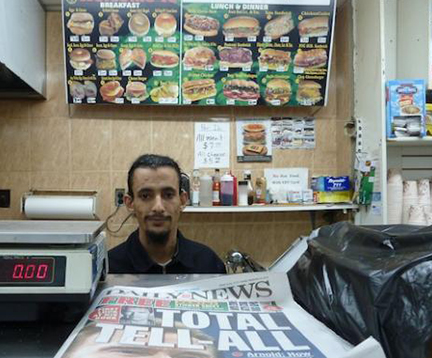
Bodega Yemeni Style in Brooklyn


Photo by Kiran Sury

Yemeni Immigrant Saga
Every time you buy a beer or a lottery ticket at a bodega run by Mohamed Mohamed or one of his countrymen, you tap into a story of ethnic succession and a struggle to reconcile one culture with another

by Kiran Sury, The Brooklyn Bureau, Monday, Jan 7, 2013

On the corner of Flatbush Avenue and Glenwood Road in Brooklyn, Mohamed Mohamed runs Gold Star Deli Grocery with his father Mohamed and another employee, also named Mohamed, all of them from Yemen. This unique situation arises from Arabic nomenclature. “The customers get confused, but not us,” jokes the younger Mohamed. His father, whose full name is Mohamed Abdullah Alrohani, has come up with a more pragmatic solution: just call him Alex.

Across Glenwood Road, Sadek Almontaser mans the counter of the recently opened Glenwood Deli, a corner store. Cigarettes are sold behind the counter, drinks and chips line the walls, and a small deli section offers fresh sandwiches – staples for any bodega.

But to the discerning eye of a corner-store connoisseur, there are several features that are not so standard.

As Almontaser deals with a steady stream of lottery ticket buyers, he happily discusses how Iranian President Mahmoud Ahmadinejad isn’t a bad man, just misunderstood. His uncle Ali, who runs the deli station, is 11 years his junior, a genealogical feat made possible by his grandfather’s four wives back in Yemen. Ali will be happy to make you a BLT, though he may forget to mention that the bacon is made of beef, not pork. And every so often a man will enter the store, nod to Almontaser, and make his way downstairs. Not every bodega has a prayer room in the basement.

Across the street yet again, on the other side of Flatbush Avenue, the eponymous Yafai Deli and Grocery is run by Saad Yafai. He shares it with his brother Nabil, who is currently back home in Yemen. His entire family is in Yemen, and he and his brother take turns staying in America and running the family store.

Most New Yorkers would agree that the deli/convenience store, once the exclusive purview of Jews, Italians and Germans, has come to be associated with Latinos. The word bodega, which is used interchangeably with deli, is Spanish for “warehouse” or “cellar”. According to data from the Brooklyn Chamber of Commerce, the number of firms in the borough classified as supermarket or convenience stores almost doubled during the first decade of this century. But the three stores on the corner of Glenwood Road and Flatbush Avenue show that Latinos are no longer dominant, as shifting demographics have opened up a new ethnic segment of the market. An influx of Arabs has brought a corresponding increase in Arab storeowners, each eager to pursue his own version of the American Dream.

* * * * *

Clifton Clarke, professor of finance and business management at Brooklyn College, says that shifting populations opened a void for new businesses to fill, and that companies often change according to their target market. When Arab immigrants started to populate new neighborhoods, it made sense for them to manage the corner stores as they could better cater to Arabic needs. “Ethnicity, population, drives the type of businesses that are developed,” he says. “And these bodegas, which are now mostly run by Arabs, just fit in nicely.” Continue reading Bodega Yemeni Style in Brooklyn →

The Price of Freedom


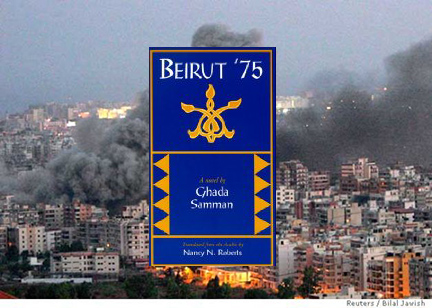
The Price of Freedom: A Reading of Ghada al-Samman’s Beirut ’75
by George N. El-Hage, Ph.D.

“Beirut has ruined me, that’s all!”

“That’s not true,” he replied, “You women all accuse Beirut of ruining you when the truth of the matter is that the seeds of corruption were already deep inside you. All Beirut did was to give them a place to thrive and become visible. It’s given them a climate where they can grow.”

“She wondered to herself…if they had allowed my body to experience wholesome, sound relationships in Damascus – would I have lost my way to this extent?”

A sense of alienation, pessimism, and ultimate nihilism, which stems from al-Samman’s existential viewpoint, envelops the main characters in Beirut ‘75. The protagonists (Yasmeena, Farah, Ta’aan, Abu’l-Malla, and Abu Mustafa) feel trapped, alone, and disconnected from each other and from society. Each character’s personal struggle sheds light on some negative aspect of Lebanese society as seen by al-Samaan in 1975. Each character is exploited in some way, either sexually, politically or economically. Although these underlying evils of Lebanese society may have existed, al-Samman only shows a unilateral view colored by her own perception of reality. She fails to offer a multidimensional and more realistic view of the society at that time. In addition, she fails to successfully convey the depth of existential crisis that each of her characters endures, consequently resulting in characters that remain shallow and who do not convince the reader that their tragic demise is warranted.

The first chapter of the novel repeatedly foreshadows the characters’ impending doom; nevertheless, the reader is still left with a sense of bewilderment at such an astonishing and violent end to an otherwise ordinary set of characters. Did they really merit such a catastrophic conclusion of events? Several reviews have been very critical of such a sensational conclusion, and some critics, as well as many readers, have been shocked and dismayed. The author loves to admit, though, that she herself was puzzled with this conclusion as she tries to justify it to the public: Continue reading The Price of Freedom →

History Channeling “The Bible”

Hollywood loves making biblical movies and once in awhile there is one worth watching. Last night the so-called “History Channel” premiered a 10-part series with the novel title of “The Bible.” To cut to the chase, this is a really awful cinematic flop. It is definitely not worth watching, no matter what you think about the Bible as history. The first episode starts with Noah brandishing a Scottish accent in a leaky ark with pairs of animals, like giraffes, in the background. How giraffes migrated to Mesopotamia where Noah lived is, for historical accuracy, better left unmentioned. In between plugging up holes in the shittim wood, with water swirling in the air around the inside of the box-like ark, Noah tells the story of creation, day by day. We get a glimpse of Adam and Eve, but not with any full body frontal nudity. Our first sight of Adam is a guy literally caked with mud, not the dust of the ground. How Eve got there is left out. The bashed-in head of Abel is shown, but no one delivers the classic line “Am I my brother’s keeper?”

The story jumps from Noah to Abraham, who convinces Lot to drag his wife along as the “tribe” moves to the promised land. The actor for Abraham could have taken lessons from Mel Brooks, who had Moses down pat in History of the World, Part One. There is a lot of hugging, but for the most part God is absent from the life of Abraham. Why anyone would want to believe in this bullying absentee creator is a mystery. Then one day three messengers appear, one looking Asian and another looking African and all three with full body armor. When Abraham hears that wicked Sodom is about to be destroyed, he asks the messengers to save Lot and his family. Sodom is a steamy and seedy place with little evidence that the young looking Lot was actually made into a judge and sat at the city gate. Good King Melchizedek of Sodom, who was saved by Abraham, is left out of the cast. Nor is the command for Abraham to circumcise, the sign of the covenant and a rather important part of the story, included. Beyond the drunken street carousing in Sodom, Lot’s willlingness to send out his virgin daughter rather than give up the messengers he had given shelter to is missing. He hardly needed to offer his daughter, as in this film the Asian looking messenger is a martial arts specialist and slices his way through the streets with Lot and family, after letting Jehovah (it is hard to tell because God is off camera much of the time) blind the evil doers. Lot’s wife turns into a pillar of salt, a historical item one should probably take with a pillar of salt, but the incest of Lot with his daughters in the case is conveniently omitted. Continue reading History Channeling “The Bible” →