To kiss or not to kiss: Iranian style

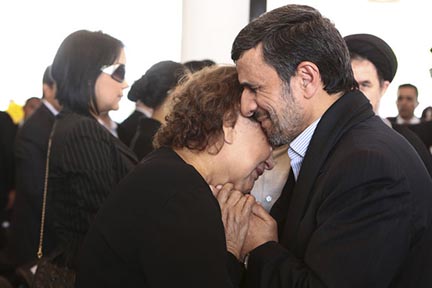
A controversial tempest in a samovar erupted last week when Iran’s President Ahmadenijad appeared to kiss the grieving mother of Hugo Chavez at the state funeral for the Venezuelan leader. The lips do touch the face of Chavez’s mother, but the context suggests an embrace of consolation rather than anything untoward. To the extent this innate human reaction of sympathy is something to be forbidden as unIslamic, religion becomes a mockery. The Muhammad presented in the Sira was a man of compassion. I suspect he would not approve of those who take the charge of modesty to such an extreme as to deny the most basic of positive human instincts.

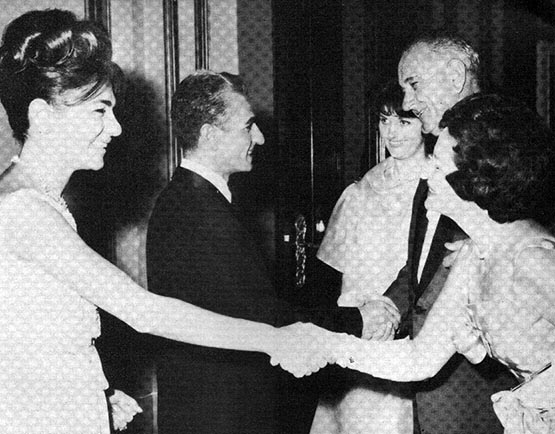
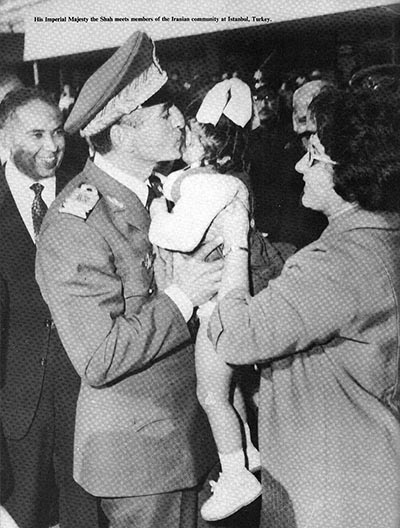
But the controversy over this alleged “kiss” reminded me of an image from a different time in Iran. I have a booklet (Iran Today) issued by the Imperial Iranian Government in the early 1960s, when Lyndon Johnson was still vice-president. This is pure propaganda for the then-young Shah’s Iran. Opposite the Table of Contents, and thus the first image in the booklet, is a full-page spread with the caption: “His Imperial Majesty the Shah meets members of the Iranian community in Istanbul, Turkey.” You will note that this image is the classic politician baby kissing. Obviously, this was seen as a positive side of the ruler who loves his people. What a difference half a century makes in the interpretation of a kiss.
The propaganda aspect of the booklet is most evident in the unflinching praise for the Shah, as can be seen below:
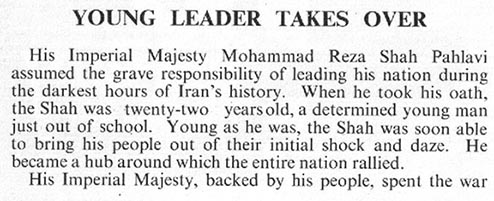
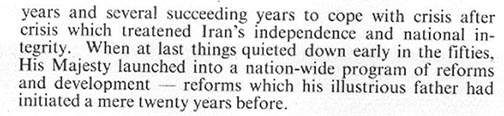
“Their Imperial Majesties the Shah and Queen Farah greet distinguished guests from the United States: Vice President and Mrs. Lyndon Johnson and their daughter, who visited Iran last summer.

Yemen’s National Dialogue


Yemen’s President Rabu Mansour Hadi has issued decree No. (12) for 2013 on Sunday, March 17, forming the presidium of the Comprehensive National Dialogue Conference, which starts today. The officers are listed below:

1- President Abdo Rabu Mansour Hadi as president of the conference.
2- Abdul-Kareem al-Iriani as a vice-president for the conference.
3- Yasin Saeed No’man as a vice-president for the conference.
4- Abdul-Wahab Ahmed al-Anisi as a vice-president for the conference.
5- Sultan Hizam al-Atwani as a vice-president for the conference.
6- Ahmed Bin Fareed al-Sorimah as a vice-president for the conference.
7- Saleh Ahmed Habrah as a vice-president for the conference.
8- Abdullah Salem Lamlas as the conference’s reporter.
9- Nadia Abdul-Aziz al-Sakkaf as a deputy for the reporter.

For a complete list of the 565 participants in Arabic, go here.

The term “dialogue” is ambitious, given the general disrespect held in Yemen for the UN, which is sponsoring this 6-month long exercise. It is hard to imagine how over 500 people can engage in a meaningful dialogue. Is the six months so they can each take the floor and filibuster? While a wide net has been cast, there is still major grievance from the southern secessionists, who staged a strike in Aden on Sunday. Although none of the former major political players will be physically present (including former President Salih, General Ali Mohsen and Sheikh al-Ahmar), they will certainly be represented by some of the participants. One is always hopeful that a path to national reconciliation can be forged. Yemenis did it themselves after the bitter civil war in the 1960s, but that was before decades of military rule eroded most Yemeni support for the central government. Still, talk is always better than bullets, so let the dialogue begin.

Mind your manures…


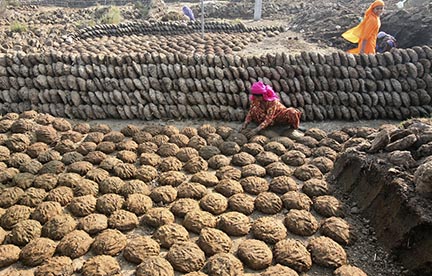
A villager makes cow dung cakes used as cooking fuel at Maloya village on the outskirts of the northern Indian city of Chandigarh on January 31, 2011; photograph by Ajay Verma / Reuters

[Webshaykh’s note: Here is a great story coming out of Indonesia about two young female science students contributing to society. I believe Marvin Harris would love this, as would anyone appreciates the Hindu doctrine of ahimsa. Yet another sacred cow sacrificed in the interest of science.]

Fermented Cow Dung Air Freshener Wins Two Students Top Science Prize

by Kimberley Mok, Care2.com, March 16, 2013

Conventional air fresheners are known for their toxic soup of chemicals that may be linked with asthma, reproductive disorders and even lung disease. While there’s no shortage of environmentally-friendly and human-healthy air fresheners on the market, two Indonesian science students are behind a rather bizarre concoction that you may be seeing soon: an affordable air freshener made from cow dung.

Yes, cow dung — as weird as it sounds, the formulation actually has a pleasant herbal smell, and has won Dwi Nailul Izzah and Rintya Aprianti Miki a gold medal at Indonesia’s Science Project Olympiad (ISPO). According to Oddity Central, the young women overcame 1,000 other competitors with their surprising freshener, which was painstakingly created by collecting unused cow manure from a cattle farm and fermenting it for three days:

Then they extracted the water from the fermented manure and mixed it with coconut water. Finally, they distilled the liquid to eliminate all impurities. The whole process took 7 days, which is pretty long, but in the end they obtained what they were looking for – a liquid air freshener with an herbal aroma from digested cow food. Continue reading Mind your manures… →

Orientalism and Bibliolatry:
Framing the Holy Land in 19th Century Protestant Bible Customs Texts

I have recently published an article in a volume edited by Ian Netton, entitled Orientalism Revisited: Art, Land and Voyage (London: Routledge, 2013, pp. 187-204). I provide the introductory paragraphs below.


Orientalism and Bibliolatry:
Framing the Holy Land in 19th Century Protestant Bible Customs Texts

“The Orient was almost a European invention, and has been since antiquity a place of romance, exotic beings, haunting memories and landscapes, remarkable experiences.” Edward Said, Orientalism, 1979

“In a word, Palestine is one vast tablet whereupon God’s messages to men have been drawn, and graven deep in living characters by the Great Publisher of glad tidings, to be seen and read of all to the end of time.” William M. Thomson, The Land and the Book, 1859

This essay begins with a famous opening phrase from Edward Said’s Orientalism not because there is a need to validate or dispute it, but because of what it leaves out. Indeed, Said’s caveat of “almost” is telling, since his text only describes the “Orient” invented through the writings of Western writers. What is remarkable about Said’s styling of the Orient as a form of politicized discourse is that the most important part of this invention is missing: the Orient invaded by Napoleon is also the Holy Land, the “vast tablet,” as American missionary William Thomson phrases it, which brings the Bible to life. Napoleon may have initiated Western imperialist ambitions in this Holy Land, but the ultimate failure of his military mission stands in stark contrast to the perpetual array of Christian pilgrims, scholars and missionaries who visited this holiest of Holy Lands for Christians and Jews. Absent from Said’s text is the genre that was most widely read in 19th century Europe and America, specifically Holy Land travel texts that cited contemporary customs and manners of Arabs and other groups encountered as illustrations of Bible characters for popular consumption, especially among Protestants.

Said’s genealogy of the discourse he identifies as Orientalism is a thoroughly academic one. Continue reading Orientalism and Bibliolatry:
Framing the Holy Land in 19th Century Protestant Bible Customs Texts →

Passport Blues

Yemenis seeking American citizenship pay exorbitant dowries in lucrative marriages of convenience

by Nadia Haddash, Yemen Times, March 7, 2013

Getting a visa from the American embassy in Sana’a is not easy for Yemenis hoping to travel to the U.S., and is especially hard for young, single men. So, many seek an alternative route: marrying a Yemeni-American woman.

By doing so, they typically become American, too, but could be in debt for years—they often have to pay huge dowries for their dual citizen brides.

Walid Al-Asimi, 28, met his wife, a Yemeni-American, in an English institute in Sana’a.

“When I knew that she would travel to America I decided to marry her,” he says. “I was surprised when her father asked me to give $30,000 as a dowry.”

The majority of Yemeni youths who marry women with dual citizenship pay very high dowries, ranging between$10,000-50,000, or around YR 2 million- 11 million. By comparison, a typical dowry paid to a bride’s family in Sana’a is around $4,000 or YR 800,000. The dowry paid to brides’ families in rural areas of the country is much less still. Continue reading Passport Blues →

Islam: The Arab Religion


By Anouar Majid, Tingis Redux, February 22nd

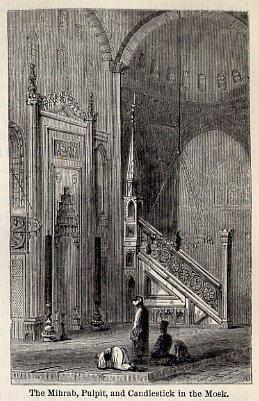
A few months ago, I immersed myself in a kind of reading that I wish was available to me and my teachers when I was in high school in Tangier (Morocco) studying philosophy and Islamic Studies. It is the kind of slow—very slow—reading that keeps you constantly challenged and fully awake. It is archeological and historical work informed by a knowledge so vast that a reader must struggle to keep track of all sorts of cultures, languages, dates, and names. Only scholarship of this scope, though, can aim at the heart of gigantic myths—myths so powerful and persistent that centuries of generations have taken them for reality and billions continue to believe in their truth.

I decided to devote some time to the work of Professor Patricia Crone because her name kept appearing with increasing frequency in the literature I had been reading in the last few years, whether by scholars who share her general view or not. I thought it was time to have a first-hand experience of what Crone’s thesis is about. So, in no particular order, and rather quickly, I read God’s Rule: Government and Islam (2004), co-written with Martin Hinds; Meccan Trade and the Rise of Islam (first published in 1987); Slaves on Horses (1980) and Hagarism: The Making of the Islamic World, the book she co-authored with Michael Cook in 1977 and which caused a storm in the rarified circles of scholars. Even though she may have changed her mind since she published the book in 1977, Hagarism and Meccan Trade totally upset the foundations of what we have grown to believe is Muslim history. They show, as do other writers in different ways, like Arthur Jeffery, John Wansborough, and, more recently, Fred Donner, Tom Holland and Robert Spencer, that what Muslims and non-Muslims learn in school about Islam is not facts that happened but literary compositions whose aim was to create a new religion with its own legitimizing mythology.

A Religion is Born

Muslims believe that their Prophet Mohammed, who was born in 570 AD and died in 632 AD, is the best human ever born in the world, chosen by God to spread his final and everlasting message, preserved in a heavenly tablet, the Koran. Starting out from humble origins in Mecca—a bustling crossroads in the caravan trade—and reputed for his honesty and wisdom, Mohammed married his older boss Khadija, received God’s message through the archangel Gabriel at a local cave when he was 40, fled his native city and migrated to Yathrib (thereafter known as Medina) when his persecution grew more intense, and later returned to Mecca as a triumphant Muslim conqueror. By the time he died, he had married several times and most of Arabia had converted to Islam. Soon his followers, known as Muslims, fanned out in a series of conquests (downplayed as futuhat in Islamic apologetics) that, within a century, had reached France and turned the Fertile Crescent, North Africa and the Iberian Peninsula into Muslim nations. Continue reading Islam: The Arab Religion →

Yemenite Jews: A Photographic Exhibition

An exhibition of photographs of Yemenite Jews is on display from February 1- April 30, 2013 at the Katz Snyder Gallery in San Francisco. The entire collection can be seen online.

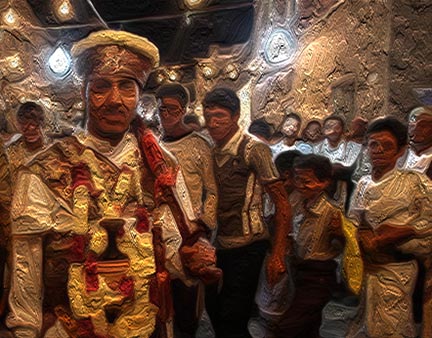
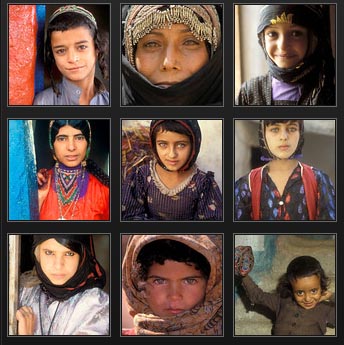
Israeli photojournalist Naftali Hilger’s breathtaking photos of Yemen reveal a nation and a landscape lost in time. His intimate portraits of the isolated Jewish communities of Yemen, taken over a period of 20 years, have been most recently seen in a widely heralded exhibition at the Museum of Islamic Art in Jerusalem.

Hilger’s life-altering love affair with the mysteries of Yemen began in 1987. Over six subsequent trips from 1987 through 2008, he documented not only one of the most ancient communities in the Jewish diaspora, but Muslim Yemen as well – its markets, its landscapes and the fascinating architecture of Sana’a and the rural villages.