Bipolar Religion

The trendy 19th century Protestant philosophical theologian Søren Kiergekaard published a Danish book in 1843 entitled Either/Or. His faith-based binary is not the the standard good vs evil, God vs. Satan model that had long been enshrined in Christianity, but rather a dialogue between an aesthetic hedonist and a duty-bound ethicist. His point, or at least one of them, is that by rigidly following either life trajectory one can simply go too far and not realize one’s true self. He was aware of the binary bind that haunts many, if not most, religions and worldviews. In politics the mantra would be “my country, love it or leave it,” or more crudely, “my way or the highway.” In economics, capitalism vs communism. In all cases binaries bind us to intolerance and the hubris that I am right and you are wrong.

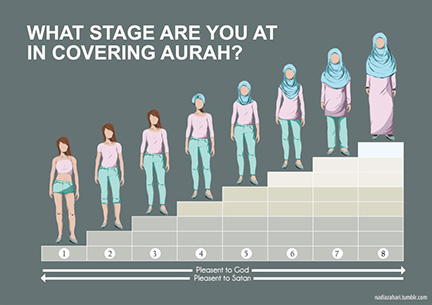
At least the Manicheans dared to assert the obvious that good and evil, like light and darkness, are locked in an eternal duel rather than an ultimate triumph of good. But this was deemed a heresy. The simple solution, what might be called the Salafi fix in Islam, is the fixation on a single standard of truth. Even if one takes the Quran as the literal word of Allah, it must still be interpreted. The history of Islamic exegesis demonstrates that very little is obvious in a text that was not originally written down as it was received in a linguistic idiom now fourteen centuries past. Yet, like the Bible thumpers in American Fundamentalism, there are always those who think they have the right interpretation and that alone must be followed. Continue reading Bipolar Religion

Tabsir Redux: Mocha Musings #2: Egypt

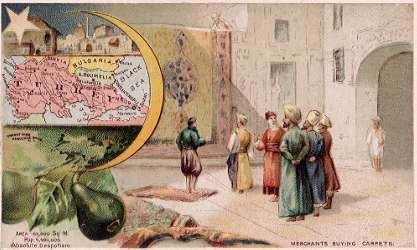
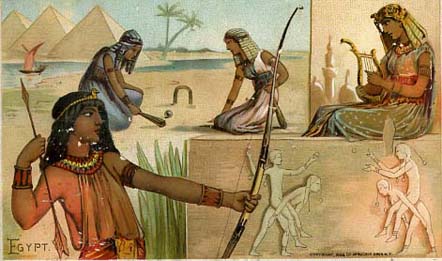
previous post I began a series on coffee advertising cards with Middle Eastern themes. One of the most colorful collections is that provided by the Arbuckle Coffee Company. In my great, great aunt’s album there is a card depicting ancient Egypt, which is shown above.

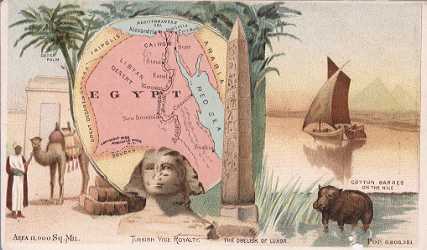
In the 1889 series depicting the nations of the world, Egypt also appears:


Area: 11,000 sq. mi
Population: 6,806,381
Government: Turkish Vice Royalty
Scenes: Date Palm; The Obelisk of Luxor; Cotton Barges on the Nile

[Tabsir Redux is a reposting of earlier posts on the blog, since memories are fickle and some things deserve a second viewing.this post was originally made on March 6, 2010]

الحوثيون يشيعون زعيمهم الروحي حسين الحوثي في صعدة بعد 9 سنوات على مقتله


عبدالملك الحوثي يؤم بعشرات الآلاف في صعدة شمال اليمن في صلاة الجنازة على شقيقه “حسين”

  • المصدر أونلاين – خاص
    الأربعاء 5 يونيو 2013 06:14:48 مساءً

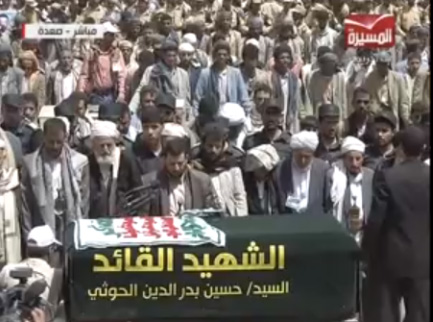
    شيع عشرات الآلاف في محافظة صعدة شمال اليمن، اليوم الأربعاء، جثمان الزعيم الروحي لجماعة الحوثيين حسين بدرالدين الحوثي بعد تسع سنوات من مقتله على يد قوات الجيش.

    وتوافد الآلاف من أنصار الحوثيين من مدن يمنية إلى صعدة حيث تتركز قوة جماعة الحوثيين، للمشاركة في تشييع الحوثي، وشدد مسلحو الجماعة من إجراءات الأمن وعززت نقاط تفتيش التي ينصبونها في أرجاء المحافظة.

    وحسين الحوثي المولود في 1965 قتل في عام 2004 خلال الحرب التي اندلعت بين الجيش وجماعته، إبان حكم نظام الرئيس السابق علي عبدالله صالح الذي أطاحت به انتفاضة شعبية انطلقت قبل عامين.

    وبدأت مراسم التشييع بأداء صلاتي الظهر والعصر وراء الدكتور المرتضى المحطوري وهو أحد أبرز منظري المذهب الزيدي في صنعاء.

    وصعد شقيقه الأصغر عبدالملك الحوثي وهو القائد الحالي للجماعة، على منصة محاطة بالحراس، يدعو فيه الموجودين في ساحة كبرى بالمدينة إلى أداء صلاة الجنازة وبدء مراسيم التشييع.

    Continue reading الحوثيون يشيعون زعيمهم الروحي حسين الحوثي في صعدة بعد 9 سنوات على مقتله

  • Tabsir Redux: Mocha Musings #1: Mecca and Arabia

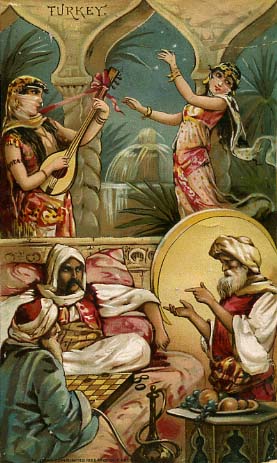
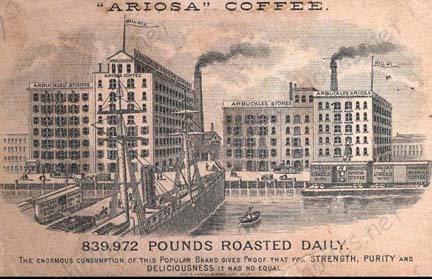
    Arbuckles’ Ariosa (air-ee-o-sa) Coffee packages bore a yellow label with the name ARBUCKLES’ in large red letters across the front, beneath which flew a Flying Angel trademark over the words ARIOSA COFFEE in black letters. Shipped all over the country in sturdy wooden crates, one hundred packages to a crate, ARBUCKLES’ ARIOSA COFFEE became so dominant, particularly in the west, that many Cowboys were not aware there was any other kind. Keen marketing minds, the Arbuckle Brothers printed signature coupons on the bags of coffee redeemable for all manner of notions including handkerchiefs, razors, scissors, and wedding rings. To sweeten the deal, each package of ARBUCKLES’ contained a stick of peppermint candy. Due to the demands on chuck wagon cooks to keep a ready supply of hot ARBUCKLES’ on hand around the campfire, the peppermint stick became a means by which the steady coffee supply was ground. Upon hearing the cook’s call, “Who wants the candy?” some of the toughest Cowboys on the trail were known to vie for the opportunity of manning the coffee grinder in exchange for satisfying a sweet tooth.

    While sorting through a bevy of late 19th century advertising cards and magazine illustrations collected by my great, great aunt in several yellowing albums, I came across several for the Middle East that were published for Arbuckle’s coffee. Continue reading Tabsir Redux: Mocha Musings #1: Mecca and Arabia

    Music hath charms…


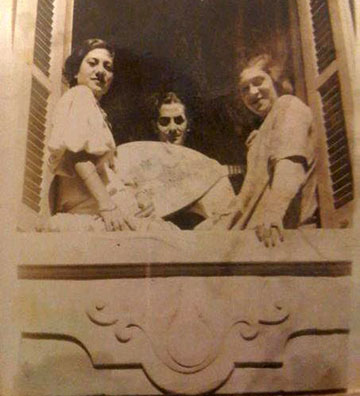
    From the left: Becky Memran (formerly Rouvio), with Farid al-Atrash, and her sister Léonie. Alexandria, sometime in the mid-late thirties

    The current antagonism on all sides over the Israel/Palestine dilemma belies the fact that relations between individual Arabs and Jews were not always hijacked by politics. One of the most revered singers in the Arab World is Farid al-Atrash, a singer and composer who was born in Syria to a father who fought the French. The family migrated when he was young to Egypt, where they were granted citizenship. A recent article by Tamar Kaplansky includes a picture of the young Farid with her grandmother, who was Jewish, in Alexandria.

    For those interested in the music of Farid al-Atrash, Youtube archives a number of clips from his movies and albums here and here and here and on many more sites.

    Taksim is not (yet) Tahrir

    By James M. Dorsey, The Turbulent World of Middle East Soccer, June 2, 2013

    Almost a week of countrywide protests in Turkey have left an indelible mark on the country’s political landscape: broad discontent with the policies of Prime Minister Recep Tayyip Erdogan’s policies and increasing haughtiness bubbled to the surface; militant soccer fans thousands of whom joined the Taksim Square protests united and were politicized; and the role police force plays in solidifying opposition groups and resolve was highlighted.

    Mr. Erdogan’s intransigence and hard-handed police attempts to suppress the protest with tear gas and water cannons swelled the ranks of the demonstrators and turned a demand for perseverance of a 75-year old Istanbul park into a massive call for the prime minister’s resignation. Thousands of militant fans of Istanbul’s three rival soccer clubs led by the left-wing, most politicized of the support groups Carsi, the ultras’ of Besiktas JK, joined forces for the first time in 30 years as they march to Taksim Square. So did rival soccer fans in other cities.

    Comparisons between Taksim and Cairo’s Tahrir Square that has come to symbolize the ability of the street to topple a government are tempting. To be sure, there are superficial similarities but these are outstripped by the differences. The two square share the unification of rival soccer fans with a history of fighting one another; the occupation of a main city square; the protesters’ slogan: Erdogan, istifa! or Erdogan resign in imitation of Egypt’s Mubarak irhal! or Mubarak leave!; the violent police crackdown; and the ultimate at least partial government backdown.

    But unlike mass demonstrations that toppled leaders in North African nations, the protests in Turkey are against a democratically elected leader who has won three elections with a respectable majority, presided over a period of significant economic growth and repositioned his country as a regional power with global ambitions. They also occurred in contrast to Arab countries in a country that despite all its warts is democratic and has a strongly developed, vociferous civil society. Continue reading Taksim is not (yet) Tahrir

    Tabsir Redux: Traveling Light in Arabia

    [Note: the following list of items for light camping in Arabia is provided by G. Wyman Bury for the early part of the 20th century.]

    CAMP EQUIPMENT
    Try to do without a tent. Arabs hate pitching tents after a long day’s march, and seldom pitch them well. They draw fire and afford no protection, while preventing your own observation; they also betray the site of your camp to bad characters and casual callers on the look out for supper.

    BEDDING
    Avoid Wolseley valises or anything with pleats and folds, which become the permanent abiding places of parasitic insects.
    ‘Blankets.’ One each for the men. A few extra for convalescents or invalided men. Two for yourself.
    ‘Pillows.’ Carry your spare clothes in a green canvas sack. Continue reading Tabsir Redux: Traveling Light in Arabia