GOOOOOOOAAAAAALLLLLL for Morsi?

Egypt’s Morsi turns to Syria and soccer to polish his tarnished image

By James M. Dorsey, Mideast Soccer Blogspot, June 17, 2013

Egyptian President Mohammed Morsi and his flailing Muslim Brotherhood have turned to foreign policy and soccer to improve their battered image in advance of a planned mass anti-government protest at the end of this month and mounting calls for his resignation.

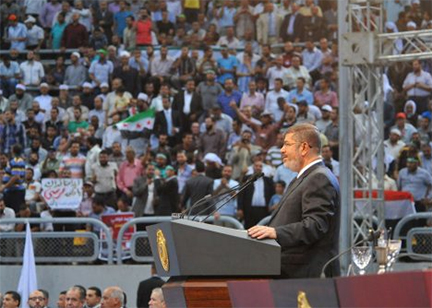
In a bid to distract attention from his domestic woes, curry favor with the United States and Gulf countries and restore Egypt to a leadership position in the Middle East and North Africa, Mr. Morsi chose a Cairo stadium to announce to his rallied supporters that he was cutting diplomatic ties with the regime of embattled Syrian President Bashar al-Assad.

The president’s ruling Muslim Brotherhood at the same time said it would field candidates for the board elections of storied Cairo soccer club Al Zamalek SC and other major football teams. The move is an effort to gain control of clubs in a soccer-crazy country whose huge fan base played a key political role in and since the toppling of Hosni Mubarak two years ago.

The fans, one of the largest civic groups in Egypt, are likely to participate in a mass opposition Tamarod (Rebel) march on the presidential palace scheduled for June 30, the first anniversary of Mr. Morsi’s inauguration as Egypt’s first freely-elected post-revolt leader, to demand his resignation and early elections. Egyptian media report that a petition calling for Mr. Morsi’s resignation has so far attracted 15 million signatures, two million more than the 13 million votes the president garnered a year ago. A significant number of militant soccer fans are believed to be among the signatories. Continue reading GOOOOOOOAAAAAALLLLLL for Morsi?

Tabsir Redux: Mocha Musings #4: Morocco to Afghanistan


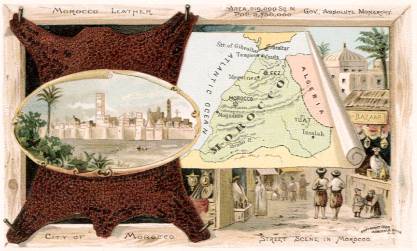
Area: 219,000 sq. mi
Population: 2,750,000
Government: Absolute Monarchy
Scenes: Morocco Leather; City of Morocco; Street Scene in Morocc
o

previous post I began a series on coffee advertising cards with Middle Eastern themes. One of the most colorful collections is that provided by the Arbuckle Coffee Company. In my great, great aunt’s album there were several Middle Eastern and North African nations represented, but she did not have all the cards. Here is a final potpourri from Arbuckle’s 1889 series, starting with Morocco above. Continue reading Tabsir Redux: Mocha Musings #4: Morocco to Afghanistan

Game changer? Game on?


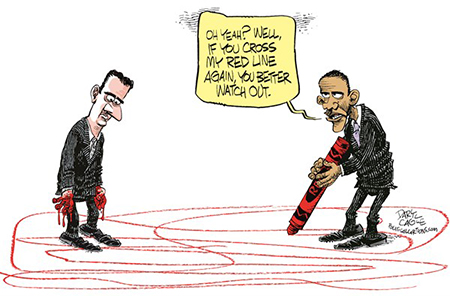
There is always a problem with drawing a line in the sand, especially the shifting sands of Middle East conflicts. President Obama is surely aware of this now, after unguardedly saying that use of chemical weapons by the Syrian regime would be a “game-changer.” The devastation in Syria, where the death toll is now estimated at around 93,000, is no game for the people of Syria or its neighbors, who are absorbing hundreds of thousands of displaced Syrians. In hindsight, President Bush’s “Mission Accomplished” banner summarizes with non-irenic irony the ineptness of his administration’s handling of the last (hopefully the last) Iraq War; will “Game Changer” haunt Obama’s record for future historians? To be blunt, is “game-changer” morphing into “game-on”?

In the rhetorical build-up to the last Iraq War, the hawkish mantra was WMD. Forget the fact that the U.S. gave tactical support to Saddam’s regime in his bloody 80’s war with Iran or had the opportunity to take him out in the earlier Iraq war. The intelligence icing on the “yellow cake” was that Saddam had become a threat to the U.S. (surely Israel was not absent in the equation), even though he had zero to do with 9/11 and was intolerant of any Islamic extremism at home. Although Libya did not seem to have WMDs, it did have the crazy loon Qaddafi, an easy target for removal by an air campaign of the U.S. and its NATO allies. Tunisia and Egypt sprung out of their respective dictatorial nightmares on their own, as the U.S. was basically reduced to observer status. The conflict in Yemen drones on, with the Saudis and the GCC doing the dirty work to redesign Yemen. Forget about changing the scene in Bahrein, where the U.S. docks its naval ships.

So the focus now is on Syria. Well, not just Syria. Continue reading Game changer? Game on?

The Gezi Occupation: for a democracy of public spaces


Occupied Taksim, June 10

by Nilufer Gole, Open Democracy, June 11, 2013

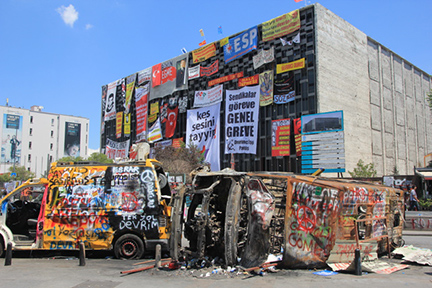
“Respect” has become a new slogan tagged on walls all over the cities, and expressing the need for a return to civility and call for politeness in Turkish public life. Gezi occupation reveals to us all, how “public square” becomes literally vital for our democracies.

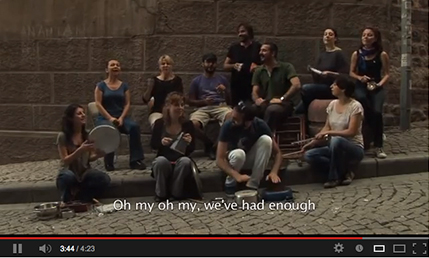
Over the past week, protest movements have spread across Turkey’s largest cities, and appear to become widespread urban uprisings. Despite often violent police intervention, people have not hesitated to take to the streets and block avenues, neighbourhoods, and their cities’ central spaces. Others participate from their balconies, with whole families chiming in to the protesters’ chorus, banging on pots and pans. They have found pacifist means of protest that require no arms or political slogans to express their discontent and frustrations with the Erdogan regime.

This urban movement, started by young people, supported by the middle classes and featuring a strong female presence, has not weakened in the face of impressive displays of force by riot police who use tear gas without hesitation. Clouds of gas cover the sky in town centres, making breathing difficult; but these clouds, symbols of pollution and the abuse of power, have only bolstered the anger of ordinary citizens.

The public sphere has been suffocating for some time in Turkey. Restrictions on freedom of expression and the crackdown on the opposition, particularly journalists who have lost their jobs and the mass media which has changed its editorial line, have put a muzzle on public discourse. The most recent protests in Taksim, which were not covered by the major television stations, are ample proof of this. Continue reading The Gezi Occupation: for a democracy of public spaces

Islam minus “Theism”

[Webshaykh’s note: There are many Christians and Jews who still find spiritual and moral value in their faiths while rejecting literalist interpretations, especially those that preach exclusivity rather than tolerance. This same holds for many Muslims, although their voice are seldom given a chance to be heard or else are gobbled up with relish by Islamophobes. The following commentary by Ali A. Rizvi is well worth reading.]

An Atheist Muslim’s Perspective on the ‘Root Causes’ of Islamist Jihadism and the Politics of Islamophobia

by Ali A. Rizvi, Huntington Post, May 3, 2013

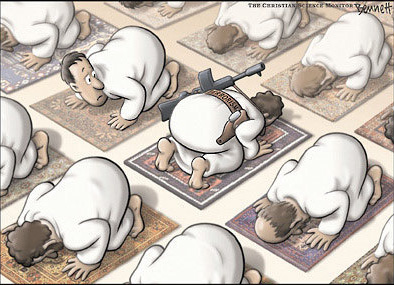
The ambassador answered us that [their right] was founded on the Laws of the Prophet, that it was written in their Koran, that all nations who should not have answered their authority were sinners, that it was their right and duty to make war upon them wherever they could be found, and to make slaves of all they could take as prisoners, and that every Mussulman who should be slain in battle was sure to go to Paradise.

The above passage is not a reference to a declaration by al Qaeda or some Iranian fatwa. They are the words of Thomas Jefferson, then the U.S. ambassador to France, reporting to Secretary of State John Jay a conversation he’d had with Sidi Haji Abdul Rahman Adja, Tripoli’s envoy to London, in 1786 — more than two and a quarter centuries ago.

That is before al Qaeda and the Taliban, before the creation of Israel or the Arab-Israeli conflict, before Khomeini, before Saudi Arabia, before drones, before most Americans even knew what jihad or Islam was, and, most importantly, well before the United States had engaged in a single military incursion overseas or even had an established foreign policy.

At the time, thousands of American and European trade ships entering the Mediterranean had been targeted by pirates from the Muslim Barbary states (modern-day North Africa). More than a million Westerners had been kidnapped, imprisoned and enslaved. Tripoli was the nexus for these operations. Jefferson’s attempts to negotiate resulted in deadlock, and he was told simply that the kidnapping and enslavement of the infidels would continue, tersely articulated by Adja in the exchange paraphrased above.

Adja’s position wasn’t a random one-off. This conflict continued for years, seminally resulting in the Treaty of Tripoli, signed into law by President John Adams in 1797. Article 11 of the document, a direct product of the United States’ first-ever overseas conflict, contained these famous words, cementing America’s fundamental commitment to secularism:

As the Government of the United States of America is not, in any sense, founded on the Christian religion; as it has in itself no character of enmity against the laws, religion, or tranquility, of Mussulmen; and, as the said States never entered into any war, or act of hostility against any Mahometan nation, it is declared by the parties, that no pretext, arising from religious opinions, shall ever produce an interruption of the harmony existing between the two countries.

Yes, the establishment of secularism in America back in the 18th century was largely related to a conflict with Islamist jihadism.

So where did Abdul Rahman Adja’s bin Laden-esque words come from?

They couldn’t have been a response to American imperialism (the start of the conflict precedes the presidency of George Washington), U.S. foreign policy, globalization, AIPAC or Islamophobia. Yet his words are virtually identical to those spouted ad nauseum by jihadists today who justify their bellicosity as a reaction to these U.S.-centric factors, which were nonexistent in Adja’s time.

How do we make sense of this? Well, the common denominator here just happens to be the elephant in the room. Continue reading Islam minus “Theism”

Bulliet on Religion and the State in Islam

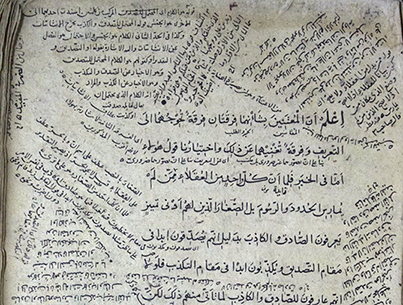
The Center for Middle East Studies at the University of Denver has published its second Occasional Paper, “Religion and the State in Islam: From Medieval Caliphate to the Muslim Brotherhood.” Adapted from a lecture given by Richard Bulliet, Columbia University Professor of History, when he visited DU in February, the paper seeks to contextualize ongoing political changes in the Muslim world by providing a more nuanced reading of Islamic history. To read the pdf online, click here.

Tabsir Redux: Mocha Musings #3: Turkey and Persia


Area: 63,800 sq. mi
Population: 4,490,000
Government: Absolute Despotism
Scenes: Merchants Buying Carpets

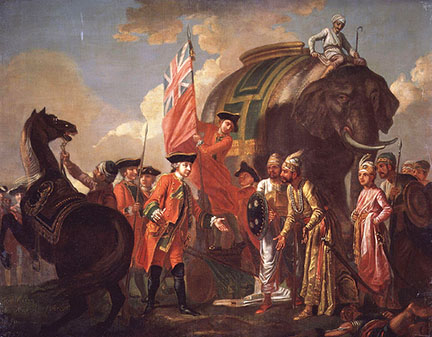
previous post I began a series on coffee advertising cards with Middle Eastern themes. One of the most colorful collections is that provided by the Arbuckle Coffee Company. In my great, great aunt’s album there were several Middle Eastern and North African nations represented, but from a different series than in the Arbuckle’s 1889 series. The 1889 version of Turkey is shown above, but my aunt’s version of Turkey is decidedly more imaginative:

Continue reading Tabsir Redux: Mocha Musings #3: Turkey and Persia

Displaced in Yemen: A Life on Hold

IRIN’s film, A Life on Hold, tells the story of Qasim and his family, who for the past three years have been living in a camp for internally displaced people (IDPs) in northwestern Yemen.

Years of conflict in the region between the Houthi tribe and government forces has led to the displacement of more than 300,000 civilians, who have to cope with a decline in health and educational services. Malnutrition is common in the IDPs camps, as well as in the apartments, mosques and schools where many have found shelter.

Authorities have tried to encourage the displaced to go back to their homes, but renewed clashes in 2012 actually increased the IDP numbers in the north. Extensive damage to houses and infrastructure, continuing insecurity, fear of reprisals and the lack of livelihood opportunities and basic services all serve as deterrents to return.

For more information on the situation in Yemen, please visit:

http://www.irinnews.org/Country/YE/Yemen