Agricultural policy in Yemen’s highlands and lowlands


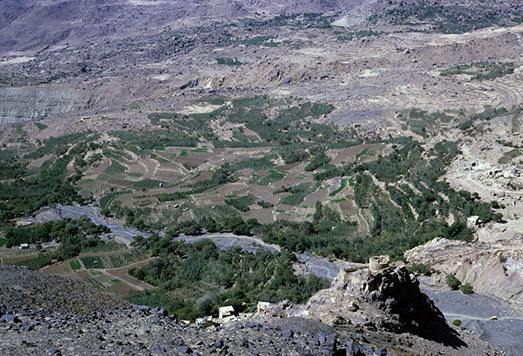
Terraced fields below al-Saraha in valley of al-Ahjur; photograph by Daniel Martin Varisco

by Zaid Ali Alwazir, La Voix du Yemen, June 9, 2013

Agricultural policy describes a set of laws related to the local farming and imported agricultural products from abroad. These laws are supposed to be implemented to get certain results such as utilizing the land, operating it or stabilizing prices of imported and local products.

Since the start of the “youth revolution” in Yemen, talks about the political and economic reforms got increased without focusing on “the agricultural economy” as if it was not part of the general “economy”. Therefore, no attention was paid by reformers to this issue since their talks had been focusing on “the material economy” such as “taxes”, “Zakat” and others.

“Agricultural economy” is not given the required attention despite the fact that agricultural development would feed the budget with more income, boost up farmers’ capacity to give more and optimize their living standards to ensure their welfare. Continue reading Agricultural policy in Yemen’s highlands and lowlands

The right barnamaj for Egypt

“If your regime is not strong enough to handle a joke, then you don’t have a regime.” Such was the sentiment of satirist Jon Stewart, who made a surprise appearance on the popular Egyptian television comedy show, al-Barnamaj, starring Bassem Youssef. If the Arab Spring protests were not simply an exercise resulting in one kind of intolerance replacing another, then this may be one of the most important lessons to be learned from the prevailing winds of post-people-revolution hopes. Obviously Moubarek did not handle jokes well, nor did Ben Ali, nor Qaddafi, nor Ali Abdullah Salih. Neither does Bashar al-Asad, who is desperately trying not to be the next ex-dictator in the Middle East. But then the ruling parties in the Islamic Republic are not exactly comedy-friendly. Bin Laden was the butt of millions of jokes, but it is hard to imagine him having success as a stand-up comedian.

The irony is that most of the people I have met in Egypt and Yemen are fond of jokes and have a rich tradition making fun of those in power, corrupt regimes and religious hypocrisy. Many have a sharp edge of “othering” one group or another, but some are self-deprecating. Satire has a way of getting to the crux of problems, which is probably why it is so irritating to those in power. Consider the following joke about the Syrian regime of Hafez al-Asad, a joke I heard from a Lebanese friend when Syria was basically in control of much of Lebanon.

The heads of the CIA, the KGB and the Syrian intelligence agency met at a conference and were bragging about their abilities to track down and find terrorists. Continue reading The right barnamaj for Egypt

Yemen’s National Dialogue Behind Closed Doors

by Sama’a al-Hamdani, Atlantic Council, June 17, 2013

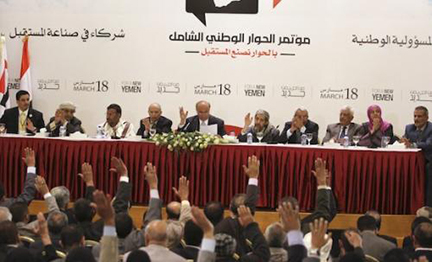
Yemen’s National Dialogue Conference (NDC), which began on March 18 and just reached the halfway point of its six-month mandate, was conceived as a core part of the transition process and is intended to bring together Yemen’s diverse political, social, geographic, and demographic groups to address the most critical issues plaguing the beleaguered country. Unfortunately, the way the dialogue was developed, designed, and directed created intrinsic flaws that may undercut its success. Some argue that the large number of participants and the lack of genuine representation outside of political parties are the reasons it is doomed for failure. Others feel that the process is advancing too quickly, leaving honest reconciliation out of the equation. One of the other major concerns is the lack of clear communication with the Yemeni public, transparency of the proceedings, and oversight of expenditures.

Although some Yemen experts remain pessimistic about the future of the country, they refrain from critiquing the dialogue because the outcome is still unclear and many perceive the dialogue as the only way to prevent a descent into civil war. Particularly because the process is opaque and because there is genuine skepticism about the Gulf Cooperation Council (GCC) transition agreement and the dialogue itself, the NDC should pro-actively report on all working group and plenary proceedings, publish all records and modifications, and disclose all financial contributions and allocations. This is the time to measure the discrepancy between the dialogue’s stated intention and the reality on the ground, if there is hope for effective progress. Continue reading Yemen’s National Dialogue Behind Closed Doors

Al-Aqsa Arabic Manuscripts Going Online


Top of page from 1347 CE copy of Miftah al-‘ulum of al-Sakaki in the al-Aqsa Mosque Library

The British Museum is sponsoring a project to digitalize Arabic manuscripts in the al-Aqsa Mosque library of Jerusalem. Details below and at their website:

EAP521: Digitisation of manuscripts at the Al-aqsa Mosque Library, East Jerusalem

The main goal of this project is to preserve the historical manuscript collection housed at the Al-aqsa Mosque Library in Jerusalem. The Al-aqsa Library located at the heart of the Old City of Jerusalem serves as a primary research center for Islamic studies and as a reference library for scholars and students from Jerusalem and other Palestinian cities. The library’s rare and most valuable collection consists of approximately 2000 manuscripts. The manuscripts were acquired by the Al-aqsa Library from prominent scholars, private collections, and from libraries in Palestine that have ceased to exist. The materials selected for this project represent 119 manuscript titles in the most immediate need of preservation.

EAP521/1: Al-Aqsa Mosque Library Collection of Historical Manuscripts [12th century-19th century]

“This manuscript collection contains 119 Arabic language titles that span over several Islamic periods from the 9th century CE to the end of the Ottoman rule in Palestine at the beginning of the 20th century. Most of the manuscripts relate to aspects of the Islamic religion, but also cover Arabic literature, the Arabic language, logic, math and Sufism and provide a unique insight into centuries of Arabic culture in Palestine. The numbers of pages of original material represent double pages, often librarians of islamic manuscripts use one number for every two pages. ”

Digitisation is planned primarily as a means of preservation in order to create high-quality archival digital copies of the original source materials that are at risk of deterioration. Environmental factors, wear and tear of manuscripts due to poor storage conditions, the lack of security at the library, and the unstable political situation in Jerusalem contribute to the sense of urgency and make digitisation of these unique manuscript materials a top priority. Continue reading Al-Aqsa Arabic Manuscripts Going Online

Gezi Park and the Sound of Music

Omid Safi has a fine post (Sounds of Protest: Les Miserables, Gezi Park, and the Power of Music) on his blog at Religious News on the music in the recent protests in Turkey. Check it out for a nostalgic journey through protest songs since Joan Baez. Here is one of the songs he discusses, made at Gezi Park by Kardeş Türküler and called Sounds of Pots and Pans. Check out his commentary for far more. There is also a Turkish website with many tracks of protest music at http://capulcular.bandcamp.com/

British Dominion in India


Robert Clive and Mir Jafar after the Battle of Plassey, 1757, by Francis Hayman

In 1894, as Queen Victoria smiled upon the empire upon which the sun never was allowed to set, the British literary historian Sir Alfred Comyn Lyall wrote a book that was to go through five editions by 1910 and reprints for a decade after. This was The Rise and Expansion of the British Dominion in India, published by Murray in London (I am using the 1919 edition, only recently ejected from my university library collection). This was, of course, before the fall, before India achieved independence from the Raj lords in 1947. As the 19th century came to a close, Lyall could boast that “the existing relations between India and England constitute a political situation unprecedented in the world’s history” (p. 3). Although Edward Said was aware of the biased Orientalist notions of Lyall, this particular book appears to have escaped Said’s justifiable wrath. He thus missed the telling remark that the “Indian people were, from the beginning, so far from objecting to the English dominion in India that they co-operated willingly in promoting it” (p. 3). Perhaps Lyall prefigures Gramsci in this respect; both understand the power of hegemony. Lyall, by the way, was also a poet, who once wrote a diatribe in verse, called Theology in Extremis, against attempts in India to convert British prisoners to Islam.

Lyall, not to be confused with his fellow civil servant and Arabist namesake, Charles James Lyall, was also concerned about the future of British India. He teases the reader with a quote made by Sir James Mackintosh that “England has lost a great dominion in North America in 1783 and had won another in India in 1805,” adding that “it was still uncertain whether the former as any real loss, or the latter any permanent gain” (p. 353). Another historian, Spencer Walpole, opined “Centuries hence, some philosophical historian … will relate the history of the British in India as a romantic episode which has had no appreciable effect upon the progress of the human family” (p. 353). Perhaps the episode was not romantic for people under British rule in India and the appreciable effect took place mainly on Indian bodies on the Indian continent. But Walpole seems quite prescient to me.

The future had to be more British rule, as Lyall saw it. Continue reading British Dominion in India