The Yemen Spring nipped in the bud? Where do we go from here?


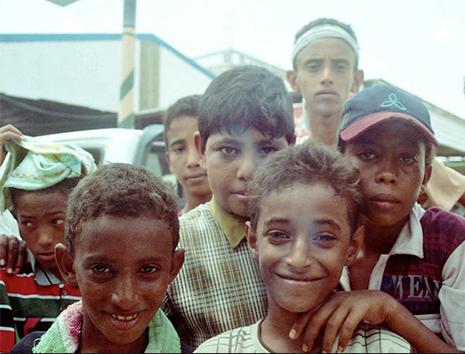
Yemen’s future; photograph by Rayman al-Hamdani

By Samira Ali BinDaair

The Yemeni version of the Arab spring has not received the attention it deserves in international media where most of the attention has been focused on reporting events and the conflicting politics of the different actors on the Yemeni scene; nothing much has been said about the dynamics of the youth revolution in the squares. The countries in the region have not taken the youth-propelled Spring seriously either, conveniently referring to it as fueled by political differences. While hundreds of youth were being brutally massacred, these nearby countries simply procrastinated in efforts to put real pressure on the regime. They played the cards they obviously held seeing that they were the financiers of the regime and the powerful tribal lords in Yemen.

In the later stage of the Spring, there were feeble attempts to persuade the regime to relent, while in another breath making it conditional upon the dismantling of the change square, so that the upheaval did not spill over the borders to ignite dormant fires, in which flames were being extinguished successfully so far. Then there was the long saga of “will he sign or will he not sign?” with the Gulf Initiative which had gone through so many changes with the claim that the red carpet had to be removed slowly lest the regime turn into a ferocious bull that might go charging and throw the country into civil war. There was some truth in that argument seeing that the regime was armed to the teeth, with the military being a family business rather than a national army for the protection of the country from outside aggression. The US in its battle with al-Qaeda had chosen Yemen as the main battleground for this, with all the paraphernalia of unmanned drones, rigorous security screening. All the while, it was training the military and supplying the most sophisticated weapons as part of its anti-terrorist agenda. Therefore to draw a parallel, the US had powerful cards to play with the regime, for as the saying goes,”he who pays the piper calls the tune”. However, despite the murmurs about the regime using the weapons intended for the fight with the al-Qaeda on Yemeni civilians, the regime suffered no penalties for such abuse. Perhaps the US too saw some advantage in keeping the power balance intact, uncertain as it was of the new emerging powers and their loyalties. Continue reading The Yemen Spring nipped in the bud? Where do we go from here?

Tahrir: Take 2

First, it was the fall of Mubarak; now comes the second act: the pending removal of President Morsi, who has managed to do more damage to the image of the Muslim Brotherhood than Nasser, Sadat or Mubarak could. The people massed peacefully in Cairo’s Tahrir Square have had enough of a candidate who pretended to be independent but over the past year has increasingly been linked to the intolerant policies of the Brotherhood. Five ministers in Morsi’s cabinet have resigned, including the Tourism Minister Hisham Zaazou, who was furious that a man linked to the tourist massacre in Luxor in 1997 that killed 62 people had been appointed as a governor in Luxor. The announcement by the army giving Morsi an ultimatum to satisfy the demands of the protesters has all but assured that he will not survive. A formal coup in unlikely, but the pressure on Morsi to resign may do the trick.

The major concern in Egypt is not about democracy but the economy, which has crashed with little prospect for recovery under Morsi. The continuing unrest, coupled with fear of the rising influence of the Muslim Brotherhood, has decimated the tourism industry, which is a major impact on the local economy. In 2008 almost 13 million tourists visited Egypt, bringing in some $11 billion to the Egyptian economy. Today hotels are near empty and tourism is virtually non existent. Conflict at the luxury Semiramis Hotel in Cairo in March caused many tour operators to cancel bookings there. When the tear gas settles, the Pyramids will still dot the horizon in Gizeh, but in all likelihood Morsi will be out of a job soon. Continue reading Tahrir: Take 2

Hezbullies


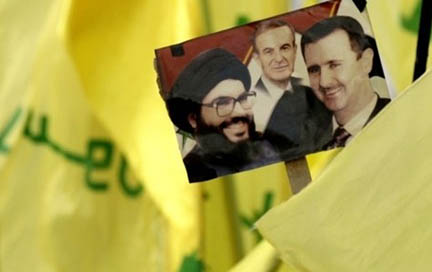
ebanese Hezbollah supporters hold a picture of Hezbollah leader Hassan Nasrallah (L), Syrian President Bashar al-Assad (R) and his late father President Hafez al-Assad (C) in Bint Jbeil on September 22, 2012 (AFP)

[This post was first written a month ago and recently published in Middle East Muddle on Anthropology News.]

The bullet and bomb-blast battle of the bullies is raging in Syria. The biggest bully is Bashar al-Asad, son of Hafez al-Asad who in February, 1982, sent his troops into the city of Homs and slaughtered between 10,000-40,000 civilians who dared to oppose his dictatorial rule. Hafez has slain his thousands, Bashar his tens of thousands. One estimate, reported by Reuters, estimates that between 94,000 and 120,000 Syrians have died in the wake of the Arab Spring that toppled other long-standing dictator regimes. Over a million and half Syrians are refugees who have fled the fighting to neighboring countries, where many do not find even the most basic humanitarian aid. Millions within Syria are in desperate shape, victimized by all sides. But the bully of Damascus hangs on, with Russian backing and Iranian duplicity.

There are other bullies in this fight, from a small faction of radical Muslims intent on reinstalling a caliphate where the Umayyads once ruled to seemingly secular-minded opponents of Asad’s brutal policies. And recently a new bully has arrived, the Hezbollah Hezbullies who control southern Lebanon and thrive as a thorn in the side of Israel. Israel, thus far, has mainly watched from the sidelines, no doubt content to see a bloodbath not directed at them. There was a sharp military response a couple of weeks ago to what appeared to be stockpiles of weapons from Iran on the Damascus road to Hezbollah. Continue reading Hezbullies

An Ottoman Scribe


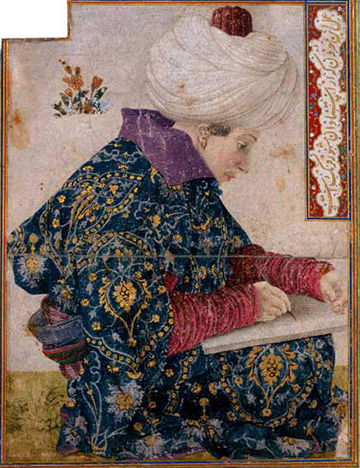
A Seated Scribe, 1479-80, Attributed to Gentile Bellini, Italian, 1429–1507

The painting above is located in the Gardner Art Museum in Boston. Here is the description posted on their website:

Curious visitors who lift the cover from the unassuming Seated Scribe will be richly rewarded by what they see: an intimate painting in miniature of a young member of the Ottoman court bent intently over a writing pad. Dressed in a navy velvet caftan woven with gold, the elegant youth wears bright silks at his arms and neck. The generous folds of his turban hold in place a ribbed, red taj – headgear worn in the court milieu of Ottoman sultan Mehmed II (1432–1481), who nurtured a passionate interest in portraiture and particularly in western traditions of the genre.

Striking for its gleaming tones and stunning delicacy of line, the Seated Scribe is spectacular not only visually, but also in historiographic terms. The painting’s original dimensions have been trimmed, and a later hand has taken care not only to embellish the image, but also to frame, mount, and, ultimately, historicize it. An added inscription in Persian records the image as the “work of Ibn Muezzin who was a famous painter among the Franks.” Scholars have never doubted that a European or “Frankish” artist painted the Seated Scribe. The pressing issue of late has been who, precisely? Whether the Venetian Gentile Bellini, a renowned portraitist sent to Istanbul in 1479, or Costanzo da Ferrara, a court artist at Naples who also sojourned at the Porte, the specificity of detail in the Seated Scribe leaves little doubt that the artist drew from life.

Once the debate over attribution subsides, the more intriguing issue to raise is whether one can call the work a portrait. Might western pictorial realism have been the point of the exercise? A pronounced crease just above the youth’s elbow suggests the image was initially handled as a loose-leaf, autonomous work of art before being mounted (and in this way preserved) in a sixteenth-century album. Like other western-style works Mehmed II commissioned or obtained during his sultanate, the Seated Scribe may have been used as a pedagogic tool for rising artists of the Ottoman royal workshop. A slightly later copy of the miniature (Freer Gallery of Art, Washington) certainly affirms its value for Ottoman and Persian artists as a pictorial model worthy of imitation. If the pictured youth is not a scribe but an artist, shown in the act of drawing while he himself is being drawn according to Western pictorial practices, the Seated Scribe taught by poignant example – it sits indeed at the nexus of Ottoman art and European traditions of representation.

Source: Susan Spinale, “A Seated Scribe,” in Eye of the Beholder, edited by Alan Chong et al. (Boston: ISGM and Beacon Press, 2003): 97.

Voltaire on Tolerance


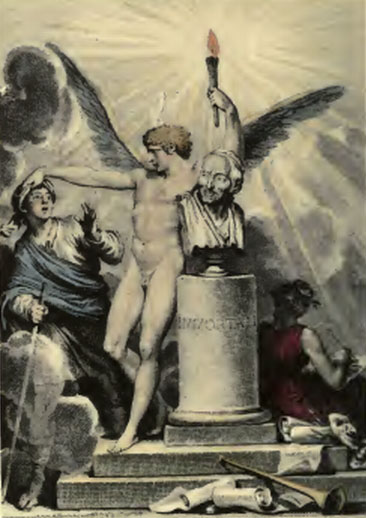
Allegorical bust of Voltaire; from 1901 text

One of the vexing paradoxes of modernity is whether or not intolerance can be tolerated. Should dictators be cuddled if they play up to the foreign policy concerns of a democracy? Should anyone — man, woman or child — be forced to live by religious dogma? How much of the intolerable actions in this world should we tolerate? Some wise words on the problem were offered two and a half centuries ago by the French savant, Voltaire, as brilliantly said in his Philosophical Dictionary. Here is what Voltaire said:

What is tolerance? it is the consequence of humanity. We are all formed of frailty and error; let us pardon reciprocally each other’s folly–that is the first law of nature.

It is clear that the individual who persecutes a man, his brother, because he is not of the same opinion, is a monster. That admits of no difficulty. But the government! but the magistrates! but the princes! how do they treat those who have another worship than theirs? If they are powerful strangers, it is certain that a prince will make an alliance with them. Franois I., very Christian, will unite with Mussulmans against Charles V., very Catholic. Francois I. will give money to the Lutherans of Germany to support them in their revolt against the emperor; but, in accordance with custom, he will start by having Lutherans burned at home. For political reasons he pays them in Saxony; for political reasons he burns them in Paris. But what will happen? Persecutions make proselytes? Soon France will be full of new Protestants. At first they will let themselves be hanged, later they in their turn will hang. There will be civil wars, then will come the St. Bartholomew; and this corner of the world will be worse than all that the ancients and moderns have ever told of hell.

Madmen, who have never been able to give worship to the God who made you! Miscreants, whom the example of the Noachides, the learned Chinese, the Parsees and all the sages, has never been able to lead! Monsters, who need superstitions as crows’ gizzards need carrion! you have been told it already, and there is nothing else to tell you-if you have two religions in your countries, they will cut each other’s throat ; if you have thirty religions, they will dwell in peace. Look at the great Turk, he governs Guebres, Banians, Creek Christians, Nestorians, Romans. The first who tried to stir up tumult would be impaled; and everyone is tranquil.

Humanitarianism (?) in Lebanon


bread provided by NGOs to Syrian refugees in the aid kit in Wadi Khaled (Akkar); photograph by Estella Carpi


A practitioner and a researcher assess humanitarianism in today’s Lebanon

By Fiorenzo Conte and Estella Carpi

In our combined effort of providing the perspectives of the practitioner and the researcher, we would like to take as a point of departure Italian scholar Roberto Belloni’s theses according to which humanitarianism, on the one hand, ends up being the short-term substitute for development, and, on the other, tends to reproduce the same cleavages it tries to overcome.

Humanitarianism as a short-term substitute for development

While conducting research and grounded humanitarian work in Lebanon, we have noticed how humanitarianism, while providing increasing quantity of aid, avoids addressing the root causes of Lebanese chronic poverty, administrative anarchy and recurring war-like events. Predominantly Western and Gulf countries have focused their attention on managing the symptoms of the malaise without effectively addressing its causes and hence engaging in the long term.

The humanitarian needs in Lebanon are surely huge for both Syrian refugees and long neglected Lebanese host communities. With the massive influx of Syrian refugees since August 2011, the Lebanese community, living in the poorest regions, has felt the pinch. Indeed, many residents are currently trying to tackle increased expenditures and a drop in income caused by a variety of factors: the closure of the border and the consequent inaccessibility to Syrian cheaper goods through the usual border-cross smuggling; fierce competition in the labor market that has been increased by the presence of Syrian workers; a deteriorating security situation; and reduced access to the agricultural lands strewn with landmines (1).

The situation for Syrians is similarly grim: according to a recent report, more than 50% of Syrian refugees and Lebanese returnees live in substandard conditions, as Lebanese host communities are no longer able to absorb new flows of refugees in their houses. Continue reading Humanitarianism (?) in Lebanon

A new emir for Qatar


Former Emir Hamad with his son Tamim to the right

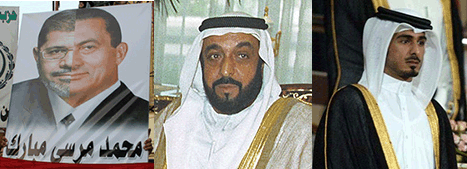
In 1988, when I was living in Doha and conducting research at the Arab Gulf States Folklore Centre, the emir of what was still a rather sleepy little gas-rich emirate was Khalifa bin Hamad Al Thani, who had named his son, Hamad bin Khalifa, heir apparent back in 1977. While his father was out of the country in Geneva, in 1995, the son ousted his father in a bloodless coup. The deposed emir lived in France and Abu Dhabi until his return to Qatar in 2004. On Tuesday Shaykh Hamad pre-empted any such repeat performance by one of his eleven sons by naming his son Tamim the new emir and effectively retiring from leadership without having to find a villa in France. Tamim, the son of Hamad’s second wife, Shaykha Mozah, was declared heir apparent back in 2003, so he has been groomed for the job, including education at Sandhurst in England. Emir Tamim already has four children, so the dynasty will not run out of heirs any time soon. Continue reading A new emir for Qatar