T. S. Eliot’s Influence Upon Salah Abdel-Sabour, #3

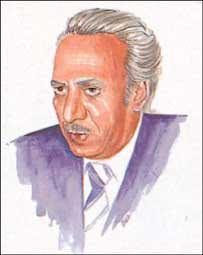
Abdel Sabour

By George Nicolas El-Hage, Ph.D.

[For Part 1 of this essay, click here. For Part 2, click here.]

7. Sabour’s Departure from Traditional Arabic Poetry

Up until now, I tried to demonstrate Eliot’s influence on Abdel Sabour’s poetry, especially with regard to his themes and techniques. Because of the vast gulf that separates the two poets culturally, spiritually, and educationally, it seems a vain effort to look for absolute similarities. On the other hand, it is easier for the critic with an adequate knowledge of the traditional models of Arabic poetry to notice that Sabour’s modern poetry departed almost completely from the classical tradition.

Prior to his exposure to the poetry of T.S. Eliot, Sabour wrote traditional poetry using the classical meters. After reading Eliot, the Egyptian poet adopted new themes, techniques, and structures. He no longer used traditional meters with the long, heavy lines, built on two hemistiches and rhyming with each other throughout the poem. This new type of poetry was able to come into existence and flourish after a long struggle led by contemporary poets like Abdel Sabour. (19)

Starting in the late 1950s, the experience of writing in free verse became a familiar occurrence. In the poetry of Sabour, not only the mood, style, use of myth and illusion, and the interior monologue resemble Eliot’s, but “we have a sense of aimlessness and isolation, of memory and futility, it is definitely the mood of The Wasteland and the Hollow Men.” (20) Moreover, there are clear-cut images in Sabour’s poetry which demonstrate Eliot’s great influence on the Arab poet’s attitude toward life and death. Sabour also makes use of Eliot’s theme of alienation and of his description of empty rooms. In “The Love Song of J. Alfred Prufrock”, Eliot says:
“The yellow fog that rubs its back upon the window-panes.
The yellow smoke that rubs its muzzle on the window-panes.”

Sabour says, echoing Eliot in his “My Peerless Star”:

“Fingers of an eastern wind
Rub the window-panes.” Continue reading T. S. Eliot’s Influence Upon Salah Abdel-Sabour, #3 →
T. S. Eliot’s Influence Upon Salah Abdel-Sabour, #2


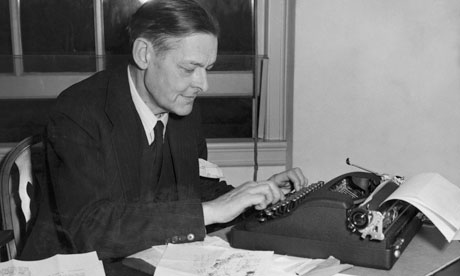
T. S. Eliot

By George Nicolas El-Hage, Ph.D.

[For Part 1 of this essay, click here.]

4. A Brief Summary of Eliot’s Background

T.S. Eliot, the Anglo-American poet, was born in 1888 in Saint Louis, Missouri. He studied at Harvard, the Sorbonne, and Oxford. Despite the fact that Eliot was brought up in a conservative Christian atmosphere, he exposed himself later to a completely different culture when he went to live in England. It is obvious that the political and spiritual world in which Eliot lived bestowed upon him its own distinguishing characteristics.

Eliot was lucky in his education. Harvard offered him a thorough introduction to Dante and to Romance literature. Since his earlier poetry, Eliot was influenced by Dante. Dante held a central position in Europe and linked the Roman past with the modern age. In Dante, Eliot found the spiritual identity of Europe. This allowed him to try to make Europe more conscious of itself. Eliot also allowed the French culture to influence him. Originally an American without the inherited English rigidity, he accepted the characteristics of the French civilization. His views of criticism were those of Remy de Gourmont’s school, and Charles Maurras influenced him politically.

Although it is always possible to argue that Eliot is, after all, an American, no one can deny that his exposure to different cultures gave him a unique political and literary background. Of course, it was his genius and talent which contributed most to the production of his great works of poetry and criticism.

5. A Brief Summary of Salah Abdel Sabour’s Background

Salah Abdel Sabour was not only a major poet, but also the literary editor of a wide spread newspaper, Al-Ahram. He was born in 1931 in the provincial district of Zaqaziq, Egypt, in a conservative Islamic house. When he was twenty, he graduated from Cairo University with a degree in Arabic Language and Literature. Continue reading T. S. Eliot’s Influence Upon Salah Abdel-Sabour, #2 →

Enough! Damn this continued violence


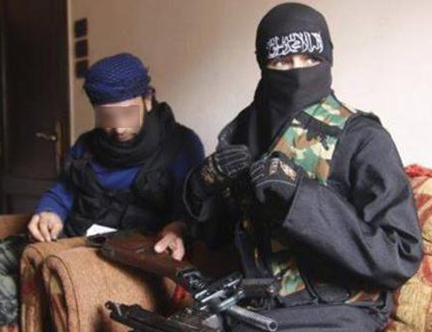
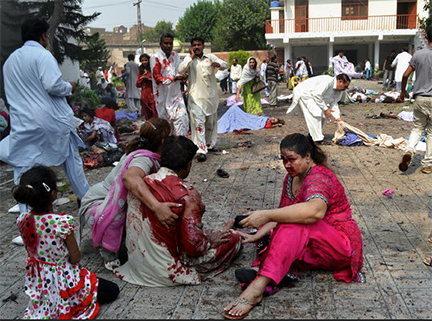
Up to 600 worshipers had attended the service and were leaving to receive free food being distributed on the lawn outside when two explosions ripped through the crowd. Photograph by Mohammad Sajjad/Associated Press

Enough blood has been shed in the past few days to make any sane person question how anyone could possibly justify such cold-blooded and senseless attacks on innocent people. The poison gas in Syria is bad enough, but now we hear that the Somali Shabab have decided to kill shoppers in a Nairobi mall rather than play Captain Hook off the East African coast and now at least 78 Pakistani Christians are killed in a blast at a historic church. This is the ugly side of religion. More than a hijacking of Islam, this is dragging the faith that produced great scholars like Ibn Sina and al-Ghazali into the sewer. To say that the Prophet Muhammad would have condoned this kind of indiscriminate murder is as absurd as the medieval Crusader claim that Jesus would bless the slaughter of Jews and Muslims. But at least the crusades ended several centuries ago.

Muslims killing fellow Muslims or Muslims targeting Christians for death are both equally insane acts. Every day the death toll rises in Iraq and Syria, as though we have returned to the days of the Mongols and Mamluks. Continue reading Enough! Damn this continued violence →

T. S. Eliot’s Influence Upon Salah Abdel-Sabour, #1


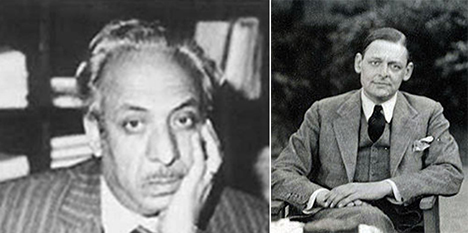
Salah Abdel-Sabour, left; T. S. Eliot, right

T. S. Eliot’s Influence Upon Salah Abdel-Sabour

By George Nicolas El-Hage, Ph.D.

The degree of influence of the Anglo-American poet, T.S. Eliot, on the Egypto-Arabic poet and dramatist, Salah Abdel-Sabour, has not yet been vastly explored. In this article, I shall not only attempt to compare the two poets in a more enlightened perspective, but I shall also probe the fundamental methodology governing a general comparative study. My approach includes the following:

1. A Valid Comparative Study and the Importance of Comparative Literature
2. Traditional Arabic Poetry
3. Why T.S. Eliot?
4. A Brief Summary of Eliot’s Background
5. A Brief Summary of Abdel Sabour’s Background
6. A Practical and Comparative Analysis of One of Sabour’s Poems
7. Abdel Sabour’s Departure from Traditional Arabic Poetry
8. A Brief Comparison between Two Plays
9. Conclusion

1. A Valid Comparative Study and the Importance of Comparative Literature

A fruitful and acceptable treatment of a subject which discusses the influence of one poet upon another must not stop at the limits of a shallow consideration of the most obvious similarities of forms, meanings, and techniques. It must go to the depths to consider the various elements that concern the sources of similarities, as well as the differences, in the light of the cultural backgrounds of the two poets. For example, a comparative study between Corneille and Racine, Wordsworth and Coleridge, and Sabour and Mahmoud Darwish would not be valid for each pair of these poets or writers belongs to the same culture and submits to the same political and social atmospheres.

Comparative Literature is neither a literary comparison nor a mere translation of a foreign literature. It is, as Jean-Marie Carre says, a study of the international and spiritual relations between men and cultures. A meaningful comparative study requires two artists belonging to remote cultures, yet dealing with the same literary genre. The comparativist, thereby, investigates the major differences existing between the environments which produced habits, customs, and verbalization of thought. Again, it appears necessary to investigate the spiritual and material factors which establish the concepts of every culture. It is also necessary to determine the degree of understanding each poet has of his own literary tradition and to ascertain the extent to which his cultural heritage pervades his poetry. The political, religious, economical, and linguistic elements are important factors to be considered. Continue reading T. S. Eliot’s Influence Upon Salah Abdel-Sabour, #1 →

Make love and make war?


A number of Tunisian girls who had travelled to Syria for “sexual jihad” have returned home pregnant, the government says

Newspapers love a juicy story line. What could be more apt for tabloid sensationalism than one that combines multiple sex partners and jihad fighters? The Telegraph (no one seems to have informed the management that telegraphs are a bit on the ancient side these days) has come up with the following headline ‘Sex Jihad raging in Syria, claims minister” for its September 20th edition. Here are the lead paragraphs…

Tunisian women have travelled to Syria to wage “sex jihad” by comforting Islamist fighters battling the regime there, Interior Minister Lotfi ben Jeddou has told MPs.

“They have sexual relations with 20, 30, 100” militants, the minister told members of the National Constituent Assembly on Thursday.

“After the sexual liaisons they have there in the name of ‘jihad al-nikah’ – (sexual holy war, in Arabic) – they come home pregnant,” Ben Jeddou told the MPs.

He did not elaborate on how many Tunisian women had returned to the country pregnant with the children of jihadist fighters.

Jihad al-nikah, permitting extramarital sexual relations with multiple partners, is considered by some hardline Sunni Muslim Salafists as a legitimate form of holy war.

The minister also did not say how many Tunisian women were thought to have gone to Syria for such a purpose, although media reports have said hundreds have done so.

Here is a new twist that might actually revolutionize the way jihad is being waged by the most militant crazies. Continue reading Make love and make war? →

CyberOrient, Latest Issue Online

The latest issue of CyberOrient is available online.

Articles

Online and Offline Continuities, Community and Agency on the Internet
Jon W. Anderson
http://www.cyberorient.net/article.do?articleId=8355

The Earth Is Your Mosque (and Everyone Else’s Too): Online Muslim
Environmentalism and Interfaith Collaboration in UK and Singapore
Lisa Siobhan Irving
http://www.cyberorient.net/article.do?articleId=8336

Telling the Truth about Islam? Apostasy Narratives and Representations
of Islam on WikiIslam.net
Daniel Enstedt and Göran Larsson
http://www.cyberorient.net/article.do?articleId=8459

Comments

Digital Images and Visions of Jihad: Virtual Orientalism and the
Distorted Lens of Technology
Raymond Pun
http://www.cyberorient.net/article.do?articleId=8391

Reviews

Review: Arabités numériques. Le printemps du Web arabe
Luboš Kropáček
http://www.cyberorient.net/article.do?articleId=8352

Review: Media, Power, and Politics in the Digital Age. The 2009
Presidential Election Uprising in Iran
Zuzana Krihova
http://www.cyberorient.net/article.do?articleId=8386

Review: iMuslims: Rewiring the House of Islam. Islamic Civilization
and Muslim Networks
Vit Sisler
http://www.cyberorient.net/article.do?articleId=8385

Athletic dopes


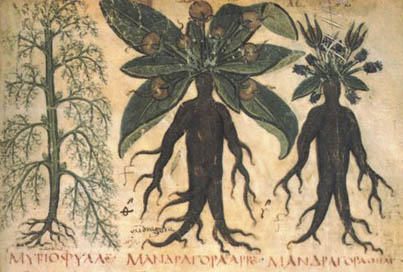
Mandrake (gr. ΜΑΝΔΡΑΓΟΡΑ, in capital letters). Folio 90 from the Naples Dioscurides, a 7th century manuscript of Dioscurides De Materia Medica (Naples, Biblioteca Nazionale, Cod. Gr. 1).

Ancient sportsmen took doping too, findings show

AYDIN – Anadolu Agency, Hurriyet Daily News, September 13, 2013

A large number of Turkish and international athletes recently banned for doping might have been born just 2,000 years too late, according to new archaeological findings in the Aegean province of Aydın that suggest using performance-enhancing drugs in ancient Greece was not only permitted but celebrated.

Locals living in the ancient city of Magnesia produced potions from the mood-altering plant mandrake, researchers have said, noting that their involvement with the drug gave them pride of place.

“Part of the [local] stadium was allocated for people who came from the ancient city of Ephesus. It is also observed that some political groups as well as bakers, gardeners, bird sellers had combined tickets. A tablet shows the most important part of the stadium, which has a capacity of 60 persons, was spared for a group of people called ‘Mandragoreitoi,’” said Turkish Professor Orhan Bingöl, who is leading archaeological excavations at the site, located in Aydın’s present-day district of Gemencik, noting that the Mandragoreitoi produced mandrake, the genus of which is mandragora. “That indicates that doping was not a crime back then, but rather that those who produced that substance had a special place in society and were encouraged.” Continue reading Athletic dopes →

Up against a wall mural


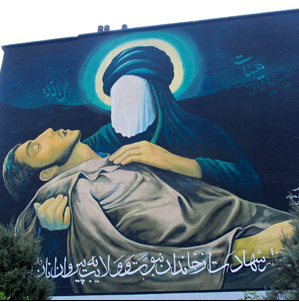
Martyrdom is the inheritance of the Prophet and his family to their followers (translated title). Three-storey high mural located on Mudarris Freeway, Abbas-Abad, Tehran, Iran, Fotini Christia, photographer.

Harvard College Library site. Here are two examples.


“You athletes should follow Ali (peace be upon him)”, Fotini Christia, photographer,