In Egypt, your empathy alone is enough


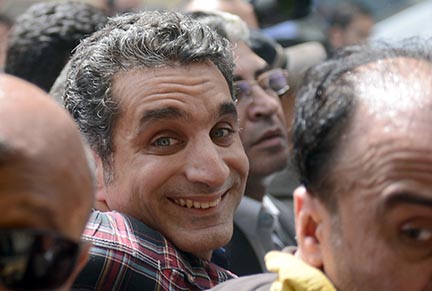
Egyptian satirist and television host Bassem Youssef is surrounded by his supporters upon he arrival at the public prosecutor’s office in the high court in Cairo
(AFP Photo)

by Bassem Youseef, al-Arabiya, December 13, 2013

In some sort of excessive selfishness, Egyptians are tending to see as victims only those with whom they sympathize. For example, if you voice your anger over the verdict to imprison the Alexandria Girls (they were later acquitted), a friend will send you a photo of the Kardasa soldiers who were unjustly killed and tell you: “If you’re sad over this verdict, then remember those soldiers.”

If you express your grief over the killing of soldiers in Sinai, Muslim Brotherhood pages on social networking websites will publish photos of the dispersal of the Rabia sit-in and tell you: “If you’re sad over those soldiers, remember the protestors who were killed first.”

National security officer Mohammed Mabrouk gets killed in a terrorist ambush, and instead of praying for mercy over his soul – since he is a human being – some rush to publish photos and names of those killed by Interior Ministry gunfire. It is as if Mabrouk is responsible for all those martyrs. Continue reading In Egypt, your empathy alone is enough

Of Drones and Reporting


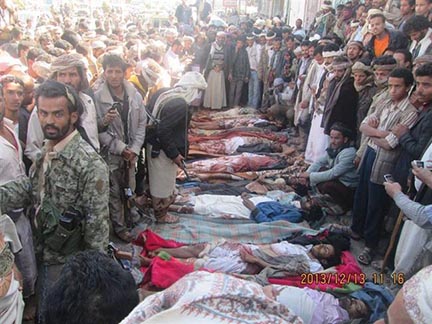
Bodies of Yemenis killed by a drone attack last Thursday

The use of drones in Yemen has received a lot of attention this year, even though there has appeared to be a lull in their use since the summer. It is reported in Yemen Press that an American drone killed 8 Al-Qaida suspects in Ahwar Abyan. No details are given in the article. Nashwan News, quoting sources from Yemen’s security forces, describes a different strike the same day in al-Bayda’ in which a top al-Qa’ida figure is said to have been killed. Or was it really a wedding procession, as reported in Al-Masdar Online, which describes a drone (known in Arabic as a ta’ira bidun tiyar) that killed 13 and wounded 30 others in hitting cars in a wedding procession (zifaf). Aden Online reports the number of dead as 17 and 32 wounded. Another source gives a range of 12 dead and wounded. The province of al-Bayda’ has seen a lot of resistance to the government. The drone struck at 4:30 pm on Thursday, hitting cars carrying men from two tribes. Two prominent tribal shaykhs were said to be wounded in the process.

The stories differ because the sources differ, some eager to justify any drone attack as effective and others unwilling to admit that the strike was successful in eliminating a terrorist. Clearly, however, as the horrendous photograph of the dead documents, whether or not al-Qa’ida lost a leader, there were quite a few other people who were killed. Even if the government thought it legitimate to go after one man, is it worth depriving so many citizens of life and limb? Once again drones serve as the best recruiting tool for terrorists in Yemen and drag the name of the United States even further into the muck. Continue reading Of Drones and Reporting

Yin and Yang over Yemen’s Drones


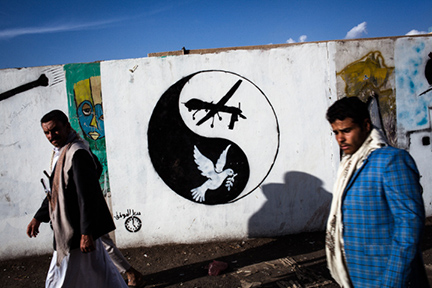
Men walk past anti-drone mural in Sanaa, Yemen, Nov. 25, 2013; photography by Juan Herrerro

Yemen’s New Ways of Protesting Drone Strikes: Graffiti and Poetry

by Tik Root, Time Magazine, November 30, 2013

An American drone hovers along a main thoroughfare in the Yemeni capital, Sana’a. Not a real drone, but rather a 7 foot-long rendition of an unmanned aircraft spray-painted near the top of a whitewashed city wall. Below it, a stenciled-on child is writing: “Why did you kill my family?” in blood-red English and Arabic script.

Painted by Yemeni artist Murad Subay, the Banksy-esque mural sits beside three others also admonishing the United States’ use of drones in Yemen to track and kill terrorism suspects. This drone art is part of Subay’s latest campaign, “12 Hours”, which aims to raise awareness about twelve problems facing Yemen, including weapons proliferation, sectarianism, kidnapping and poverty. Drones are the fifth and arguably most striking “hour” yet completed.

“Graffiti in Yemen, or street art, is a new device to communicate with the people,” says Subay, 26, who after taking up street art two years ago in the wake of Yemen’s Arab Spring revolution has almost single-handedly sparked the growing Yemeni graffiti movement. “In one second, you can send a message.”

The anti-drone chorus in Yemen has grown louder since the Obama Administration took office in 2009. All but one of the dozens of reported drone strikes in Yemen have been carried out since Obama came to office (although strikes here and in Pakistan have been more sporadic in recent months). Operations are rarely acknowledged by American officials but have nonetheless stirred a global debate about the strikes’ legality, morality and effectiveness. Continue reading Yin and Yang over Yemen’s Drones

Response to “The Collapse of Tradition”


On Marriage by Khalil Gibran

The following is a response by Dr. Najib Sifri of Lebanon to the post and poem entitled “The Collapse of Tradition” by George Elhage.

كتت أعتقدُ انني لن أقرأ لجورج نقولا الحاج قصيدةً مثل ” عقدة الجنس ” بعدما حملنا العمر ستة عقودٍ من الاعوام واكثر . ولكنه يبدو ان شعر جورج كالنبيذ الغالي كلما تعتق في خوابي السنين صار أطيب وارحب واكثر تأثيرا في معناه وفي مبناه ..
لقد حملتني هذه القصيدة الى سنوات الشباب الثائر على التقاليد الجوفاء وعلى الممنوعات السوداء وعلى المتاجرة بمصير النساء , وكأننا نعيش في زمنٍ غابرٍ اكل الدهرُ عليه وشرب !
صحيحٌ أنني وهو في ذلك الزمن قد قطفنا الرمان وتلذذنا بملمسه ومذاقه , ودخلنا فيما دخلنا اسرة الصبايا من كل نوعٍ ولونٍ وجنسٍ ولعلنا كنا من الاستثناءات التي ساعدنا فيها كوننا درسنا في مدارس مختلطة يجلس فيها هذا قرب هذه , وانتقلنا الى جامعة هي ايضا تقدس الحرية الشخصية لكل فرد رجلا كان او امرأة , اضافة الى اننا ننتمي الى طائفة دينية غير متعصبة ونسكن ايضا في امكنة لا حجاب فيها ولا نقاب .
هذه القصيدة التي انشدها جورج في القرن الواحد والعشرين تدلنا على انه حتى في ايامنا كان الامر افضل مما نحن عليه اليوم , فبدل من ان يكون القول الى الامام سر اصبح الى الوراء در …
جورج من الذين يتقنون صبّ المعاني في قوالبها فهو مهندس بارع في سبك العبارة وتحميلها لصدر وعجز مناسبين تمام التناسب , وهو فنان في ضبط الايقاع عدا انه مصور ماهر ذات خيال خصب وهذا ما يميز هذه القصيدة حيث ان هناك كثيرين ممن كتبوا في هذا الموضوع لكنهم اخفقوا , ولعل كل بيت من أبيات هذه القصيدة يحتاج الى صفحة اواكثر تدقيقا وتمحيصا وليس هنا المكان المناسب لهذا الامر , فليست هذه سوى رسالة شخصية لصديق يرسل الى اخيه خواطر من القلب الى القلب .
هي الثقة مشكلتنا في هذا الشرق , فلا ثقة لامٍ بابنتها , ولا ثقة لاخٍ باخته , ولا لزوج بزوجته , ولا بامة بنسائها , ولالرجل بنفسه ,لان تواريخ الشعوب مكتوبة على وجه نسائها فأين تقع هذه التواريخ واين نجدها واكثر نسائنا تضع الاقنعة السوداء على وجهها رحمنا الله وهنيئاً لجورج الحاج …..

Karbala becomes Carbala

by Abbas Sarhan, Niqash, November 28, 2013

Only a few years ago a woman driving on the streets of Karbala was an unusual sight, one that some considered indecent and odd. But this has changed a lot, with more women driving and more locals considering it acceptable. And despite the city’s conservative ways, local authorities are now sending their female staff to driver education courses.

Local woman Ruqaya is proud that she was one of the first females, if not the first, to drive a car in the conservative Iraqi city of Karbala. She’s a school teacher and she was taking taxis to work every day. “This was costing almost one quarter of my salary,” she explained to NIQASH. “So I decided to buy a car. It was an old Daewoo and I bought it for US$3,000. In 2009, I sold it and bought a sportier model, a Kia.”

That was in 2005. “It was strange to see a woman driving a car here,” she continues. “People often looked surprised or outraged when they saw it. And there were men who would make fun of female drivers and who made jokes about them.”

Once when her car broke down, Ruqaya had to leave it next to a petrol station and she was jeered at by those who saw her predicament as she left the car.

Karbala didn’t have any actual laws forbidding women from driving and, unlike in some Gulf States, there has never been a fatwa, or religious edict, issued that forbids women from driving. Continue reading Karbala becomes Carbala

Early Marriage and Early Islam


Dr. amina wadud

by amina wadud, feminismandreligion.com, Oct. 3, 2013

This week, in the state where I am living, Kerala, India:

“…nine prominent Muslim (sic) organizations have decided to approach the Supreme Court to exclude Muslim women from the law prescribing a minimum marital age. According to them, the present Prohibition of Child Marriage Act, 2006, which prescribes 18 as women’s legal age and 21 for men, violates Muslims’ fundamental right to practice their religion.”

Let me try to step back and formulate this in plain English.

India is a secular democratic nation-state, with a population of over 1 billion, a poverty rate at best estimated at 22%. It ranks as the 55th worst country with regard to its maternal mortality rate with estimates as high as 450 per 100,000, and has an infant mortality rate of 44-55 per 1000. All the above factors have a direct corollary to child marriage: poverty, maternal mortality (think babies having babies), and thus, infant mortality is directly related to the national age of marriage.

Thus, one way to eradicate poverty, save mothers, and save infants is to prevent child marriage. It is no wonder preventing child marriage is a leading strategy for development organizations, human rights organizations and even the World Bank. In 2006, India passed the Child Marriage Act which states, “This legislation is armed with enabling provisions to prohibit child marriages, protect and provide relief to victims and enhance punishment for those who abet, promote and solemnize such marriages” (pg 1).

Against the proven results: maternal mortality and infant mortality rates have declined since the inception of the Child Marriage Act, Muslim organizations in Kerala have decided to approach the Supreme Court to ask that Muslims be exempted as it “violates the fundamental right to practice their religion”!!!

While providing no evidence that child marriage is “fundamental” to our religion, the absence of which would “violate” our ability to practice—since there is no such evidence—let me at least attempt to objectively describe the process of history and culture as it might lead to such a misconception. Continue reading Early Marriage and Early Islam

Arabian Humanities Online


Urban structure of Doha until the 1960s; Source: Scharfenort 2012 (Exhibition in Msheireb Enrichment Center)

The second issue of the new journal Arabian Humanities, with selections in both English and French, is now available online here.

The table of contents is reproduced below:

Juliette Honvault
Éditorial
Villes et dynamiques urbaines en péninsule Arabique
Cities and Urban Dynamics in the Arabian Peninsula

Claire Beaugrand, Amélie Le Renard et Roman Stadnicki
Au-delà de la Skyline : des villes en transformation dans la péninsule Arabique [Texte intégral]
Beyond the Skyline: Cities in Transformation in the Arabian Peninsula [Texte intégral | traduction]

Nelida Fuccaro
Preface: Urban Studies in the Arabian Peninsula: 6 Thoughts on the Field [Texte intégral]
Préface : Les études urbaines en péninsule Arabique
1. Croissances, politiques et projets
Growth paths, politics and projects

Brigitte Dumortier
Ras al‑Khaïmah, l’essor récent d’une ville moyenne du Golfe [Texte intégral]
Ras al‑Khaimah : the recent dynamics of a middle size city of the Arab‑Persian Gulf

Steffen Wippel
Développement et fragmentation d’une ville moyenne en cours de mondialisation : le cas de Salalah (Oman) [Texte intégral]
Development and Fragmentation of a Globalizing Secondary City: The Case of Salalah (Oman)

Sebastian Maisel
The Transformation of ‘Unayza: Where is the “Paris of Najd” today? [Texte intégral]
La transformation de ‘Unayza : où en est le « Paris du Najd » ?
Philippe Cadène
Koweït City : planification urbaine et stratégie régionale [Texte intégral]
Kuwait City: Urban Planning and Regional Strategy Continue reading Arabian Humanities Online

The Collapse of a Tradition


On Marriage by Khalil Gibran

The Collapse of a Tradition, from Sacred to Profane: The Abolishment of the Institution of Marriage

by George Nicolas El-Hage, Ph.D.

In the Middle East, in general, gender equality, love, sex, marriage, emotional relationships, and the proper place of women in society and in the workplace are still issues of debatable outcome and still draw mixed interpretations and polemic conclusions. Simple rights, whether a woman should be allowed to drive, to walk into a mall unescorted, to openly date and be free to choose a mate, and to climb the corporate ladder and lead a company, such topics can still fuel serious debates and bring down questionable consequences. Of course, there are cases, in many Arab countries, where the few have dared to challenge the tradition and break the norm. However, these are rare instances where a woman, or a group of women have been bold and “wild” to take such dangerous steps. Overwhelmingly, women still lag behind and remain treated as second class citizens.

I have spent the last six months in Lebanon and have witnessed firsthand the destruction of what is commonly held as the sacred “marriage institution.” Of course, there are couples who fall in love and fight for their togetherness and try to make it the old fashion way, by earning the right to a successful marriage and a happy family, but by and large, marriage has become a commodity, a sort of contract that should yield a lucrative mutual gain, a connection with benefits, at best, a necessary evil that in some cases is performed under social, parental or economic pressures. Even further, unfortunately, it has become a monetized, materialistic show of wealth intended to keep up appearances while in reality; it is rather void of romance and any traces of love burning in the heart of either partner. Continue reading The Collapse of a Tradition