Let it Snow, dear Sphinx


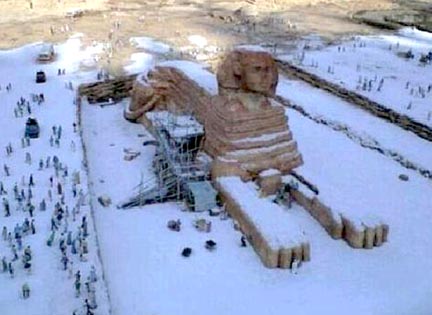
Snow at the Sphinx

As the above photograph shows, even the treasured sands of Egypt are not immune to Mother Nature’s cold warnings. Snow is rare in Egypt and when it falls there is certain to be much interest in what such a climatic omen portends, especially given the mystery that surrounds the Sphinx. After Napoleon’s invasion, unsuccessful as it was from a military standpoint, Egyptomania raged in Europe. There are many poems, as well as paintings, that draw an Orientalist view of the region. Even Mark Twain set down Tom Sawyer over the pyramids. On this Christmas Eve, when the birth of Christ is celebrated throughout the world, including Egypt, it is well to remember that mystery is in the air. Given that General Sisi has admitted that his climb to power was foreordained in a dream, the mysteries coming out of Egypt are as alive as ever.

Oscar Wilde is probably not a name anyone would associate with the night before Christmas. But he did write a semi-humorous and rather long poem in 1894 entitled “the Sphinx.” The whole version can be found here, but I excerpt a few lines to assist in the holiday spirit:

A thousand weary centuries
Are thine, while I have hardly seen
Some twenty summers cast their green
For Autumn’s gaudy liveries.

But you can read the Hieroglyphs
On the great sandstone obelisks,
And you have talked with Basilisks
And you have looked on Hippogriffs. Continue reading Let it Snow, dear Sphinx

Joshua Davidson and the Spirit of Christmas

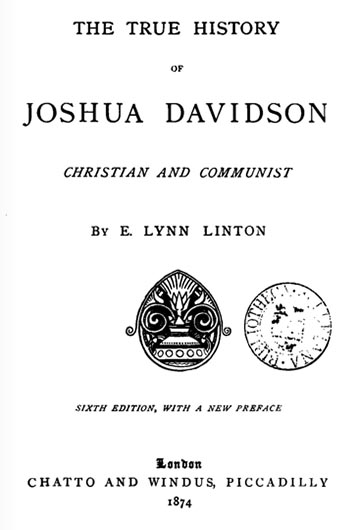
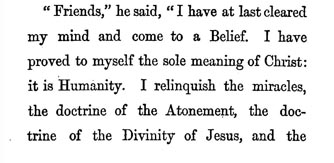
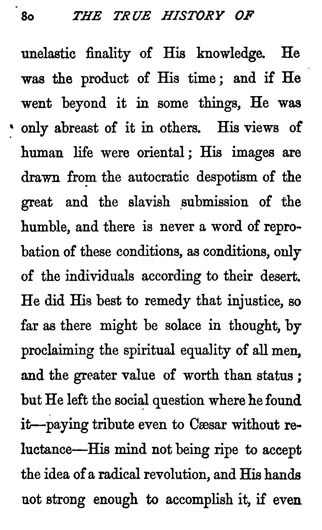
I suspect that no one reading this blog has ever heard of Joshua Davidson. He was born, actually created, in 1872 as a fictional character in a social commentary novel published by Eliza Lynn Linton and entitled The True History of Joshua Davidson, Christian and Communist, which is available online. I came across this fascinating not-quite-modern-day parable in a published lecture by the British anthropologist E. E. Evans-Pritchard. Linton’s book, originally published anonymously, imagines Jesus as a mid-19th century Englishman who sees the vicars of his day as pharisees and the money-changers outside the fancy cathedrals. In the end he is killed, like Christ, because he dared to live like the Jesus of the Gospels. The book is well worth a read speaking truth to the imperialist and high-church-minded power of Britain well over a century ago. But let the narrative speak for itself.

Continue reading Joshua Davidson and the Spirit of Christmas

Trouble in Hadramawt


The famous Hadrami town of Shibam

News reports over the past week have indicated growing tensions in the Yemeni Hadramawt, following the shooting of a major tribal leader at a military checkpoint. Military outposts have been attacked and several soldiers killed in the upheaval. According to the Yemen Times, President Hadi has accepted the demands of several tribal leaders who asked for the closing of military camps and for investigation of those responsible for killing the shaykh. To appease the local inhabitants, Hadi also promised that the oil companies in the area would hire more Hadramis.

The Hadramawt has a fascinating history as a region often sheltered from the events happening elsewhere in Yemen. There is probably no region that has seen more out-migration over the centuries with Hadramis establishing a major foothold in India, Indonesia and the East Africa coast. For a delightful video on the scenes and history of the Hadramawt in Arabic, click here.

Breaking with tradition

by Amal Al-Yarisi, Yemen Times, November 26, 2013

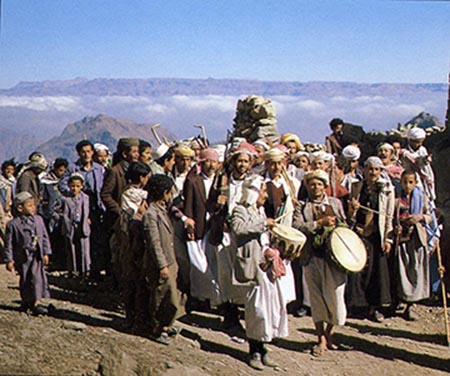
The institution of marriage has gone through radical transformations since our ancestors gave up their nomadic wanderings and adopted an agricultural-based lifestyle. What has historically been an economic arrangement and a way to merge properties and tribes in Yemen is increasingly becoming a love arrangement.

Though arranged marriages remain the norm, Yemeni women are proving how far they are willing to go to be with the ones they love, including turning the tradition of a dowry on its head. As more women marry the men they love, they are contributing to wedding costs, a phenomenon unheard of in Yemen until recently.

A year ago, Sabah Al-Khalidi and her then fiancé, Saeed Ali, began furnishing a three-room apartment in the Al-Safia district of Sana’a. The burden was solely Ali’s, but Al-Khalidi, a private school teacher, ended up contributing the majority of their home furnishings.

In Yemen, marriage costs, including the wedding ceremony, the couple’s future home and new clothes and gifts for the bride, are traditionally paid for by the groom and his family.

According to Ahmed Al-Ghazan, a social researcher at the Sana’a Social Studies Center, dowries in Yemen generally range from YR200,000 ($930) to YR2 million ($9,300), barring the extremely poor, extremely wealthy Yemenis paying higher dowry prices for women who hold citizenship from Western countries. Continue reading Breaking with tradition

The Banality of ‘Jihadism’


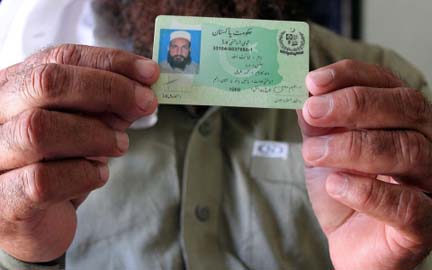
This photograph taken on May 2, 2013 shows Pakistan man, Abdul Razzaq holding the national identity card of his brother Amanatullah Ali, who has been detained for the last nine years in Bagram jail in Afghanistan, in Faisalabad. Guillaume Lavallee/AFP/Getty Images

Abu Zubaydah and the banality of ‘jihadism’

by Terry McDermott, al-Jazeera,December 19, 2013

The world is full of dangerous goofballs, but we can’t treat them all as threats to civilization

The Abu Zubaydah diaries recently made available to the public by Al Jazeera America might seem interesting only to security officials or 9/11 obsessives. To regard them as such would be a mistake, for they contain the most detailed portrait of the interior life of a dedicated jihadi that we have ever seen, and that we might ever see. They also help substantiate what should by now be clear: The U.S. has made significant, basic errors in its response to 9/11 and the threat of radical Islam.

Zubaydah, born in Palestine and raised in middle-class comfort in Saudi Arabia, rose through the 1990s — by what abilities it is not clear — to a position of some stature within radical Islam. He recorded his rise in hundreds of diary entries addressed to his future self. Written over two decades, the diaries track him from an early adulthood spent studying computer programming at a technical college in India through early 2002. Further diaries, written while he has been in U.S. custody, including at Guantánamo, have yet to be revealed.

Zubaydah was captured in the spring of 2002, the first significant Al-Qaeda-linked terrorist to be caught after 9/11. It turned out the link to Al-Qaeda was more tenuous than the U.S. government had imagined. For years, the U.S. government had viewed him as a major figure within the group, at one point even elevating him to the No. 3 position on what turned out to be a fanciful Al-Qaeda organizational chart. Continue reading The Banality of ‘Jihadism’

Veiled Women Walking

There is a fascinating Tumblr website devoted to images of veiled Muslim women walking in front of things. The pictures are well worth looking at. As the two chosen here demonstrate, there is a cultural disconnect between walkways. The Yemeni woman above is wearing a sharshaf, introduced by the Ottoman Turks and at first an urban icon. It has now spread, through Salafi influence, to the whole country, even the blistering hot Tihama. The image below is revealing because the veiling is much more of a social statement against the grain in Western contexts where bare or nearly bare female bodies are easily viewed. Both demonstrate conformity, which most fashion dictates no matter what is worn or not worn, but the context, and thus the contrast, differs.

Goodbye, Lawrence, Goodbye Mr Chips

The extraordinary British actor Peter O’Toole died yesterday at the age of 81. His most famous movie, without question, was Lawrence of Arabia. But he made many other performances, including Becket (1964) with Richard Burton, a remake of Goodbye Mr Chips in 1969 and the hilarious spoof, The Ruling Class (1972). I had the privilege of meeting O’Toole at the Chicago Humanities Festival in 1997, when he gave a stirring reading of his latest autobiography. You will find numerous obituaries, but here is the one in The Guardian.