Yemen: Ready for Change?

Yemen: Ready for change?
by Peter Salisbury, Al Jazeera Online, February 3, 2013

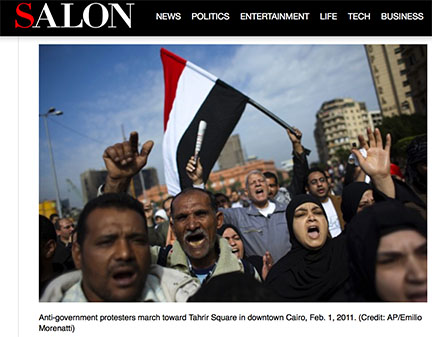
Yemen’s national dialogue has concluded, but the country remains beset by a slew of smouldering conflicts.

Yemen’s President Abd Rabbu Mansour Hadi is not known for his skill as an orator. During interviews and at public events he seems stiff, ill at ease and disconnected. He rarely speaks freely, choosing instead to read out pre-written comments. But at a recent meeting in Sanaa, Yemen’s capital, he was passionate, and seemed at several points to be on the verge of bursting into tears.

“I need you to stand by me, for the sake of Yemen,” he said in a rare moment of unscripted candour. “Serious decisions are going to be made.” Like many of those in the room at the upmarket Movenpick hotel, the president was carried away by a moment that many in Yemen had begun to doubt would ever come. The National Dialogue Conference, a months-long series of peace talks aimed at the creation of a new constitution, had finally come to an end.

Four days later, on January 25, at a ceremony held to formally conclude the talks, Hadi held a copy of the agreement in the air, to rapturous applause. Describing the conference as an “unprecedented success”, he also sounded a warning that summed up the mood in the room. “Some people say that the problem is not in writing laws, it is implementation,” he said. “This is relatively correct… There is a big difference between our past and our future.” Continue reading Yemen: Ready for Change?

Huthis vs. Hashid


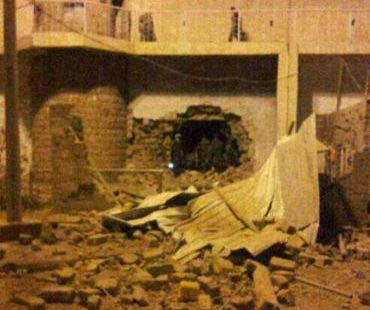
Embattled residence of Husayn al-Ahmar

I wish this was a commentary about rival football clubs in Yemen, but it is not. The news this morning is that Huthi forces have battled the tribal guard of the al-Ahmar clan, specifically the home of Husayn of al-Ahmar. Husayn is the son of the late Abdullah al-Ahmar, who passed away in 2007 but had been paramount shaykh of Hashid since the execution of his father by Imam Ahmad. Before the revolution that toppled the Zaydi imamate, the two tribal confederations of Hashid and Bakil were said to be the wings of the imamate, cautiously manipulated by the last dynasty of Zaydi imams in the north. While tribal identity, and more importantly tribal values embedded in an honor code of qabyala, is still of major importance in Yemen today, the importance of Hashid and Bakil as major political blocks has weakened. This is due in part to the efforts of Ali Abdullah Salih, Yemen’s last president, to create loyalty to his regime. But it is also a result of imported views of Islam, including the Saudi-funded Salafis.

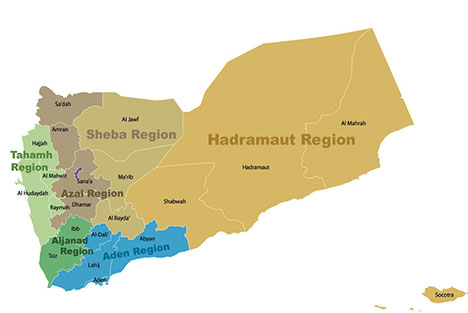
Yemen is beset with internal strife, fueled in large part by outside interests. The recent National Dialogue Conference has recommended a resolution to the current political stalemate along the lines of a federalist state. The expansion of Huthi influence closer to the capital may be part of the jousting for position in determining the boundaries of new federal states. Whatever the reason, this escalation of violence only exacerbates the tension that exists between Yemenis in various regions. Assassinations now seem to be almost a daily occurrence and Yemen’s economy has ground to a standstill. It is reported that the agricultural lands near Sa’da have been destroyed due to the fighting there between the Huthis and their foes, both the military excursions that Salih sent and the Salafis based in Dammaj. In this unrest, the feeble AQAP is able to operate with virtual impunity, despite the continued use of drones to target suspected terrorists.

Reflections on the State of Islamic Studies

The prominent scholar Omid Safi has written a commentary on Jadaliyya entitled “Reflections on the State of Islamic Studies”. It is well worth reading. I attach the beginning paragraphs below.

I have been asked to share my impressions about the state of Islamic studies in the North American academy. Given that the pioneers of this field include many of my mentors, and many of my own peers have struggled for years to help advance the field to its current state, my observations will not be dispassionate. And since I have been fortunate to have a front-row seat along the development of the field over the last twenty years, I hope I’ll be able to do justice to the current state of the field.

I became a graduate student in the field of Islamic studies in the early 1990s. In those days, almost all of us were “converts”: no one went to undergraduate studies planning to become a professor of Islamic studies. For many, particularly Muslims of transnational background, the usual academic caste options were the familiar: doctor, lawyer, engineer, maybe the always dubious “business.” Almost all of us who entered the field did so by following the siren call of one mentor or another: Seyyed Hossein Nasr, Hamid Algar, Roy Mottahedeh, Bruce Lawrence, Vincent Cornell, Carl Ernst, Michael Sells, Annemarie Schimmel, and a few others.

My own path was similarly convoluted: I had been accepted to medical school, and turned that down to embark on a PhD. It was three or four years before it occurred to me to ask anyone what the likelihood of getting a job in this field was, or what kind of salary one could expect. Imagine my shock towards the end of finishing my PhD to find out that in 1999, there were four jobs in Islamic studies in all of North America That actually represented a remarkable improvement over the 1980s, when typically there was one tenure track job in Islamic studies in the whole country.

The game changer, of course, was 9/11. In the aftermath of those events, the overwhelming majority of American universities and colleges suddenly found themselves without the necessary faculty to “explain” the event to their students, to serve as a spokesperson in engagement with local communities, and to interact with the media. Those are not identical roles, and the list of desiderata was long and imposing. But quickly, the demand for Islamic studies positions went up dramatically: the next few years (until the market crash of 2008) saw between 40-50 tenure track positions per year…

For the rest of Omid’s article, click here.

The Riya-lity of Power

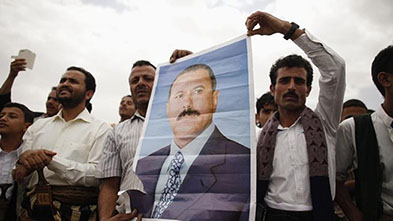
Michel Foucault, the French philosopher/historian, is oft quoted for equating knowledge (savoir) with power (pouvoir). Thanks to investigative reporting by Yemeni journalists, we now have knowledge about how Ali Abdullah Salih, the former President of Yemen, used his power to create riyal-ity, that is fabulous wealth skimmed off Yemen’s oil revenues in riyals. As reported in Yemen Press, Salih funneled millions of his wealth to the United Arab Emirates, also having villas built for his family. He has also distributed his vast wealth, as yet unaccounted for, to Morocco, France, Germany and Italy. It is reported that he did not use his own name, but those of family members.

So what else is new? Dictators, like kings and sultans of the past, have always enriched themselves while poor people starved on the streets. The more power tends to be absolute,or near absolute, the more the coffers get filled. Mamluk sultans in Egypt would periodically sack wealthy officials or merchants just to absorb their wealth. While most contemporary states have safeguards to prevent wholesale laundering of a country’s wealth, dictators generally define their own rules. While Asad hangs on to power in embattled Syria, there are no doubt several bank accounts full of cash if he ends up being forced out.

While it is true that there are various kinds of power, positive as well as negative, economics trumps the abstract notion of knowledge. Greed explains more than prejudice, although the two generally go hand in hand. Yemen is a special case in the seasonal shift following the Arab Spring. Continue reading The Riya-lity of Power

An American Tabari, #4

In a previous post I continued a series on the universal history of John Clark Ridpath. The image above is the classic image of a preacher, looking more Gospel than imamic to my eyes. I would question the sincerity of a famed imam who relied on a print version of the Quran rather than his own memory, as the image above suggests. The “preacher” with hands outstretched is a trope that crosses cultures, whether or not it is the cross being pounded on the pulpit (and certainly not on the minbar). Consider John Eliot who set his eyes on converting the “heathen” natives of the new world:

Or the long history of fire-and-brimstone wailing of American Protestants.

An American Tabari, #3

In a previous post I continued a series on the universal history of John Clark Ridpath. As one might expect, a particularly important place is reserved for Mecca itself. The image above is an ornamentation for the start of Ridpath’s discussion of Islam. The image below is a drawing of the hajj season where any sense of the individual is lost, resulting in a blur of heads.

to be continued

The Drone and the Wedding Party


Right before the first missile struck this Toyota Hi-lux — fourth in the line of vehicles — all three of its occupants fled, including the man whom eyewitnesses thought was the apparent target of the strike. Iona Craig

A little more than a month ago on December 12, 2013 a drone sent four missiles into a wedding convoy in rural Yemen, apparently targeting a senior al-Qaida figure. In this attack 12 men died. The secrecy surrounding this tragic event has prevented an accurate accounting of what actually happened. This report by Iona Craig, an independent journalist based in Sanaa, provides a thorough analysis, based on interviews with the people involved. This is the best analysis of the event that I have seen. Check it out on al-Jazeera.