Sponge Bob in Winterland

The future belongs to the young, no matter how much older generations try to shape that future. Educations plays a key role, as does the whole family context, but in the past century it is the expansion of media that has establishing a seemingly hegemonic control over the curiosity of the young. Disney launched the careers of Mickey Mouse and Donald Duck, not to mention the lily white Snow White or comfortably brown Bambi. In my day there was Woody Woodpecker, but my son’s generation was mesmerized by the Ninja Turtles. I have not kept up with cartoon evolution, but I had heard something about a cheesy character named Sponge Bob. It seems that there are many episodes of Sponge Bob available in Arabic on Youtube. The image above is from an adventure in a hibernating-bear-in-an-igloo winterland.

I have seen Arabic translations of Western and Japanese cartoon shows before, and anthropologist Mark Peterson has written a fascinating ethnography (Connected in Cairo: Growing Up Cosmopolitan in the Modern Middle East, Indiana University Press 2011) about the Pokemon phenomenon and other comic characters in Cairo. It is important to remember that the urban generation that has taken to the streets in the Arab Spring and lives and dies through the social media has also been brought up in a steady diet of cartoons, both comic books and videos. While academics have been arguing over the impact of erudite Orientalism, there is a far more potent source influencing the thought of the young: I call this “cartoonality,” the shaping of opinion through fictional non-human or ultra-human cartoon characters. Continue reading Sponge Bob in Winterland →
Anti-Muslim Sentiment Rising in the U.S: What Is Happening to Religious Tolerance?

by Charles Kurzman, ISLAMiCommentary, February 13, 2014:

Islamic terrorism has proved to be a relatively small threat to public safety in America since 9/11. Isolated individuals have engaged in sporadic violence such as the Boston Marathon bombings, but radicalization has remained far more limited than security officials feared. A report issued this month by the Triangle Center on Terrorism and Homeland Security shows that the number of Muslim-American terrorism suspects and perpetrators remained low in 2013.

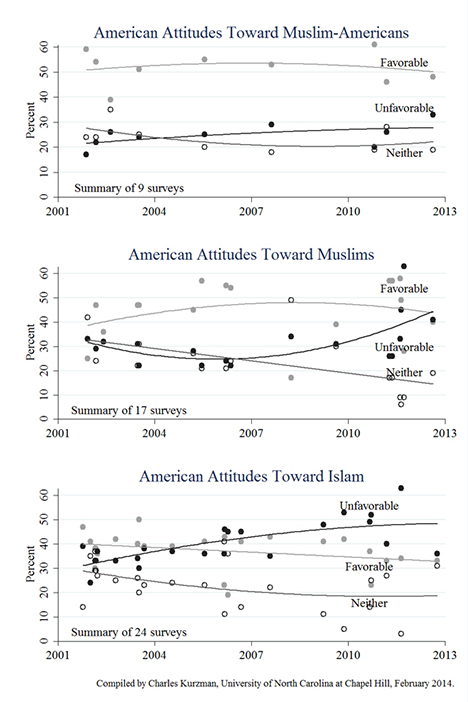
Yet American attitudes toward Muslim-Americans have grown more negative in recent years. Eight surveys since 9/11, most of them conducted by the Pew Forum on Religion and Public Life, have asked random samples of adult Americans whether they have a “favorable” or “unfavorable” view of Muslim-Americans. As shown in the top graph, the proportion answering “unfavorable” has increased over time: before 2006, all five surveys found “unfavorable” rates of 26 percent or lower; in the four surveys between 2006 and 2012, only one found “unfavorable” rates that low.

These numbers are still considerably less than positive responses, but they suggest that a growing segment of the American population is willing to express negative views about Muslim-Americans in recent years. Continue reading Anti-Muslim Sentiment Rising in the U.S: What Is Happening to Religious Tolerance? →

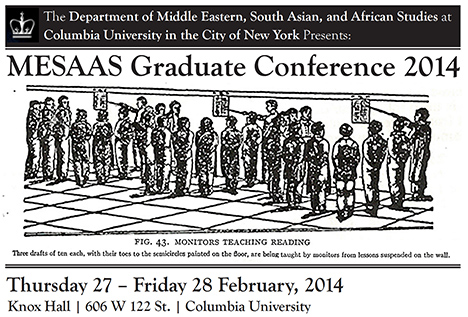
MESAAS Graduate Conference 2014

For more information on this upcoming conference at Columbia University, click here.

THURSDAY 27

8.30 – 9.30 am: Registration (Knox Lobby) and Light Breakfast (Knox 207 and 208)

9.30 – 10.30 am: Welcome Remarks (Matan Cohen) and Plenary Address (Sudipta Kaviraj) – Knox 208

SESSION 1: 10.45 am – 12.45 pm

Scanning the Shelves of the African Islamic Library – Knox 207

Wendell Marsh
Reading Sudanic Africa in the Margins: the Perils of Commentary

Kimberly Wortmann
Intellectual Cartographies in the Medieval Western Sahel (c. 1464-1627)

Ariela Marcus-Sells
Spells and Prayers: Discussing Muslim Practice in Saharan Society

Lori De Lucia
On the Edges of Mediterranean History: Finding Evidence for Sub-Saharan African Narratives in the 16th Century Kingdom of Naples

Discussant: Mamadou Diouf
Moderator: Tommaso Manfredini Continue reading MESAAS Graduate Conference 2014 →

The Arab World Learning Barometer

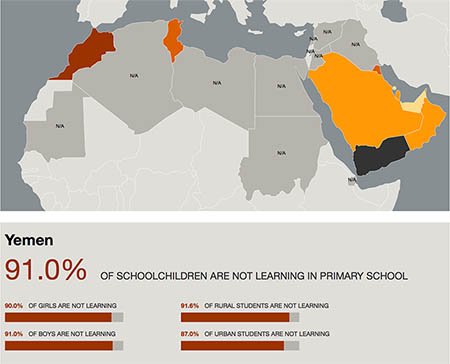
The Brookings Institute has recently released an “Arab World Learning Barometer,” that includes information on education and youth in Yemen. Check it out here.

The Arab World Learning Barometer is an interactive tool developed by the Center for Universal Education at Brookings. Using the latest available data, the barometer provides a snapshot of the state of education and learning in the Middle East and North Africa.

The barometer measures the quality of education and learning by examining four areas: getting into school, staying in school, whether students are learning basic skills while in school, and the link between education and youth unemployment. The barometer brings together often scarce data for 20 countries in the Arab region. The data cover the 2001-2012 period and do not reflect setbacks due to recent conflicts in the region.

Continue reading The Arab World Learning Barometer →

No Palestinian Idol at World Cup?

Palestinian Arab Idol Gets Booted From World Cup, and Shakira’s Response Was Perfect

by Milana Knezevic, PolicyMic, February 13, 2014

Palestinian Arab Idol winner Mohammad Assaf says he has been banned from performing at the World Cup opening ceremony this summer — and that Shakira is boycotting.

He said at a press conference earlier this week that he was supposed to sing at the show kicking off the FIFA World Cup in Brazil, but that because of some “countries” or “groups” — no one was specified — his record company was told this won’t happen after all. He also said that Colombian superstar Shakira, who sang the 2010 World Cup anthem “Waka Waka,” has refused to perform at the ceremony because of it.

Assaf rose to fame last year when he won the regional singing competition Arab Idol, and was especially lauded for his performances of traditional Palestinian music:


Hear the winning song on Youtube here

In the process, he gained some high-profile fans. FIFA President Sepp Blatter visited Palestine last summer, and said he would invite Assaf to sing at this summer’s World Cup.

It was reported then that Assaf and Shakira might sing together in Brazil, but now it appears both will be staying away from the festivities. Continue reading No Palestinian Idol at World Cup? →