Tabsir Redux: Islamic Folk Astronomy, #3


Mohammed at the Kaaba. Miniature from the Ottoman Empire, c. 1595. Source: The Topkapi Museum, Istanbul

Folk Astronomy and Islamic Ritual

Astronomy was relevant to Muslims in large part because of several of the ritual duties proscribed in the Quran and Islamic tradition. The three most important of these are determining the beginning of the fasting month of Ramadân, reckoning the times for the five daily prayers, and determining the proper direction of the qibla or sacred direction toward Mecca. While Muslim astronomers later worked out mathematical solutions to some of these problems, correct timing and orientation could be achieved by those untrained in astronomy and with virtually no computation skills beyond simple arithmetic (King 1985:194). Continue reading Tabsir Redux: Islamic Folk Astronomy, #3

Famous Yemenis


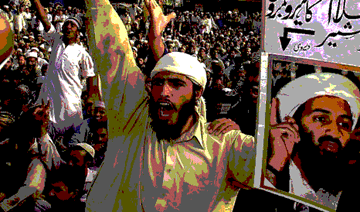
By accident I came across a website called “countrylicious: World country facts” which has a section on Famous People in Yemen. It is telling that the first entry is for Mukesh Ambani, an Indian business magnate who is India’s richest man with personal wealth of $21.5 billion. He does not seem to have anything to do with Yemen, but he is followed by Tawakkol Karman and then Ali Abdullah Salih, who weighs in just above Abu Hureirah, the companion of the Prophet, who was indeed born in Yemen (the entry here is taken verbatim from Wikipedia). But then when you scroll down to Abd al-Majeed al-Zindani, a rather strange thing happens. The picture shown is actually of Anwar al-Awlaqi or else Zindani has had major plastic surgery. Here is where copying from Wikipedia can get you in trouble. The Wikipedia site for al-Zindani also has the picture of al-Awlaqi and no one checked to see the switch. So much for the facts on this site…

Ba’d Kharab Halab


January 2013: Syrian government troops take position in a heavily damaged area in the old city of Aleppo; AFP/GETTY

There is a well-known, and after 2003 quite apt, proverb in Arabic: “After the destruction of Basra” (Ba’d kharab Basra). It originally referred to a slave revolt in Basra, the southern Iraqi port, in the 9th century. But it still resonates a millennium later. The savage violence that has left Syria in turmoil not seen since the days of the Mongols has now reduced major parts of one of the splendid cities of the Middle East to rubble. Now we see the destruction of Aleppo (Halab in Arabic), once Syria’s second largest city, with little evidence of a resolution of the fighting. Even the old suq has been destroyed beyond recognition. UNESCO designated Aleppo a World Heritage site, but this status has not saved it from massive destruction.


The Aleppo of the recent past

For the last three months the government of Bashir al-Asad has been dropping barrels — more than a thousand — of barrel bombs, making much of the city a ghost town. Some estimates indicate that 90% of Aleppo’s population has been forced out.

Sad pictures are readily available on the internet and on Youtube. But the horror of kharab continues. It appears that al-Asad is content to be the dictator of Damascus and let the rest of Syria be damned. Of course, he has his accomplices, the fanatic jihadists who are as vicious as the regime they are intent on toppling. Meanwhile the Syrian people suffer and the rest of the world either ignores this or makes things worse by supporting one side or the other with arms. If only we had a new proverb: ba’d kharab this insanity!

Nigel Groom


A husn or stronghold in Wadi Bayhan

The Telegraph, March 12, 2014

Nigel Groom, who has died aged 89, was an Arabist, historian, author, soldier, spy-catcher and perfume connoisseur. These pursuits saw him fend off a tribal assassination attempt in Aden, uncover a KGB spy embedded in the RAF and explain the association between frankincense and Christ’s divinity.

As a young Political Officer for the Colonial Service, Groom arrived in the British Protectorate of Aden in 1948. He was responsible for the north-eastern area, based in Bayhan, a remote emirate bordering the central Arabian Desert, and accessible only by small RAF aircraft. Two years later he took over the northern area, based in Al Dhali’, regarded at the time as a difficult, ungoverned tribal part of the Protectorate, riven by unrest fuelled by the Imam of Yemen in pursuance of his claims over the whole country.

At Christmas in 1950 the British agent for the western area of the Protectorate, Basil Seager, and his wife arrived to spend the holiday in Al Dhali’, unaware that a plot was afoot to assassinate both Seager and Groom (and their escort of Arab soldiers) at a Christmas Day lunch in a nearby village. However, while out for a walk with armed guards on Christmas Eve, Seager and his wife by chance met the chief assassin, a religious fanatic high on khat, and his party on their way to their assignment. The assassin stabbed Seager with his dagger, causing serious injury, and in the subsequent gunfight several of the escort and several assailants were killed. Groom signalled to Aden for a doctor, who arrived after a five-hour night-time journey over rough tracks, and for a substantial force of Aden Protectorate Levies, to leave early on Christmas morning to help counter a planned tribal uprising. Continue reading Nigel Groom

Socotra Film

One of the remaining marvels off the east coast of Africa is the island archipelago of Socotra, historically associated with Yemen, the nation which it belongs to. Socotra is a preserve of biodiversity with a local population not yet catapulted into the under-development pains of the 21st century. There is a fascinating film about the need to protect Socotra’s unique environment and its people from the devastating impact of uncontrolled “development.” Among the individuals speaking is Dutch ecologist Paul Scholte, who has extensive research experience both in Yemen and Africa. Check out both parts of the film here and here. There are a number of Youtube videos on Socotra, but most are tourist oriented and do not match the information level of this film.

Tabsir Redux: Islamic Folk Astronomy, #2

Time Reckoning

Era means a definite space of time, reckoned from the beginning of some past year, in which either a prophet, with signs and wonders, and with a proof of his divine mission, was sent, or a great and powerful king rose, or in which a nation perished by a universal destructive deluge, or by a violent earthquake and the sinking of the earth, or a sweeping pestilence, or by intense drought, or in which a change of dynasty or religion took place, or any grand event of the celestial and the famous tellurian miraculous occurrences, which do not happen save at long intervals and at times far distant from each other. Al-Bîrûnî (1879:16)

Time is relative. Given the modern world’s reliance on formalized calendars and machines that define time for us, it is easy to forget that the expansion of Islam occurred at a time when telling time was not dependent on a formal science of astronomy. How time is measured is not only a practical issue but also reflective of the desired interval of duration and the precision in defining it. Simple observation of the sun rising and setting, as well as its location, can easily yield calendars to determining hours, days, months and years. Similarly, the moon’s phases made it a useful measure for the Islamic lunar calendar. Observations of movements by the stars, as well as the planets, also provided practical ways of measuring units of time both short and long. Continue reading Tabsir Redux: Islamic Folk Astronomy, #2

Tabsir Redux: Islamic Folk Astronomy, #1


from Ibn Balkhi’s manuscript on astronomy, 850 CE

It was He that gave the sun his brightness and the moon her light, ordaining her phases that you may learn to compute the seasons and the years. He created them only to manifest the truth. He makes plain His revelation to men of understanding. Yûnus 10:9 (Dawood 1968:64)

When the Quran was revealed in seventh century Arabia as the basis for Islam, references were made to the sun, moon and stars as evidence of the creative power and practical foresight of God. The idea that God, or a particular god or goddess, had created the visible heavens was not unique. Creating stories about astronomical phenomena is as old as the first civilizations that appeared in the ancient Near East. Some of these survived, in highly edited variants, in the scriptures of Judaism and Christianity. As Muslim science evolved, a variety of religious and scientific knowledge from classical Greek texts, as well as Zoroastrian and Hindu sources, was encountered. While the influence of these classical and textual traditions on Islamic astronomy has been the focus of much previous study on the history of Islamic science, little attention has been paid to the oral folk traditions of peoples who embraced Islam. How ordinary Muslims viewed the same heavens visible to educated scientist or illiterate shepherd is the subject of this chapter. For practical reasons the focus here will be on the Middle East, especially the textual information on the pre-Islamic Arabs of the Arabian Peninsula and contemporary tribal groups in the region.

What is Islamic Folk Astronomy?

It is unfortunate that many times the idea of “folk astronomy” is understood mainly by what it is not. Continue reading Tabsir Redux: Islamic Folk Astronomy, #1

The future of Egyptian democracy: Political Islam becomes less political

by Nathan J. Brown, The Immanent Frame, March 11, 2014

For the past few years, much of the scholarly literature on Islamist movements has danced around the “participation/moderation” idea: that participation in democratic politics tends to moderate the ideology and positions of Islamists. I choose my term deliberately. When I say “danced around” I do not mean that scholars have endorsed its automatic applicability; far from it. Most have eschewed the vague term “moderation,” but even those who have used it have tried to give it specificity. And they have noted that the “participation” in question has generally been in non-democratic systems, so that a generalization culled from scholarship on political party behavior in democratic electoral systems (one that has plenty of qualifications and exceptions attached) is unlikely to be transferable to elections in which the existing regime will not allow itself to lose.

But while avoiding any simple “participation/moderation” argument, scholars were drawn to the idea that the ideology and behavior of Islamist movements could shift in response to changes in the political environment in which they operated. In short, they directed their attention away from how Islamists changed politics and instead focused on how politics changes Islamists. Continue reading The future of Egyptian democracy: Political Islam becomes less political