The Haram of Boko Haram

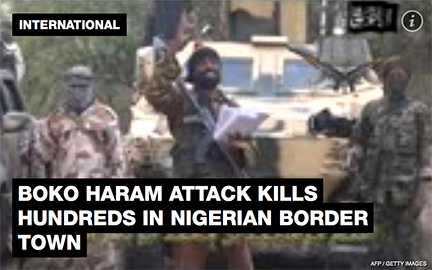
Here is a snap question: which does more harm to the image of Muslims, especially in the Western media: the political maneuvering of Egypt’s now outlawed “Muslim Brotherhood” or the savage acts committed by the self-styled Boko Haram in Nigeria? Boko Haram is well named, if you remove the Boko. I would have a hard time thinking of a more bloodthirsty and irrational group calling themselves Muslims, and there are far too many examples to choose from historically. Their kidnapping of some 276 Nigerian girls from a school to essentially enslave them is bad enough, but reports now surface of an indiscriminate killing spree in a crowded Nigerian market with over 300 said to be dead. The death toll from this group is measured in the thousands, both Christians and fellow Muslims becoming victims. Boko Haram espouses such a distorted view of Islam, that it is more accurate to label them a political terrorist group using the umbrella of Islam to carry out their barbaric acts.

Boko Haram is not alone. It is this kind of volatile mix of politics and religion that has plagued human history, probably from the start of recorded history. If one steps out of the Western preoccupation with the biblical tradition, the idea that any kind of just God would tell his ragged followers to kill every man, woman, child, ox, sheep and ass in a Canaanite city is a clear attempt to justify what most of us would rightly see today as a violation of human rights. The crusades and the bloody wars in Europe between Protestants and Catholics turned religion into yet another excuse to justify killing others. Hindus and Buddhists also have their blood-soaked moments, as do most known religions. The point is that “religion” is never separate from the real world except in some imaginary. It is myth that drives belief, whether from a sacred text written in a shroud of mystery or the quotidian alibi of personal experience. Those who take on the mantle of “God” show how little faith they really have. Continue reading The Haram of Boko Haram →
They died with their sandals on

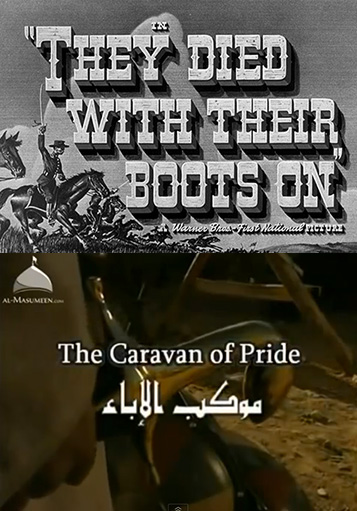
When I was young and impressionable, one of my favorite movies was They Died with their Boots On, the Errol Flynn movie about Custer’s last stand. There was Flynn/Custer with his sword raised out in front of his troops heading for the savage Indians. Had it been a fair fight, of course he would have won, but he stood his ground and was the last man standing. Watching this film recently, apart from the totally ahistorical plot of the made-for-Hollywood battle scene, I wonder how many horses were maimed from the trip wires. In a sense Flynn represented a hero against impossible odds, but in another it perpetuated the notion of the white man’s manifest destiny at the expense of the savage “red man.” I doubt it inspired any sarsparilla party types to go out and shoot any Indians, but it certainly reinforced a cultural bias that remains to this day.

I recently came across a film about the death of Husayn, the Prophet Muhammad’s grandson, at Karbala. This comes in Arabic and Urdu versions and is entitled “The Caravan of Pride” (موكب الاباء). Like the Flynn film, the bias in the film is evident from the start. This is a film highlighting the conservative Shi’a view of an evil and crazed Yazid. Watching the film creates sympathy for the tragic death of Husayn and his followers at the same time that it denigrates the incoming Umayyad caliphs as heretics. It is easy to forget that the event taking place happened in 61 AH/680 CE, before there were any of the Sunni law schools and five years before Abd al-Malik became caliph and authorized a new edition of the Qur’an. Continue reading They died with their sandals on →

Nose kiss, anyone? How the Gulf Arab greeting has evolved

By Abdullah Hamidaddin | Special to Al Arabiya News
Sunday, 4 May 2014

Last March, the “First Kiss” video was released on YouTube attracting more than 80 Million views so far. Not many people in this region were excited about it. For many here it symbolized the decadence and corruption of the West. Yet there were those who considered it interesting enough to inspire them into making a parody of it: “First Nose”. In it you have a set of guys ready to give each other a ‘first nose’.

In the “First Kiss” video the participants are embarrassed and nervous; it’s an awkward moment particularly because of the intrusive effect of the camera. And the same feelings were acted in the “First Nose” video.

There is a difference of course between a “first kiss” and a “first nose.” A kiss is an intimate act and so to kiss an absolute stranger in the presence of a camera can be quite awkward. But a “nose” is merely – or mainly – a handshake using other means. There’s no intimacy at all there. It would be hard to imagine anyone feeling awkward because he/she had to shake hands with complete stranger; camera or not. Even though the video is a parody it led to some misunderstanding. Continue reading Nose kiss, anyone? How the Gulf Arab greeting has evolved →

Noah and the Muslim Brotherhood

What do a new film about the biblical Noah, who built the ark, and the Muslim Brotherhood have in common? Both have been banned in Egypt. Muhammad Morsi, the stealth brother who was elected president of Egypt, was removed from office last July (one day before we in America celebrated our revolution). On December 25 (the consummate day for thinking about peace one earth), Egypt declared the Muslim Brotherhood a terrorist organization. Now along comes Noah, at least the latest Hollywood version, with Russell Crowe donning the mantle (at least the biblical robe variety) of Charlton Heston and providing a robust challenge to John Huston’s whimsical Noah in The Bible. The major Egyptian Islamic institution, al-Azhar, has issued a fatwa condemning the film for depicting the Prophet Noah (who has an entire chapter devoted to him in the Quran). Qatar, Bahrain and the United Arab Emirates have already officially banned the film and Egypt is likely to follow suit, given the fatwa. Continue reading Noah and the Muslim Brotherhood →

Omid Safi on George Clooney

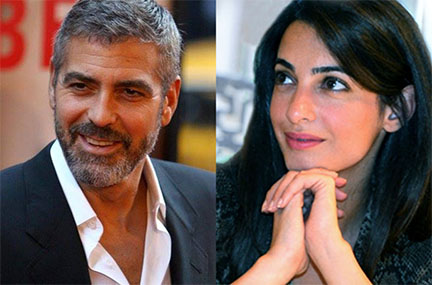
What is the religion of George Clooney’s fiancé, Ms. Amal Alamduddin? Druze? Muslim?
by Omid Safi, What Would Muhammad Do, April 29, 2014

The news that George Clooney, the perpetual bachelor, had gotten engaged to Amal Alamuddin, a stunning Arab beauty, who (ahem, ahem) is also a badass brainy Oxford-educated international human rights lawyer—pardon us, barrister—has now officially gone viral. Here and here and here.

On social media, many professional women, in their 30s and 40s, have expressed joy that Clooney was wedding a brainy (Ok, and stunning) professional woman.

Many human rights activists see this as an opportunity to bring attention to catastrophes like Syria.

Many Arabs are naturally seeing this as a confirmation of the attractiveness of Arabs. [Just check out the outburst of pride on FB!] Continue reading Omid Safi on George Clooney →

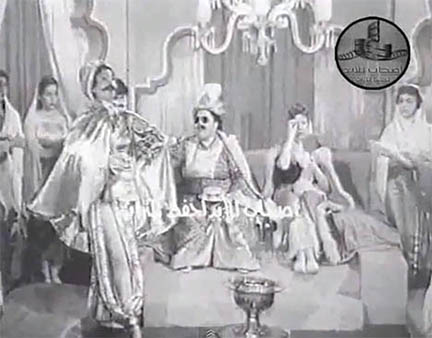
فيلم مدرسة البنات بطولة نعيمه عاكف و كمال الشناوي لسنة 1955

Half a century ago the Egyptian film industry was in full swing. Here is a clip from a 1955 film called مدرسة البنات. This was only 13 years after the classic Road to Morocco with Bob Hope and Bing Crosby. Are these films Orientalist? Indeed, that is there appeal, but there is also an undertone of satire in both. Check out the moustaches on the harem beauties in the Egyptian film.

Thimar: Research on Agriculture in the Arab World


[
Thimar is a new organization that promotes research on agriculture, environment and labor in the Arab World. Check out their website, which is still under production.]

Problematic

The lands which formed a cradle of plant and animal domestication exhibit today the greatest ‘food insecurity’ of any region in the world. Stark dependence on imported food is often attributed, on the production side, to aridity exacerbated by climate change, soil salinity, and under-capitalized small land-holdings, and on the consumption side, to population growth and change in food cultures. Dominant political and economic interpretations would have us see the region’s food deficit as ‘natural’ (a result of aridity, population growth and the force of the market).

But this argument dismisses the centrality of economic, political and social policies. An important example is Syria, where changes in policy from the end of the 1980s have led the country by 2007 to face, for the first time in its history, major national food insecurity and growing rural child-malnutrition. A comparison with Iran since the late 1980s is telling. While Syria lost industrial production, scaled back support for agriculture, and failed to develop a national consensus about the relation between wealth distribution and population policy, Iran sustained the growth of its manufacturing sector, strengthened its programme of national food-security, continued to engage with pastoral producers, and opened a public debate on population and development which led to an effective family-planning programme operating through the country’s public primary healthcare service. Continue reading Thimar: Research on Agriculture in the Arab World →