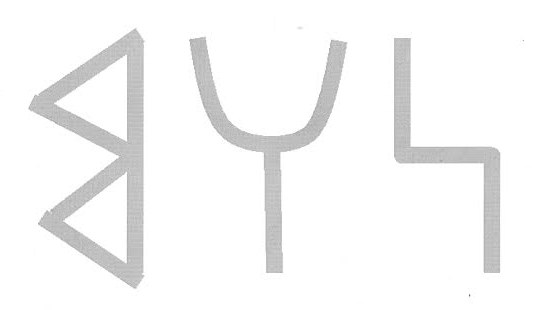
N-H-M in Sabaean
Not being a resident of Utah, I sometimes forget that there are people who take The Book of Mormon (the original and not the Broadway play) seriously. There is a passage in 1 Nephi 16:34 that suggests the place of Ishmael’s burial: “And it came to pass that Ishmael died, and was buried in the place which was called Nahom.” So where might Nahom be? Well, why not Yemen? That is the argument in an article by Warren Aston, who traveled to Yemen and found an inscription on an alter at Marib that referred to Nihm, a tribe. Thus, The Book of Mormon is verified, as innumerable Mormon websites attest, including one on Wikipedia.
There is indeed a Yemeni tribe called Nihm, part of the Bakil confederation. But why exactly would Ishmael end up getting buried in Yemen? There is certainly no indication in the Old Testament of Ishmael going to Yemen. Genesis 25:17 reads “And these are the years of the life of Ishmael, an hundred and thirty and seven years: and he gave up the ghost and died; and was gathered unto his people.” I sort of doubt that the priestly authors mention of “his people” meant the Sabaens down in Yemen. And in Islam Ishmael stops at Mecca. So either the Torah is wrong, Islamic tradition is wrong or the 19th century Book of Mormon is wrong. And, of course, given that this legendary material, they may all be wrong. There are indeed skeptics of Nephi.
The placename fallacy has a long history in pseudo-archaeology. One can rather easily manipulate major biblical placenames in Arabia. The Lebanese scholar Kamal Salibi played this game to the hilt in his imaginative The Bible Came from Arabia. Two individuals in Bahrain have continued the theme. It is difficult to dismiss the political motive (that Abraham and Moses were not herding their flocks and refugees respectively to ancient Israel) that no doubt underlies such attempts to rewrite history. Certainly there is no archaeological evidence for these bizarre claims. And just as certainly there is no end of lunatic archaeology in sight.
UPDATE:
Dr.Mohammed Maraqten, who has excavated at Marib, sends the following details about the altar:
This altar is from BarʾÄn Temple (Arsch Bilqis), ca. 6 Century B.C. and still in situ.
The complete filiations of the dedicator of this altar to Almaqah reads: Bʿṯtr / bn / s¹wdm / bn / nwʿm / nhmyn
The partly damaged letters are / N / and / H / (like Arabic Hirra) and the complete word is NHMYN and has for sure NOTHING to do with Biblical NḤM with / Ḥ / and the Canaanite root NḤM. The root is NHM and not NḤM.
Two possibilities to understand this word:
– NHMYN (al-NihmÄ«) is Nisbe to the very famous and many time attested in the inscriptions, in the Islamic period and still in the same place northeast of Sanaa. Also the Nisbe NHMYN is attested may times.
– NHMYN is a designation of a profession “Stonemasonâ€, Munahhim or Muhandis, the verb NHM is well known in the inscriptions and the Arabic sources as a Yemeni term in the meaning of “to dress stonesâ€.