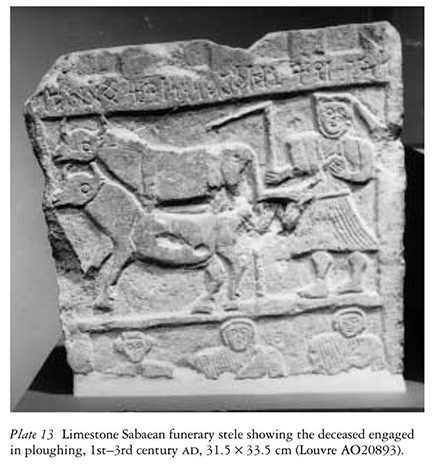
South Arabian Agriculture

The following is the abstract of a Yemeni MA thesis on agricultural crops in ancient South Arabia.

زراعة المحاصيل الزراعية في اليمن القديم
الباحث: أ / ليبيا عبد الله ناجي صالح دماج
الدرجة العلمية: ماجستير
الجامعة: جامعة صنعاء
الكلية: كلية الآداب
القسم: قسم التاريخ
بلد الدراسة: اليمن
لغة الدراسة: العربية
تاريخ الإقرار: 2009
نوع الدراسة: رسالة جامعية

الملخص:
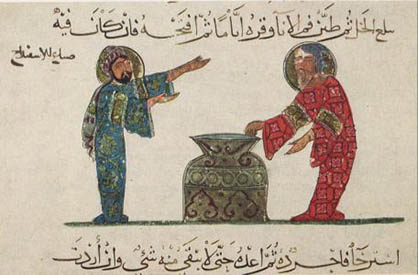
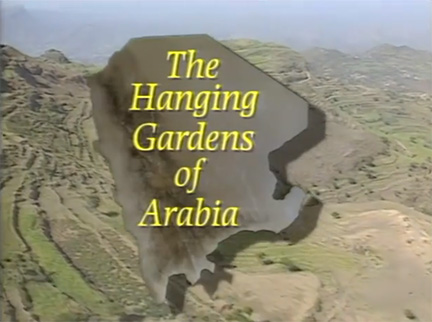
موضوع هذه الدراسة “المحاصيل الزراعية في اليمن القديم” لا تتناول ماهية تلك المحاصيل فقط وإنما تتناول كل ما يتعلق بها من كافة الجوانب، من حيث البدايات الأولى لظهور الزراعة في اليمن القديم، والآراء المختلفة والمتباينة حول ذلك، وما كان يزرع من محاصيل آنذاك. وكذا بداية ظهور الري والاعتماد عليه في سقي المزروعات. بالإضافة إلى توضيح الوسائل المستخدمة في العملية الزراعية خلال تلك الحقب الزمنية. ثم تدرس باستفاضة المواسم الزراعية وفصول السنة وشهورها، بالإضافة إلى مصادر المياه المتمثلة بالأمطار وطرق الري المختلفة والمتناسبة مع هذا المصدر، منذ سقوطها على الجبال وانحدارها نحو الأودية وحتى وصولها إلى الأراضي الزراعية. وكذا المصدر الثاني وهو المياه الجوفية، وما يتطلب من حفر أبار لاستخراج تلك المياه من باطنها. كما تتطرق الدراسة إلى كيفية تقسيم المياه بين الأراضي الزراعية، والقائم بتلك العملية.
Continue reading South Arabian Agriculture →
40 Maps that Explain the Middle East

There is a very interesting set of 40 maps that Max Fisher has put together on one website to explain the history of the Middle East. Check it out here.

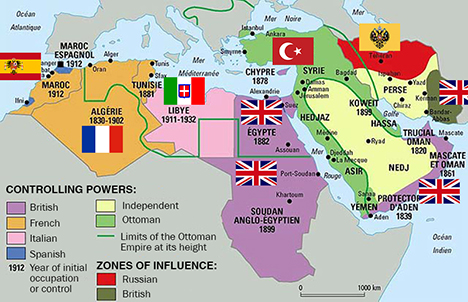
Below are Map #7 and Map #23

What the Middle East looked like in 1914

This is a pivotal year, during the Middle East’s gradual transfer from 500 years of Ottoman rule to 50 to 100 years of European rule. Western Europe was getting richer and more powerful as it carved up Africa, including the Arab states of North Africa, into colonial possessions. Virtually the entire region was ruled outright by Europeans or Ottomans, save some parts of Iran and the Arabian peninsula divided into European “zones of influence.” When World War I ended a few years later, the rest of the defeated Ottoman Empire would be carved up among the Europeans. The lines between French, Italian, Spanish, and British rule are crucial for understanding the region today – not just because they ruled differently and imposed different policies, but because the boundaries between European empires later became the official borders of independence, whether they made sense or not.

Syria’s refugee crisis

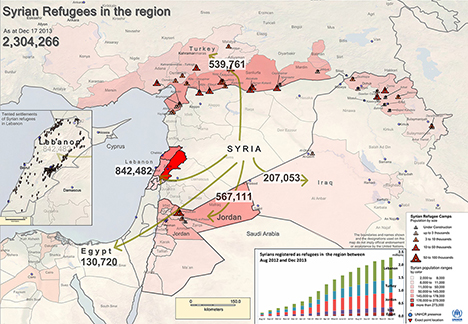
Syria’s civil war hasn’t just been a national catastrophe for Syria, but for neighboring countries as well. The war has displaced millions of Syrians into the rest of the Middle East and into parts of Europe, where they live in vast refugee camps that are major drains on already-scarce national resources. This map shows the refugees; it does not show the additional 6.5 million Syrians displaced within Syria. Their impact is especially felt in Jordan and Lebanon, which already have large Palestinian refugee populations; as many as one in five people in those countries is a refugee. While the US and other countries have committed some aid for refugees, the United Nations says it’s not nearly enough to provide them with basic essentials.

Ode to Islamic Studies: Its Allure, Its Danger, Its Power

by Edward E. Curtis IV, Religion Bulletin, May 2, 2014

Editor’s note: This post is part of the Reflections on Islamic Studies series.

By any measure, Islamic studies is a vibrant field. In the last several decades, the number of tenure-track positions dedicated to the study of Islam as a religion and to Muslim politics and societies has expanded. New journals have appeared; book sales are good; and interest in Islamic studies has led to important public humanities projects such as the National Endowment for the Humanities’ Muslim Journeys Bookshelf.

What makes Islamic studies so dynamic? For one, its ever-expanding body of participants, who come from a number of disciplinary perspectives. The field is populated by intellectual networks rather than one identifiable set of intellectual authorities. Islamic studies finds institutional homes not only in religious studies and Near Eastern languages departments, but also in history, anthropology, sociology, political science, ethnomusicology, and art and architecture, among other academic units.

Islamic studies attracts some of the very best scholars in the world. There are now so many scholars producing so much scholarship that it is impossible for one person to know all of the literature in this vast field. Questions about where to do a graduate degree must be followed by the question of what the applicant wishes to study.

The multi-disciplinary study of Islam nurtures ever-expanding circles of conversation about the significance of Islam to both specialized disciplinary concerns and interdisciplinary inquiry. The origins of Islamic studies may be found in orientalism, that is, the scholarly, philological study of Islamic religion and Muslim cultures. But today, Islamic studies is a field defined by shared and intersecting questions, themes, and data, not any one methodology or set of texts. Its practitioners are not tied together by any one canon—one needn’t be an expert on the Qur’an to be in Islamic studies. Continue reading Ode to Islamic Studies: Its Allure, Its Danger, Its Power →

A Literary History of Medicine


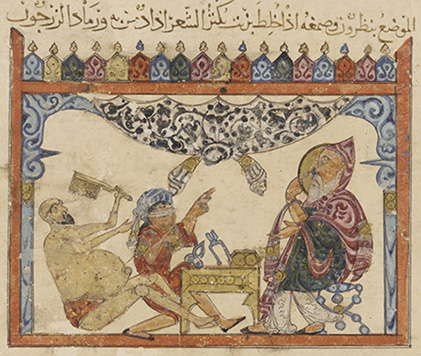
Sackler Gallery Smithonian Institution S1986.97aPhysician with two patients, Baghdad 1224 (Smithsonian Institution, Sackler Gallery SI986.97a)

[The Wellcome Trust is generously funding a joint University of Oxford/University of Warwick publishing project online of an important 13th century medical text. Read about it below and on their website.]

Kitāb ʿUyūn al-anbāʾ fī ṭabaqāt al-aṭibbāʾ
كتاب عيون الأنباء في طبقات الأطباء

In the mid-13th century, a practising physician in Syria named Ibn AbÄ« Uá¹£aybiÊ¿ah set himself the task of recording the history of medicine throughout the known world. His book The Best Accounts of the Classes of Physicians covers 1700 years of medical practice, from the mythological beginnings of medicine with Asclepius through Greece, Rome, and India, down to the author’s day. Written as much to entertain as to inform, it is not only the earliest comprehensive history of medicine but the most important and ambitious of the medieval period, incorporating accounts of over 442 physicians, their training, practice, and medical compositions, all interlaced with amusing poetry and anecdotes illustrating their life and character. The ‘Herodotean’ breadth of the book reflects the geographical and cultural reach of the Islamic empire. Written by a man who was a medic and a poet, this highly readable history reflects considerable medical experience and lies at the interface of the serious medical practice of the day with society’s interest in biography and gossip.

The Wellcome Trust is generously funding a joint University of Oxford/University of Warwick project that will make this remarkable historical source available for the first time in a reliable and readable translation and study, as well as a critical edition of the text itself, resulting in a step-change in our knowledge of medical history in Medieval Islam. For nearly 300 years attempts to translate this monumental work have failed owing to the extraordinary range of skills needed to tackle it. This joint project is the first to assemble a team of senior and junior scholars with the required skills and interests to make it happen.

As work proceeds during the three- and one-half-year project, samples of biographical entries will be placed on this web page, with an opportunity provided for general discussion and comment.

With Latefa Ahrrare in Rabat

by Anouar Majid, Tingiata, April 15, 2014

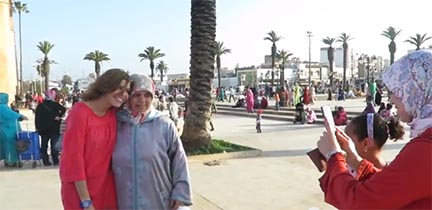
The most controversial actress in Morocco and the Arab world gave me a tour of Rabat, the capital of Morocco. To say that it was a unique experience would, quite frankly, be a huge understatement. Parking attendants, men in uniform, women with hijabs and jellabas, food sellers and everyone—literally—who saw Latefa greeted her with smiles and affection. People took photographs with her and asked for new performances. She is truly a people’s artist, one who uses a container (labelled “cont’n’art”), among other tools, to foster awareness about health and difficult social issues.

The car ride, as you could see in the video, was, in itself, a fascinating spectacle. The free-spirited Latefa sang throughout most of trip, ending, most appropriately, with the theme of Carmen, reminding us that women are born to be free, not objects to be hidden away.

Halal Henpicking


Russell Brand on The Sun

The British tabloid, The Sun, which once showed Saddam Hussein in his underwear on its cover, has now taken on the chain Pizza Express for serving halal chicken. The humor of Monty Python lives on in the Fleet Street media. The apparent argument of the article is that slitting the throat of a chicken while it is still alive is cruel punishment. I suspect that the writers of The Sun have a dark motive rather than calling for a campaign to have chickens slaughtered with dignity after being stun gunned. If such a contrived story merits more attention than the ongoing slaughter of humans in many parts of the world, then they seem to be taking a cue from “Fowlty” Towers. I suspect that The Sun does not have an equal disdain of the common practice of raising poultry in such close quarters that they basically eat their own excrement, although excrement is surely an apt topic for this tabloid.

The Sun finds Islam to be a convenient target, failing to have equal animosity to Jewish kosher law, which mandates the same style of slaughter only with a different prayer. And the slitting of the throat is actually said to be a humane way of ending the life of an animal bred to be eaten. True to its name, this halal henpicking is tabloid nonsense, void of any semblance of rationality. Most people no doubt see such a story as funny, but there are enough people out there to use this kind of silly blather to reinforce their own hate of Muslims (and Jews, of course). And then there are those who respond with humor, as does the British comedian Russell Brand on Youtube. So perhaps we need to tell yet another version of the old joke: Why did the chicken cross the road? Just for the halal of it…