Islam in the Public Square

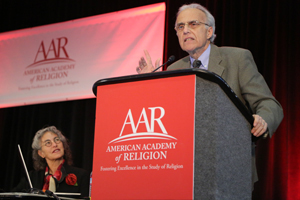
The following is an excerpt from the 2013 Presidential Address (“Islam in the Public Square”) of John Esposito for the American Academy of Religion. His entire talk is free to read online here.

The response of colleagues and family to my chosen career was interesting: Why study Islam, they asked. When I began to speak publicly, both Muslims and Christians asked why I studied Islam, but they had very different agendas in their mind. The best comment I heard was “You’ll never get a job!” At that time I was a young Catholic theologian teaching scripture and theology, and there would always be theology and religion departments.

When I was looking for a job in 1972, only one job advertised was narrowly in Islamic Studies, and the other was in World Religions at the College of the Holy Cross. When interviewed by the incoming chair at Holy Cross, I noted that Hinduism and Buddhism were my minors (in addition to an MA in theology) and that my major was Islam. He pointedly answered, “We are not looking for somebody in Islam,” and even worse, he said, “I prefer somebody in Japanese and Chinese.”

Training in Islam was totally absent for the military and foreign service officers. And not only that, our foreign service officers in the field were not encouraged to look at religion. When the Iranian Revolution came along, a friend who had been in the embassy said that there was no contact with the ulama, no going into the universities and dealing with faculty or the students in Islamic studies. Indeed, when you talked to analysts in the field reporting back to Washington or consultants on risk assessment in countries, they never looked at the religion factor. And so when Iran came along, people saw it as an epi-phenomenon. Continue reading Islam in the Public Square →

“Honest to God” Burgers


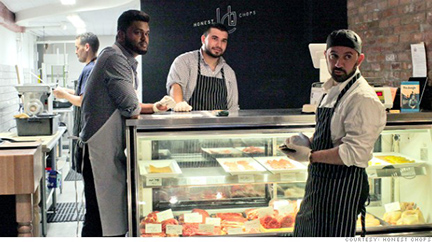
Russell Khan, Sulman Afridi, and Khalid Latif (left to right) at New York City’s Honest Chops, the country’s first halal whole animal butchery.

by NEW YORK (CNNMoney), May 30

Thick T-bone steaks and richly marbled oxtails decorate the display case at Honest Chops, a new whole animal halal butchery in downtown Manhattan.

Not only is the shop committed to selling humanely raised meat, it’s all slaughtered in the Islamic tradition, which involves a prayer and quick death using a sharp knife.

Khalid Latif, who founded the butchery in March, spoke to Muslim students and working professionals in his community who wanted a higher quality of meat than their neighborhood markets offered.

Initially, he and his partners Anas Hassan and Bassam Tariq were just interested in opening a halal butchery. But after learning about the unnatural feed that commercial cattle and chickens are raised on, they opted to source their meat from small producers in upstate New York, Maryland and Massachusetts.

“When there’s not a certain kind of purity to the food that we’re consuming, that becomes problematic from the spiritual standpoint,” said Latif, who has rigorous standards for the meat he sources. Continue reading “Honest to God” Burgers →

Darwin in Arabic

Here is a short review of an exciting new book:

Marwa Elshakry, Reading Darwin in Arabic, 1860-1950 University of Chicago, 2013.

by Carla Nappi on May 23, 2014, New Books in Science, Technology and Society

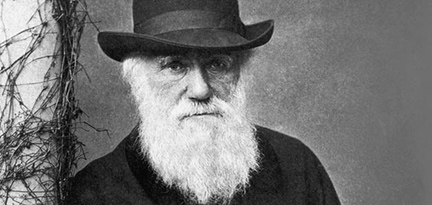
The work of Charles Darwin, together with the writing of associated scholars of society and its organs and organisms, had a particularly global reach in the late nineteenth and early twentieth centuries. Marwa Elshakry’s new book offers a fascinating window into the ways that this work was read and rendered in modern Arabic-language contexts. Reading Darwin in Arabic, 1860-1950 (University of Chicago Press, 2013) invites us into a late nineteenth-century moment when the notions of “science” and “civilization” mutually transformed one another, and offers a thoughtful and nuanced account of the ways that this played out for scholars working and writing in Syria and Egypt. The early chapters of Elshakry’s book focus on the central role played by popular science journals like Al-Muqtataf (The Digest) in translating and disseminating Darwin’s ideas. We meet Ya’qub Sarruf & Faris Nimr, young teachers at the Syrian Protestant College who were instrumental in translating scientific works into Arabic there and, later, in Egypt. An entire chapter looks closely at Isma’il Mazhar’s work producing the first verbatim translation of Darwin’s Origin of Species into Arabic, but the book also looks well beyond Darwin to consider broader Arabic discourses on the relationship between science and society, as those discourses were shaped by engagements with the work of Herbert Spencer, Ludwig Büchner, and many others. Elshakry pays special attention to the ways that this story is embedded in the histories of print culture, the politics of empire, and debates over educational reform, materialism, and socialism in the late nineteenth and early twentieth centuries, and concludes with a consideration of the continuing reverberations of these issues into late twentieth century Egypt and beyond. It is a must-read for anyone interested in the entanglements of science, translation, and empire in the modern world, and it will change the way we understand the place of Arabic interlocutors in the history of modern science.

Kidnapping of Foreigners in Yemen 2010-2014

Changing Tactics & Motives – Kidnapping of Foreigners in Yemen 2010-2014

A study conducted by Safer Yemen.

DOWNLOAD THE FULL REPORT

EXECUTIVE SUMMARY

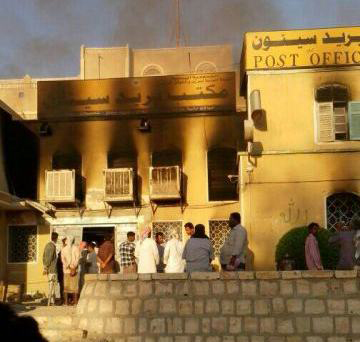
From 2010 to March 2014 there have been 47 realised kidnapping cases and more than 76 foreign victims held by kidnappers in Yemen. The country has witnessed a dramatic increase in kidnappings in this period, going from only one incident in 2010 to 19 in 2013, the highest number of incidents recorded in one year since the kidnapping of foreigners started in Yemen in the late-1980s.

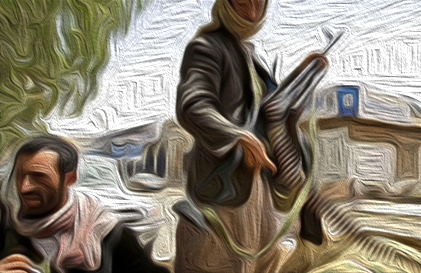
The kidnappings in Yemen can be broken down into three different types: tribal, political and criminal. Each type involves a distinct set of perpetrators, motives and tactics; however, in the past three years these have often overlapped and the actors and motives of a kidnapping are often blurred. Prior to 2011, almost all kidnappings were tribal, with only one case of criminal kidnapping and very few political kidnappings. Post-2011, most kidnappings have been criminal and political and with high impact due to increased levels of violence, prolonged captivity, ill-treatment of victims and complex negotiations.

There are a number of reasons behind this trend, which have emerged from the political crisis in 2011 and the subsequent political transition. First, the Yemeni state’s capacity to provide security throughout the country has been severely restricted since 2011. Second, in parallel to tribal kidnappings in rural areas, a new form of criminal and political kidnappings in urban centres has emerged in recent years and has specifically targeted the international community and served as a political pressure tool. Third, the lack of political, legal or military consequences for kidnappers has inspired more actors to get involved. Fourth, the payment of high ransoms in several high-profile kidnapping cases involving European citizens has contributed to a perception that kidnapping is a highly lucrative activity. Continue reading Kidnapping of Foreigners in Yemen 2010-2014 →

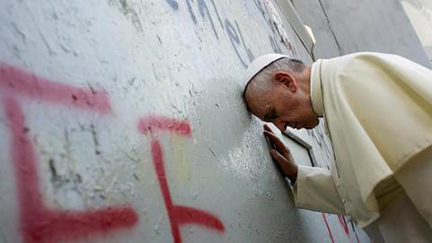
War dead and the Wall

Today is the official Memorial Day, a day set aside for Americans to honor those who died while serving their country in times of war. The idea started after the American Civil War in which as many as 625,000 individuals, almost 2% of the entire population at the time, were killed. I have an ancestor who was one of the lucky ones, having served in the northern army, captured and held captive by the confederacy and then released. I inherited some of the original New York Herald Tribune newspapers he saved from that time. I also have three uncles who served in World War II, Uncle Al in the Army, Uncle Ray in the Air Force, and Uncle Andy in the Navy. All survived, although the total U.S. war dead from World War II was over 405,000. When one tallies all the U.S. war dead, starting with Revolutionary War, the figure reaches over 1,300,000, not including those who our troops killed on the “other” sides.

So there is good reason to celebrate Memorial Day, whether your ancestors, relatives and friends were killed, wounded or survived unscathed. As moral agents we should remember and honor the sacrifice so many have made, but we should never celebrate the idea of war. “Blessed are the peacemakers,” quoth the Gospel. The unspoken follow-up must be “damn the warmakers.” Continue reading War dead and the Wall →

Yemen from Janna to Jahannam

When I first arrived in Yemen, early in 1978, I found a virtual janna, a country building itself up by the sandalstraps, people who were welcoming, tribesmen who did more than wear their honor on their sleeves, a sense that the future would bring good things. It was not a land frozen in time, despite the lack of infrastructure and Western amenities, but a force for change as Yemenis took to entrepreneurship as second nature (which it, of course, always was). Development was in the air and on the ground, as bilateral and United Nations agencies poured money into Yemen, much of it ineffectual and wasted. In 1978 USAID was sponsoring a major sorghum improvement project in Yemen, a boondoggle that did little more than collect seeds for the University of Arizona’s seed bank. Given what I learned about Yemeni farmers’ knowledge, they should have been giving advice to the United States on how to grow sorghum. Much ado was made about building up the capacity of the central government, although the money flowing in through the various programs invited corruption rather than sustainable growth. Still, I have felt over the years that Yemenis, by and large, have the resolve and grit to persevere.

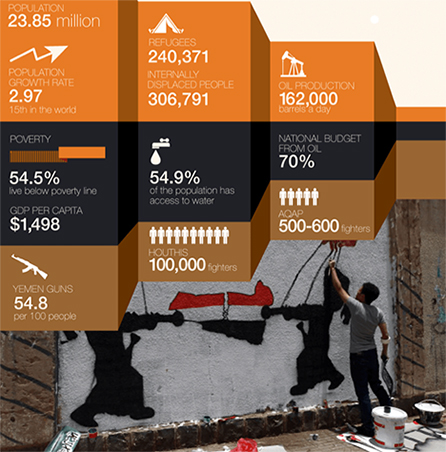
In the past three and a half decades Yemen has experienced ups and downs. A population estimated around 6 million or less back then has skyrocketed to some 24 million today. With the decline in subsistence agriculture, which at least filled stomachs, poverty and malnutrition are greater today than they were in 1978. The devastating loss of remittance wealth, which fueled Yemen’s grass-roots development in the 1980s, has led to chronic unemployment. The much touted unification in 1990, a kalashnikov wedding in hindsight, could not overcome the power politics and regional rivalry that have played out in the last two decades. The removal, or at least side-lining, of Ali Abdullah Salih has thus far not resulted in progress towards a peaceful solution to Yemen’s agonizing conflicts. The problem is not so much the inability of Yemen to renew itself, but the continual interference from outside forces. Continue reading Yemen from Janna to Jahannam →

Knowledge as Politics by Other Means


The first part of an interview with Wael Hallaq by Hasan Azad has just been published on al-Jadaliyya. Below is the introduction and the first part of a much longer exchange which can be followed here.

Throughout the last three decades, Wael Hallaq has emerged as one of the leading scholars of Islamic law in Western academia. He has made major contributions not only to the study of the theory and practice of Islamic law, but to the development of a methodology through which Islamic scholars have been able to confront challenges facing the Islamic legal tradition. Hallaq is thus uniquely placed to address broader questions concerning the moral and intellectual foundations of competing modern projects. With his most recent work, The Impossible State, Hallaq lays bare the power dynamics and political processes at the root of phenomena that are otherwise often examined purely through the lens of the legal. In this interview, the first of a two-part series with him, Hallaq expands upon some of the implications of those arguments and the challenges they pose for the future of intellectual engagements across various traditions. In particular, he addresses the failure of Western intellectuals to engage with scholars in Islamic societies as well as the intellectual and structural challenges facing Muslim scholars. Hallaq also critiques the underlying hegemonic project of Western liberalism and the uncritical adoption of it by some Muslim thinkers.

Hasan Azad (HA): One of the debates raging nowadays has been about the inattention that Muslim intellectuals receive in the West. One can say that, with relatively minor exceptions, the modern Muslim presence in, or contribution to, the intellectual world of the West is near nil. In the closing pages of your Impossible State, you have pointed out that a robust intellectual engagement between Muslim thinkers and their Western counterparts is essential, not only for the sake of better Western understanding of Islam, but also for the sake of enlarging the scope of intellectual possibilities in the midst of Euro-American thought. Your argument, I believe, meant to convey the idea that there is much that the Islamic worldview and heritage can contribute toward enriching our reflections on the modern project, in the West no less than in the East. What is that contribution, and why is it not happening? What are the obstacles standing in the way?

Wael Hallaq (WA): To speak of the potential contributions of Islam to a critique and restructuring of the modern project is a tall order, one that should come subsequent to a diagnosis of the present modern condition and its causes. The obstacles you alluded to are numerous and multilayered, and originate in both sides of the divide. If there are any failings—and there are many indeed—they cannot be located on one side only. The first, and most obvious of course, is the linguistic obstacle, the only means to communicating ideas. The West (by which I here mean Europe, its Enlightenment, distinctively modern institutions and culture and the spread of all these mainly to North America), has seen it sufficient to consider its two or three major languages so universal as not to care to learn other languages well, if at all. Even Orientalism, as an academic discipline, has not been successful in producing sustained command of Islamic languages, despite the fact that it did produce individuals whose linguistic competence even in more than one Islamic language was no less than masterful. It remains the case however that those who can navigate an Islamic language or text are a miniscule—in fact insignificant—minority in Western societies.

But there is a larger sense to Orientalism involved here. In many ways, the field of Orientalism is surrounded by an outer, immensely extensive layer; that is, countless numbers of influential voices who really never bothered to do any of the hard intellectual and philological work on Islam; yet, they feel quite justified and confident to pronounce on the “Orient,” both within the classrooms of academia or as so-called “experts” in mass media. This “peripheral” Orientalism usually escapes our common definitions of that discipline, but it forms the bulk of common and popular Western knowledge about the rest of the world, especially Islam. In any case, this is roughly the linguistic obstacle.