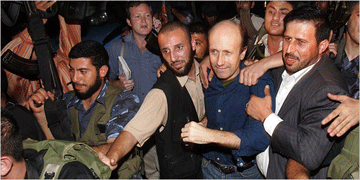
BBC Reporter Johnston Freed

BBC NEWS, 2007/07/04 08:37:02 GMT

BBC correspondent Alan Johnston has been released after 114 days in captivity in the Gaza Strip. He describes the “appalling experience” at the hands of his captors, called the Army of Islam.

“I am hugely grateful to all the people – an amazing number of people that worked on the Palestinian side, the British government, the BBC from top to bottom, and a huge amount of support from BBC listeners and viewers.

I had a radio almost throughout, and was able to follow all the extraordinary level of support and interest in my case, and it was a huge psychological boost.

I am immensely grateful. It’s just the most fantastic thing to be free. Continue reading BBC Reporter Johnston Freed

Tuareg Blues


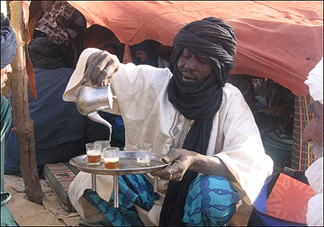
[Tuareg man serving tea; photo by Jane Greenhalgh for NPR.]

“Climate Connections” on today’s NPR website has a slideshow and brief article on recent changes in Tuareg lifestyle in southern Mali. Known as the “Blue Men” of the desert (for their indigo clothing) and serving as a prime ethnographic example of a society where the men (rather than the women) veil, life for the Tuareg is undergoing rapid change. In this case it is prolonged drought that has served as the main impetus for change. The slide feature is well worth a look.

The Little Rebellion that Was


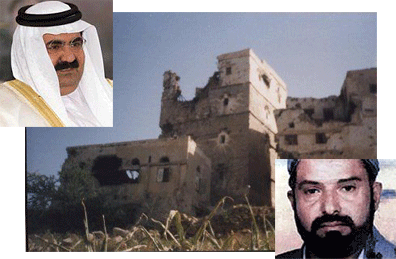
[Illustration: Emir Hamad Bin Khalifa al-Thani of Qatar, left; bombed out buildings in northern Yemeni town of Sa‘da in 2004 fighting, center; Husayn al-Houthi, right.]

In September, 2004, Yemen’s military captured and killed a Zaydi cleric in the northern part of their country. His name was Husayn al-Houthi and he is alleged to have started a rebellion with a strong anti-American thrust. Although claims were made that he was trying to revive the Zaydi imamate (which was toppled in 1962 in the revolution that formed a republic in North Yemen), such an al-Qaeda clone conspiracy theory are exaggerated. Nevertheless, his followers carried on a regional rebellion, lately under the leadership of his son Abd al-Malik, and as a result thousands of soldiers, rebels and civilians have died and tens of thousands of civilians have been displaced. It is not surprising that you may not have seen much about the fighting in the media. Indeed it has been a little rebellion compared to events in Iraq, Afghanistan or Gaza, and it certainly did not threaten the ruling government’s overall hold on the country. But it was certainly a big deal in Yemen. And now, with mediation by the Emir of Qatar, it appears that there will be an end to the armed conflict. Details are provided in today’s Yemen Observer.

Al-Houthi rebels descend the mountains, lay down their weapons

Written By: Nasser Arrabyee
Yemen Observer, Jun 30, 2007

Al-Houthi rebels have come down from the mountains of northern Yemen to put down their weapons and return home, as instructed by a Qatari-brokered agreement to end the five-month war between them and the government troops, said mediators Thursday. Continue reading The Little Rebellion that Was

Wavell in Yemen: “Of Fire and Sword”


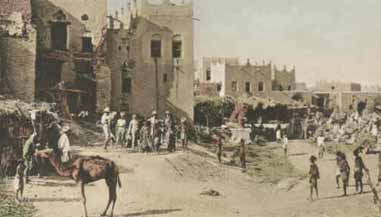
Market in Lahj, southern Yemen

[Note: Arthur John Byng Wavell (1882-1916) was a British soldier and adventurer who traveled in disguise to Mecca in 1908 and went on to Yemen in 1911 to witness fighting between the Zaydi imam’s troops and the Ottoman Turks. This account was originally published in 1912.]

The events in that country [Yemen] are worthy of a chapter in the history of these prosaic days. The counter-currents of human interest and activity that run up and down the Red Sea, linking the civilizations of the East and West, leave undisturbed this backwater. Western Europe knows little and cares less about what goes on there. Continue reading Wavell in Yemen: “Of Fire and Sword”

The Prophet’s Medicine: Part One


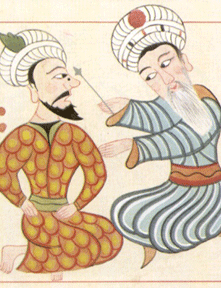
[Illustration: Miniature illustrating the treatment of a patient, Serefeddin Sabuncuoglu. Jarrahiyatu’l-Hâniya. Millet Library, Ali Emiri, Tib 79.

In the 7th century Muhammad set in motion one of the world’s great religions, Islam. As an Arabian prophet, Muhammad spoke of the same God known to Jews and Christians for centuries. The message received by Muhammad, and revered today by over a billion Muslims, is contained in the Arabic Qur’an. Although the focus of this scripture is on the spiritual health of mankind, there are also numerous statements regarding physical health and emotional wellbeing. Muhammad himself often spoke regarding medicine and diet, and his words are accepted as authoritative only beneath the level of God’s revelation in the Qur’an. As Muslim scholars in later centuries encountered the medical traditions of classical Greece, Syriac tradition, and India, they compared this indigenous knowledge with the Qur’anic view of man and the prophet’s statements about health. Eventually, a specific literary genre called the “Prophet’s Medicine,” or al-tibb al-nabawi in Arabic, came into existence. In the texts of this genre Muslim scholars tried to merge the most accepted and current scientific knowledge about medicine with the folklore of Muhammad’s Arabia. Continue reading The Prophet’s Medicine: Part One

History in Century Hindsight

How will the history of the world be written in another century? I am glad I will not be around to find out, although I suspect future historians will look at the post-9/11 operations at home on the patriot front and abroad with patriot missiles as a low point in America’s future past. We can always look back and see how history was written a century ago. Here is a passage from a popular “History of the World” by John Clarke Ridpath, who penned it near the end of the 19th century. Although dated in its racial and ethnocentric overtones, it is refreshing to see some critical assessment on Western stereotypes at work as well. As an exercise, read the excerpt below to sort out the prejudice from the attempt, even if not up to present-day standards, to be less rather than more subjective.

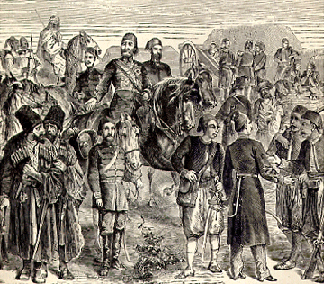
Some allowance, however, must be made for the judgment which the Western peoples have passed upon the Turks. There is no denying the fact that a part of this judgment is prejudiced. The Aryan races have always shown a disposition to reject and contemn those usages with which they themselves are unfamiliar. They have done so. Not because the usages in question have contradicted the laws of right reason, the interests of the state, of the principles of morality, but simply because such facts have been strange, unfamiliar. The intolerance of the Western people in this respect has been as severe and inexcusable as many of the usages which they have contemned and despised. Continue reading History in Century Hindsight

Wavell in Mecca: On Javan Muslims


[Note: Arthur John Byng Wavell (1882-1916) was a British soldier and adventurer who traveled in disguise to Mecca in 1908 and went on to Yemen in 1911 to witness fighting between the Zaydi imam’s troops and the Ottoman Turks. This account was originally published in 1912.]

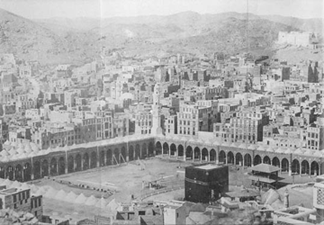
Among all the pilgrims of different races daily pouring in [to Mecca on the hajj], I was most struck by the Javanese. In appearance and manners they seem not unlike the Japanese. They have the same acquisitive and imitative temperament, are intensely curious regarding everything new to them, and quick to adopt any fresh idea that may seem to them an improvement on what has gone before. In this they stand in strong contrast to the Arabs, and in fact to most Eastern peoples, whose extreme conservatism is what really hinders their progress. But while the Japanese have seemingly agreed to take England as their model, the Javanese endeavor to turn themselves into Arabs. The first thing they do on arriving is to attire themselves in the local costume – which, by the way, does not suit them at all. I am told that there are so many people wearing Arab dress in Java that a stranger might fancy himself in the Hedjaz. Continue reading Wavell in Mecca: On Javan Muslims

Reading the Qur’an: Mohammed Arkoun

By Jane Dammen McAuliffe
Dean of Arts and Sciences, Georgetown University
Professor, Department of Arabic and History

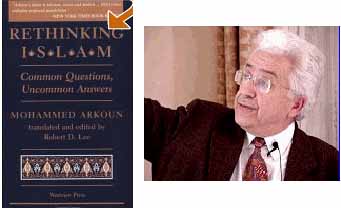
Mohammed Arkoun is the most honored French Islamicist alive today and continues to receive lecture invitations from around the world. His first language was Berber, and he learned Arabic and studied Islamic sources in French-speaking schools, first in Algeria and then in Paris (Gunther:127-131). Arkoun’s life-long project has been the sustained analysis of Islamic reason from the perspective of the contemporary epistemologies, both philosophical and social scientific. He is well-schooled in the successive forms of critical theory that have occupied humanistic scholarship for the last generation, particularly structural linguistics and semiotics. Continue reading Reading the Qur’an: Mohammed Arkoun