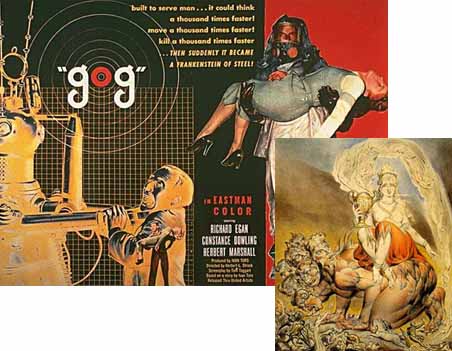
Apocalypse Watch: And It’s Gog Awful

Thus says the Lord GOD: It shall happen in that day, that things shall come into your mind, and you shall devise an evil device: and you shall say, I will go up to the land of unwalled villages; I will go to those who are at rest, who dwell securely, all of them dwelling without walls, and having neither bars nor gates; to take the spoil and to take the prey; to turn your hand against the waste places that are now inhabited, and against the people who are gathered out of the nations, who have gotten cattle and goods, who dwell in the middle of the earth. Ezekiel 38:10-12

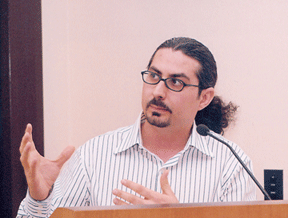
Application of biblical prophecy to contemporary events is no doubt as old as the prophets themselves. The extraordinary literary success of the near-sited Left Behind series should not be taken lightly. There are many fundamentally sounding Christian apocalypticists out there and more coming online all the time, thanks to the freedom of website development. One site I recently came across is by a man named Ken Power, who describes himself as follows: Continue reading Apocalypse Watch: And It’s Gog Awful →
The Land and the Book #1: Looking for an Omnibus?


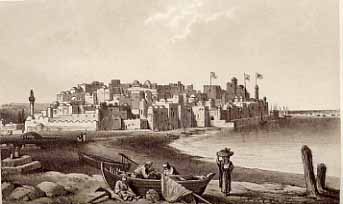
Jaffa from Thomson’s “The Land and the Book”

Almost 150 years ago one of the most popular travel accounts of the Holy Land was penned by an American missionary named William M. Thomson. Born in Ohio, my own home state, the 28-year old Thomson and his young bride arrived in Lebanon in 1834 as Protestant missionaries. This was a mere 15 or so years after the first American missionaries had made the Holy Land a mission field. At once an entertaining travel account and Sunday School commentary on the places and people of the Bible, this may have been one the most widely read books ever written by a Protestant missionary.

Reading Thomson is like reading one of the early English novels. The language is less familiar, although still thoroughly Yankee and the devotional tone has long since disappeared for a readership buying out The Da Vinci Code as soon as it hit the bookstores. The biblical exegesis, literalist yet frankly pragmatic at times, is intertwined with astute and at times humorous accounts of the people Thomson met along the way. But the style is not at all dry or discouragingly didactic. From the start Thomson engages in a dialogue with the reader, making the text (which stretches over 700 pages in the 1901 version) a rhetorical trip in itself.

Here is one of the forgotten books of a couple generations back. Easily dismissed as an Orientalist book, in the sense propounded and confounded by Edward Said, it is nevertheless a very good read. With this post I begin a series to sample the anecdotes and local color presented by Rev. Thomson. The times have indeed changed, but such textual forays into the night reading of a previous generation of Americans are well worth the effort. Let’s begin with the author’s own invitation. Continue reading The Land and the Book #1: Looking for an Omnibus? →

When in Paris, Don’t Drink the Wine

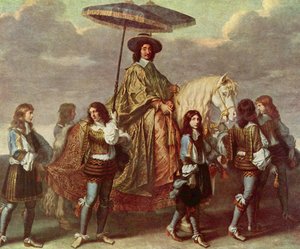
There are numerous travel accounts by European and American writers who spent time in the Middle East. Many of them comment on Islam, whether as missionaries condemning a rival religion or admirers of what they often saw as a vibrant faith in the everyday life of people. But few people are aware of the writings by Muslim visitors to Europe. I am talking about real individuals, not the fictional characters like those in Montesquieu’s The Persian Letters. One of these travelers was the Moroccan Ahmad ibn Qasim al-Hajari, a translator for the sultan, who visited Paris in 1612. As translated by Nabil Matar, Ahmad provides a lively account of what he saw and the debates engaged in.

One of these revolved around the issue of drinking wine, a Christian custom that his French guests thought a kind of sacred duty. The visiting Moroccan set out to disabuse them of such a notion:

“One day before sunset, I walked to the judge’s house to attend to some formalities. The judge said, ‘Would you like to have dinner with us?’

‘I am not permitted to eat some of your foods,’ I replied. Continue reading When in Paris, Don’t Drink the Wine →

Soccer Diplomacy

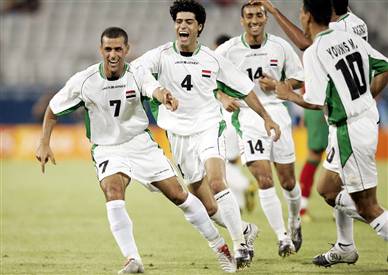
Forget the World Cup head butt, football (soccer for those who think “football” is a foreign word for the world’s most popular sport) may now be one of the only bright spots in war-torn Iraq’s immediate future. In case you have not heard, the Iraqi National Team won the Asia Cup. They did it with Shi’a, Sunni and Kurd and without the threat of torture for a missed goal. Their star, Younis Mahmoud, scored the winning goal against Saudi Arabia. Soon after ordinary Iraqis took the streets with guns, but shot into the air in celebration rather than at each other. At least for one day. Simon Apter has a nice article about this in The Nation.

Iraq’s success in soccer is, perhaps, one of the few concrete triumphs to have come out of the quagmire. Call it a beneficent side effect. The WMDs were, indeed, not there, but the bastinado was, awaiting whomever Uday capriciously felt had embarrassed the country with a sub-par performance. Running possibly the only Ministry of Sport complete with a torture chamber and jail, Uday made Bob Knight look like Francis of Assisi. Continue reading Soccer Diplomacy →

Islam Obscured


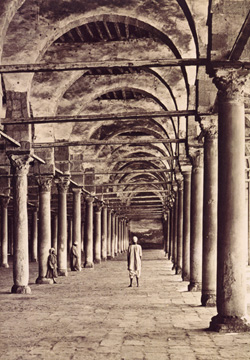
“Interior of the Amron Mosque,” Henry Bechard, ca. 1870

[Note: the following excerpt is from the introduction to my recent book on the ways in which anthropologists study and represent Islam.]

What the world does not need is yet another book which assumes Islam can be abstracted out of evolving cultural contexts and neatly essentialized into print without repeating the obvious or glossing over the obtuse. This is–I believe and I hope–not such a book. I have no interest in telling you what Islam is, what it really must be, or even what it should be. In what follows I am more attuned to what Islam hopefully is not, at least not for someone who approaches it seriously as an anthropologist and historian. I bare no obvious axe to grind as either a determined detractor against the religion or an over-anxious advocate for it. Personally, as well as academically, I consider Islam a fascinatingly diverse faith, a force in history that must be reckoned with in the present. The offensive tool I do choose to wield, if my figurative pen can stand a militant symbol, is that of a critical hammer, an iconoclastic smashing of the rhetoric that represents, over-represents and misrepresents Islam from all sides. By avoiding judgment on the sacred truth of this vibrant faith, I shift intention towards an I-view that takes no summary representation of Islam as sacred. Continue reading Islam Obscured →

Springtime for Osama

If you had taken a poll of Holocaust survivors after their liberation from death camps in World War II, chances are few would have imagined that a future comedian (and a Jewish one at that) would produce a box-office smash that included a chorus line of goose-stepping rockettes prancing to “Hitler in springtime.” For the record, Mel Brooks spares no one, including a Busby Berkeley romp with Torquemada through the Spanish Inquisition. Nor does Monty Python, who satirized Nazis and, spam-spam-spam, The Spanish Inquisition, on the other side of the Atlantic. Of course, neither Brooks nor Python would have kept their heads (or the body parts they make the most jokes about) in 15th century Spain. So if even the cruelest atrocities of history can be lampooned with hindsight humor, when is a good time to rip into Osama Bin Laden and the distorted political mantra of jihad?

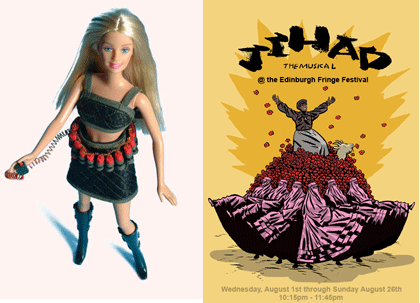
Jihad: The Musical
already hit New York, and now it is taking Britain at the fringes (if Edinburgh can be deemed a fringe venue) according to the latest news reports on the BBC and The Guardian. Continue reading Springtime for Osama →

Letter to a Country with No Frontier

by George El-Hage

[Note: This is a translation from the Arabic, which is available in pdf by clicking here.]

Stand up! Get up!

Carry your bed and follow me.

Let’s leave this ungrateful land

This land…

That savors the decaying cadavers of its sons

A land satiated by the blood of its children.

Let’s leave these poor people

Defeated, fragmented

Knowing nothing but selfishness,

Servicing foreigners,

And worshipping the hollow love of prestige. Continue reading Letter to a Country with No Frontier →

The Contribution of Overseas Doctors to Britain’s NHS


By Omar Dewachi

The recent failed terrorist plots that targeted the heart of London and Glasgow airport came as a shock for many as the identity and background of the suspects were revealed. Most of the detained were medical doctors who worked in Britain and who had Indian, Iraqi and Jordanian backgrounds. The fact that they were doctors was seen as a betrayal of the medical profession with its aim to save lives. However, the bigger shock in the UK was that these were overseas doctors who were working in Britain’s National Health Service (NHS), the main provider of health care to the country. As the new Labour prime minister, Gordon Brown, promised in his first press conference to review the NHS recruitment, more background checks and surveillance of overseas doctors is going to take place. However, one wonders how this surveillance is going to take place and who is going to pay its heavy price and consequences? Britain has always imported its medical staff from abroad using them as an expandable labor pool. In this wave of hysteria about background checks and surveillance, the contribution of the overseas medical population in building Britain’s NHS must not be forgotten. Continue reading The Contribution of Overseas Doctors to Britain’s NHS →