The Letters of Bakr Shakir al-Sayyab:#2


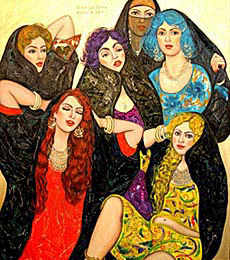
[Art by Wasima al-Agha, Iraq’s Fine Arts Gallery.]

[Note: This is the second in a series of translations of selected letters of the noted Iraqi poet Badr Shakir al-Sayyab.]

Letter #2
Abu al-Khaseeb: 4/ 20/1946

My Beloved Brother, Khalid (al-Shawwaaf),

A grim and suffocating event has made me hate writing letters even to those dearest and closest to me. No doubt, you remember the encounter…my encounter… with my first love; you recall what she said to me…. “Bring me all the poetry you write…by way of Miss …..”

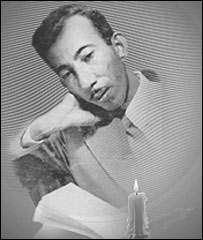
I have completed the poem, “The Song of Encounter,” which reached a hundred and nineteen lines in length. I proceeded to copy it into a small and elegant notebook which I devoted two long days to do in order to also decorate and beautify it, and I sent it to Miss….imploring her to deliver it to my ladylove and to hurry back and inform me of the effect that my poem has left on her soul. Continue reading The Letters of Bakr Shakir al-Sayyab:#2 →

Blame it on the Bossa Nova. Or the Israel Lobby. Whatever.

by Gregory Starrett

One Monday late last March, I got back to my office after five days away and found e-mails from six different mailing lists and individual colleagues discussing, or linking to discussions of, or linking to the text of a London Review of Books article by John Mearsheimer and Stephen Walt, two prominent American political scientists, on how “The Israel Lobby” in the United States distorts U.S. foreign policy. Journalists, academics, former government officials, and others have been busily taking notice of the piece, looking for their names or the names of their friends and mentors, (or for those of their bete noirs and whipping boys), and dutifully proclaiming either that it’s about time someone outside the ranks of the Left finally noticed AIPAC’s shenanigans, or squawking about the article’s myriad inaccuracies, basic unfairness, and blatant anti-Semitism.

As far as I can tell, there are three difficulties with Mearsheimer and Walt’s work. Continue reading Blame it on the Bossa Nova. Or the Israel Lobby. Whatever. →

Letters of Badr Shakir al-Sayyab


The Iraqi Poet Badr Shakir al-Sayyab

Introduction to the Translation of the “Letters of Badr Shakir al-Sayyab”

By George Nicolas El-Hage, Ph.D.

Throughout the better part of his brief life (1926-1964) Badr Shakir al-Sayyab was haunted with the idea of death, the afterlife, mortality and immortality. At the end of his earthly journey, Badr made peace with himself, and thereby reconciled the two seemingly contradictory aspects of “Life” and “Death.” He conquered death by humanizing it, mastering his fear of it, and by surrendering to his fate as the ultimate rest for an ailing and constantly deteriorating body. Although never an existentialist, Sayyab, at one point, entertained the idea of embracing “Existentialism,” surmising that it might have the philosophical answer to his existential problem: how far and how high will he be able to carry the rock of Sisyphus? How long will his battle with destiny last and who will prevail? Sayyab was immensely in love with life, yet his poetry and personal letters ironically convey a different message and are colored with the dark clouds of dejection, frustration, loneliness, exile and poverty.

Sayyab played a prominent role in shaping the course of modern Arabic poetry and literature. The tragic journey of this poetic genius was marked with constant tragedies that punctuated his life with one disaster after another: the death of his grandmother, the tragic loss of his loving mother whose passing left a permanent scar on his soul, the stormy relationship with his father and insensitive stepmother, his intense political struggle against the Iraqi regime, persecution and repeated imprisonment and exile, job uncertainty and insecurity, extreme poverty, unhappy marriage and the burden of family obligations, and ultimately his ailing health and deteriorating physical condition that left him paralyzed from the waist down. All these catastrophic events that inflicted his frail body with severe and constant pain were unable to break his spirit, restrain his will or dampen his inspiration. He continued to write magnificent poetry that portrayed both his physical and psychological suffering. Even when he was on his death bed oscillating between moments of unconsciousness, hallucinations and lapses of memory, his imagination remained ablaze and alert, and his inspiration alive and focused. In the last few years before his tragic death, Sayyab renounced his political activities and turned from “committed” poetry to “personal” poetry that became more permeated with self eulogy and focused on his heroic struggle with destiny and man’s place in the universe. Continue reading Letters of Badr Shakir al-Sayyab →
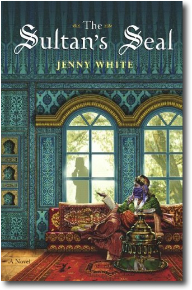
The Sultan’s Seal

“Your brush is the bowstring that brings the wild goose down.”

(Reviewed by Jana Kraus MAR 22, 2006)

Jenny White, an anthropologist and the author of numerous nonfiction works on Turkish society and politics, has written a real winner with her debut novel, The Sultan’s Seal. A historical mystery with a bit of romance thrown in, this book makes for an unputdownable read. Ms. White paints a remarkably vivid portrait of life in 19th century Turkey, from the luxurious sultan’s palaces to the most squalid slums of Istanbul, and writes intelligently of the political turmoil of the period. Continue reading The Sultan’s Seal →

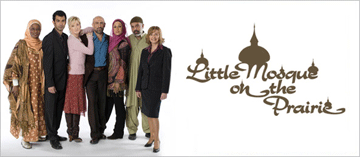
Little Mosque on the Prairie

It started with Little Joe on Bonanza; you’ve seen the reruns and you’ve hummed the theme song. Then Little Joe went family fare and moved into a Little House on the Prairie. This is the television icon of conservative, what-a-wonderful-life-we-all-had-in-the-good-old-days Americana, if ever there was. I have watched a seemingly infinite number of reruns of both programs, but to my knowledge the only Orientals in sight were Chinese; no Muslims crossed the prairie.

So it is certainly time for a Little Mosque on the Prairie, even if it debuts in Canada rather than Kansas. Yes, fellow Americans, Muslims can be funny and not just the butt of Islamophobic jokes. It may not be surprising that nearly 2 million viewers tuned into the premier of the new television series on CBC. Continue reading Little Mosque on the Prairie →

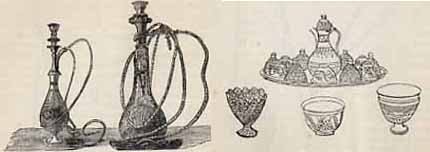
The Land and the Book #2: Smoke on the Water


Water Pipes, left; coffee set, right; from Thomson’s “The Land and the Book”

The rustic American style pilgrim’s progress of Rev. William M. Thomson in the 1830s through the 1850s in Palestine was not just about places where the locals swore that Abraham bought a cave or Jesus preached. There were real people along the way and Thomson takes the reader inside a diwan from time to time. In one of his accounts he would be in good company with legislators who ban smoking in public places. Although cigarettes were just taking off in popularity, the traditional approach to tobacco in Syria and Palestine was smoke on the water to be followed by Turkish coffee. Let’s return a century and a half to this precursor of the modern sheesha bar. Continue reading The Land and the Book #2: Smoke on the Water →

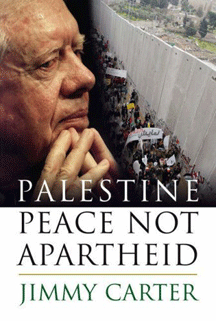
The Problem with ‘My Problem with Jimmy Carter’s Book’

Middle East Quarterly, published by Daniel Pipes’ organization Middle East Forum, contains an article titled “My Problem with Jimmy Carter’s Book”, by Kenneth Stein, the first executive director of the Carter Center in Atlanta from 1983 to 1986, and currently a professor of Contemporary Middle Eastern History at Emory University. Stein, it will be remembered, resigned from his affiliation with the Carter Center, where he was a Middle East Fellow for over two decades, in protest over former President Jimmy Carter’s book, Palestine: Peace Not Apartheid. Touring the country explaining his objections to his former boss’s perspective on the Israeli Palestinian conflict, Stein has refrained from tarring Carter with the label “Jew-hater” (this from the ever-subtle David Horowitz), or claiming that Carter’s criticisms of Israeli policy stem from Carter having “enriched[ed] himself with dirty money”–dirty Arab oil money, specifically–from Shaykh Zayed bin Sultan al-Nahyan of the United Arab Emirates, “an unredeemable anti-Semite and all-around bigot” (this from the extraordinary Alan Dershowitz in an article) It should be noted, since Dershowitz does not, that much of the alleged dirty money that flowed through the Carter Center would have supported—and in the early years, been managed and disbursed by–Professor Stein. Continue reading The Problem with ‘My Problem with Jimmy Carter’s Book’ →

Famous General Supports Iraq War

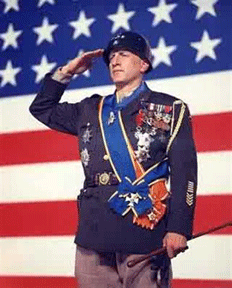
America has a number of famous generals who now serve as icons of our legendary military prowess. General Washington beat the red pants off of Lord Cornwallis. General William Tecumseh Sherman put the heat on those good old southern white boys down in Georgia. General Custer died with his boots on, as did all the men he led into battle. Then there were the heroes of World War II, the most cinematic being General George C. Scott, I mean General George S. Patton. It turns out that General Patton, like all superheroes, has risen from the grave and returned to tell it like it should be (since “like it is” is not going so well) in the War on Terror and Iraq. If you would like his revamped take, then all you need to do is go to YouTube and see him read the Patriot Riot Act, courtesy of a 21st century impersonator and vintage 20th Century Fox (no relation to Fox News this time) footage.

If you are disappointed that the footage here is from the movie, then rest assured that General Patton has indeed been seen, though not as many times as Elvis. Just ask Don Imus.

Luke R. Publican