Revenue Sharing, but not Drug-free


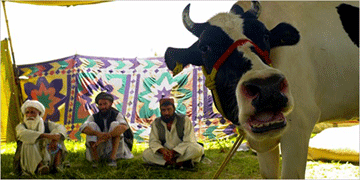
[The American plan to convince Afghan farmers not to grow poppies: some good old cow dung smothered in politically expedient B.S. Photo from the New York Times.]

In the old days (before 9/11, the posters for Osama dead or alive, the seeming fall of the Taliban, Operation Shock and Awe, etc.) before terrorism merited an all-out war, there were more socially-minded wars on the American political scene. An earlier Texan (so early he was Democratic) named Lyndon Johnson started a War on Poverty. The wealth of Bill Gates shows how well that succeeded. Then Betty Ford helped launch a War on Drugs. Casualty figures for this have been withheld by the government for insecurity reasons. Indeed, today’s New York Times has an article that suggests the War on Drugs has fused with the War on Terrorism and we are losing on both fronts. “Afghanistan produced record levels of opium in 2007 for the second straight year, led by a staggering 45 percent increase in the Taliban stronghold of Helmand Province, according to a new United Nations survey to be released Monday.” writes David Rohde in his article “Taliban Raise Poppy Production to a Record Again.” He adds, “Here in Helmand, the breadth of the poppy trade is staggering. A sparsely populated desert province twice the size of Maryland, Helmand produces more narcotics than any country on earth, including Myanmar, Morocco and Colombia. Rampant poverty, corruption among local officials, a Taliban resurgence and spreading lawlessness have turned the province into a narcotics juggernaut.” Continue reading Revenue Sharing, but not Drug-free
Fascination in Fez


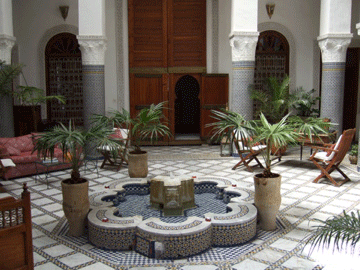
[Interior of the Ryad Mabrouka, a restored guesthouse in Fez medina.]

A trivia question: what may have been the largest city in the known world in 1180 CE? Would you believe Fez (also spelled Fes) in modern day Morocco? Less famous today than Casablanca (thanks to Humphrey Bogart) or Marrakesh, Fes is fascinating for its long history and extraordinary architecture. The Qaraouiyine Mosque, built in 859, boasts the oldest university in the world. The mosque/university library held an estimated 320,000 volumes by 1613 CE. Then there are the palaces of various sultans, the schools, the market and craft buildings, most enclosed within a medina of narrow allies that no cars can penetrate. Here was the a refuge for the 12th century scholar Maimonides, who lived in Fez with his family for five years after being forced to leave Cordoba in Andalusia. Not surprisingly the heritage of Fez makes it a protected World Heritage city of UNESCO. Exactly a week ago, I was visiting Fez as a tourist, an outsider entering a world dedicated to the inside. Continue reading Fascination in Fez

Between Cairo and Oxford: An American Dilemma

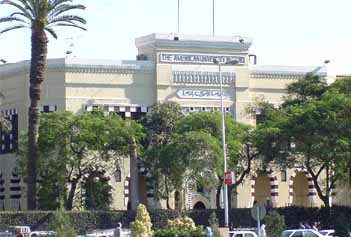
About seven years ago, I decided to accept an academic position at the American University in Cairo (AUC). This was well before 9/11, but it nonetheless sparked the same question from nearly every friend and relative: are you sure it’s safe? It was a reasonable question based on what little most Americans know about Egypt. “The Middle East” is known to be violent and volatile, hence Egypt must be so. Third World countries all hate Americans, so Egyptians must. And besides, Egypt is a desperately poor country, and we all know that poverty breeds violence.

Such perceptions have little to do with Egyptian realities. Continue reading Between Cairo and Oxford: An American Dilemma

At a Tomb in Abydos

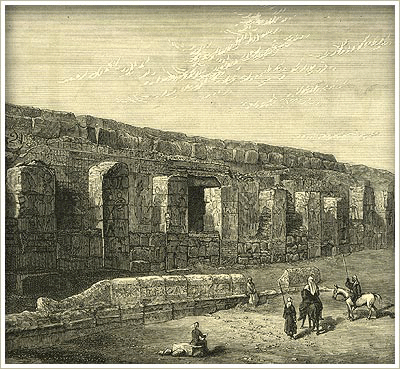
Temple at Abydos

by Augustus Wight Bomberger

How little hath life changed, O ancient King!
This fan so delicate and bracelet rare,
These dainty, jeweled trinkets for the hair,
Were thine own gifts, I know, and thine this ring.
And Bener-Ab, thy daughter, “Sweet of Heart,”
Who wore them once, was precious of a truth
And dear to thee in all her winsome youth,
Unspotted from the world, unspoiled of art:
So dear that thou at times didst reckon less
Thy royal sceptre than her soft caress;
Yet for that cause wert all the more a king,
Five thousand years ago when thou didst reign
In great Abydos — city of the plain.
And now — ah me, how close these symbols bring
Thy soul to mine across the vast of years – Continue reading At a Tomb in Abydos

The Letters of Bakr Shakir al-Sayyab:#2


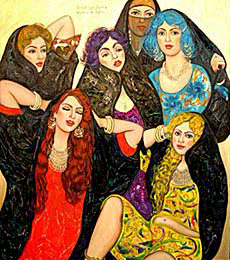
[Art by Wasima al-Agha, Iraq’s Fine Arts Gallery.]

[Note: This is the second in a series of translations of selected letters of the noted Iraqi poet Badr Shakir al-Sayyab.]

Letter #2
Abu al-Khaseeb: 4/ 20/1946

My Beloved Brother, Khalid (al-Shawwaaf),

A grim and suffocating event has made me hate writing letters even to those dearest and closest to me. No doubt, you remember the encounter…my encounter… with my first love; you recall what she said to me…. “Bring me all the poetry you write…by way of Miss …..”

I have completed the poem, “The Song of Encounter,” which reached a hundred and nineteen lines in length. I proceeded to copy it into a small and elegant notebook which I devoted two long days to do in order to also decorate and beautify it, and I sent it to Miss….imploring her to deliver it to my ladylove and to hurry back and inform me of the effect that my poem has left on her soul. Continue reading The Letters of Bakr Shakir al-Sayyab:#2

Blame it on the Bossa Nova. Or the Israel Lobby. Whatever.

by Gregory Starrett

One Monday late last March, I got back to my office after five days away and found e-mails from six different mailing lists and individual colleagues discussing, or linking to discussions of, or linking to the text of a London Review of Books article by John Mearsheimer and Stephen Walt, two prominent American political scientists, on how “The Israel Lobby” in the United States distorts U.S. foreign policy. Journalists, academics, former government officials, and others have been busily taking notice of the piece, looking for their names or the names of their friends and mentors, (or for those of their bete noirs and whipping boys), and dutifully proclaiming either that it’s about time someone outside the ranks of the Left finally noticed AIPAC’s shenanigans, or squawking about the article’s myriad inaccuracies, basic unfairness, and blatant anti-Semitism.

As far as I can tell, there are three difficulties with Mearsheimer and Walt’s work. Continue reading Blame it on the Bossa Nova. Or the Israel Lobby. Whatever.

Letters of Badr Shakir al-Sayyab


The Iraqi Poet Badr Shakir al-Sayyab

Introduction to the Translation of the “Letters of Badr Shakir al-Sayyab”

By George Nicolas El-Hage, Ph.D.

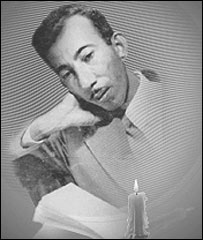
Throughout the better part of his brief life (1926-1964) Badr Shakir al-Sayyab was haunted with the idea of death, the afterlife, mortality and immortality. At the end of his earthly journey, Badr made peace with himself, and thereby reconciled the two seemingly contradictory aspects of “Life” and “Death.” He conquered death by humanizing it, mastering his fear of it, and by surrendering to his fate as the ultimate rest for an ailing and constantly deteriorating body. Although never an existentialist, Sayyab, at one point, entertained the idea of embracing “Existentialism,” surmising that it might have the philosophical answer to his existential problem: how far and how high will he be able to carry the rock of Sisyphus? How long will his battle with destiny last and who will prevail? Sayyab was immensely in love with life, yet his poetry and personal letters ironically convey a different message and are colored with the dark clouds of dejection, frustration, loneliness, exile and poverty.

Sayyab played a prominent role in shaping the course of modern Arabic poetry and literature. The tragic journey of this poetic genius was marked with constant tragedies that punctuated his life with one disaster after another: the death of his grandmother, the tragic loss of his loving mother whose passing left a permanent scar on his soul, the stormy relationship with his father and insensitive stepmother, his intense political struggle against the Iraqi regime, persecution and repeated imprisonment and exile, job uncertainty and insecurity, extreme poverty, unhappy marriage and the burden of family obligations, and ultimately his ailing health and deteriorating physical condition that left him paralyzed from the waist down. All these catastrophic events that inflicted his frail body with severe and constant pain were unable to break his spirit, restrain his will or dampen his inspiration. He continued to write magnificent poetry that portrayed both his physical and psychological suffering. Even when he was on his death bed oscillating between moments of unconsciousness, hallucinations and lapses of memory, his imagination remained ablaze and alert, and his inspiration alive and focused. In the last few years before his tragic death, Sayyab renounced his political activities and turned from “committed” poetry to “personal” poetry that became more permeated with self eulogy and focused on his heroic struggle with destiny and man’s place in the universe. Continue reading Letters of Badr Shakir al-Sayyab