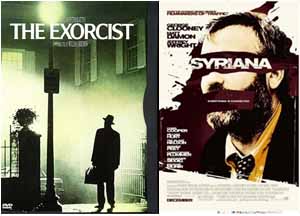
Pazuzu, Inc.: On the Movie Syriana

By Gregory Starrett
UNC Charlotte

“Now, the characteristic feature of mythical thought. . .is that it builds up structured sets. . .by using the remains and debris of events. . . .Mythical thought for its part is imprisoned in the events and experiences which it never tires of ordering and re-ordering in its search to find them a meaning.”
Claude Levi-Strauss, The Savage Mind

In a previous post, Desiree Marshall faulted director Thomas Gaghan’s recent movie Syriana, implying that a combination of bias and ignorance spoiled what might otherwise have been a useful exploration of identity and politics in the Middle East. While her misgivings are likely shared by others, she and most of the film’s other reviewers have missed its point entirely. Syriana is not at all “about” the Middle East except in the sense that it uses the debris of current events to reveal larger truths and tell much older stories. In fact, Syriana is what French anthropologist Claude Levi-Strauss would recognize as a structural transformation of another tale: director William Friedkin’s 1973 screen version of novelist William Peter Blatty’s The Exorcist. The two films are variants of the same myth. Continue reading Pazuzu, Inc.: On the Movie Syriana
This Should Make You Quake


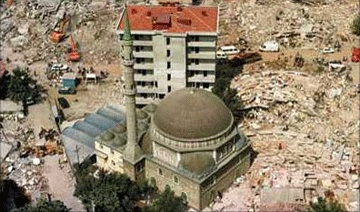
[A mosque still stands amidst the rubble of collapsed buildings in this aerial view of a neighborhood in the western Turkish town of Golcuk, 60 miles east of Istanbul, August 19, 1999.]

The recent earthquake in Peru, although not resulting in massive deaths, still has fallout which is more than nuclear. Turkey, Iran and Pakistan routinely have severe earthquakes, often resulting in the deaths of thousands. By an accident of sacred history, most of these victims are Muslim. In a number of ways these tragic events could be could be styled “an act of God.” To an insurance agent this would merely mean that it was one of those natural events which happen from time to time and are not covered in a standard policy. To Evangelical Christians, at least those who read KJV biblical prophecy as a Fox News documentary, it can easily become a special kind of act of God, not unlike the fire and brimstone that destroyed the wicked lot of Sodom and Gomorrah. But apocalyptic rhetor can boomerang, especially when the walls do not come tumbling down at the blasting away of the self-righteous. Continue reading This Should Make You Quake

Egyptian Cosmology and the Grand Canyon


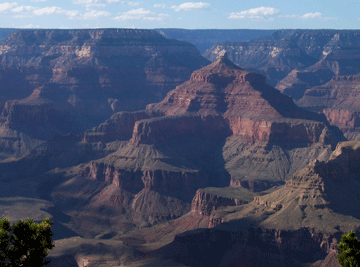
[Isis Temple of the Grand Canyon]

In mid August, this year, I traveled to the Grand Canyon in Arizona. I was stunned by the views of spectacular buttes and rises, some of which are named after Egyptian gods, goddesses and kings such as “Isis,” “Osiris,” “Horus,” “Set” and “Cheops” (the Pharaoh who built the Great Pyramid of Egypt). This exposure triggered substantial questions concerning the relationship between ancient Egyptian culture and Native Americans inhabiting the Grand Canyon recognizing that anthropological and historical studies of archaic cosmologies of ancient societies are still open for further development. I found a very interesting article on the subject of “Ancient Egyptian Treasures in the Grand Canyon: Suppressed Archeological Information and Metaphysical Paradox?” written by Barry McEwen in which he refers to an article written by David Hatcher Childress who reveals deep concern about the Smithsonian Institution cover up of important findings of G.E. Kinkaid and Professor S.A. Jordan. To quote Childress, “Perhaps the most amazing suppression of all is the excavation of an Egyptian tomb by the Smithsonian itself in Arizona. A lengthy front page story of the PHOENIX GAZETTE on 5 April 1909… gave a highly detailed report of the discovery and excavation of a rock-cut vault by an expedition led by a Professor S. A. Jordan of the Smithsonian. The Smithsonian, however, claims to have absolutely no knowledge of the discovery or its discoverers.” Continue reading Egyptian Cosmology and the Grand Canyon

This Split within Islam Must End

by Abdullah Al Rahim

What is it that makes people slaughter one another in the name of religion? Which among all these warriors can claim the integrity to dictate the terms by which God is to be venerated and who is to be slaughtered in God’s name? They call these sects Sunni and Shia. So I ask, which one of these post-Prophet innovations called sects did the holy Prophet Muhammad belong to? Which of these slaughters will he approve of, should he come back today?

We hear in mosques every time the word Bida’a [innovation] which is used to fight anything new we come up with, even if it is positive. So let me ask both, Sunnis and Shias: what are these sects? are they not innovations [Bida’a]? They are the most dangerous of all innovations which have never united but always divided the house of Islam. Continue reading This Split within Islam Must End

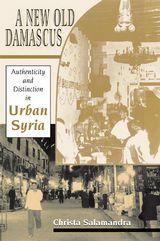
A New Old Damascus

by Christa Salamandra
Lehman College, CUNY

If you enter the Old City of Damascus at Bab Sharqi (the Eastern Gate), walk a few yards along a Street Called Straight, and turn down the first narrow alley on your right, you will find, jutting out from among the inward-looking Arab-style houses of this quiet residential quarter, a sign advertising “Le Piano Bar.” Enter through the carved wooden door, walk along the tile-covered foyer, under the songbird’s cage, past a display case strung with chunky silver necklaces, and step up a stone platform to the raised dining room. Here well-heeled Syrians sit at closely spaced tables, drinking arak and Black Label whiskey, and eating grilled chicken or spaghetti. The walls around are decorated, each in a different style. One features a collection of Dutch porcelain plates set into plaster. In another, strips of colored marble hold a series of mosaic-lined, glass-covered displays of wind instruments. A third wall features two floral wrought-iron gated windows draped in a locally produced striped fabric. Wrought-iron musical notes dance on the last. At the from of the long, arch-divided room is a huge mother-of-pearl-framed mirror. Set into the top of the mirror is a digital billboard across which Le Piano Bar’s menu and opening hours float repeatedly. Patrons listen politely as the proprieter sings “My Way” and other Frank Sinatra favorites to a karaoke backing tape. When he finishes, video screens tucked into corners feature Elton John song sing-alongs. Some nights a pianist and clarinetist play Russian songs as patrons clack wooden catanets. Continue reading A New Old Damascus

Slam Drunk Fascism:Coming to a Campus Near You

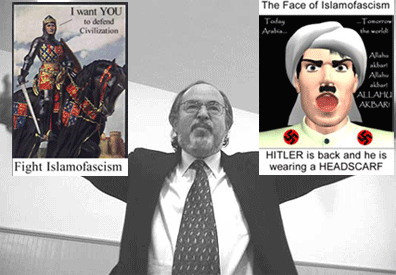
Fascism, a thorn rather than a rose by any other name, has a long and sordid history. The modern term was resurrected from the gore-galore glorified history of ancient Rome by Benito Mussolini in the 1920s to signal the power of the state (his state, of course) über alles (as his ersatz Aryan co-fascist to the north put it). As an ideology it dispensed of a need for any other religion than the twisted Durkheimian notion that the dictatorial “state” was really at stake when talking about “God.” As a fashionable pejorative term to heap abuse on one’s enemies, “fascist” readily becomes the modern day equivalent of saying the hated other is a bloodthirsty cannibal.

Now there is the recent moniker “Islamofascism,” which appears to have been coined by the Marxist French scholar Maxime Rodinson to describe the overthrow of the Shah and unexpected rise of an Islamic Republic in Iran. If so, this demonstrate the malleability of a term in which one form of fascism seemingly replaces another. But then the rhetorical door opens at least a crack for renaming the Vatican a “Christofascist” city state — surely a word game that would make both Mussolini and the popes turn over in their graves.

Confused? Not to worry … because David Horowitz, an idiotologue out to save “Western civilization” along with Daniel Pipes and Robert Spencer, has embarked on a cybercrusade campaign to make “you” aware of the apocalyptic dangers of Islamofascism. Forget about global warming (a liberal trick to discredit the Bush administration) and look out for bearded jihadis on the march. Mark your calendars for the week of October 22-26 for the coming of “Islamo-Fascism Awareness Week.” Don’t expect any parades down Main Street (we need to keep up the barriers so the terrorists don’t get us at home), but man the campus barricades and stick it to the Women’s Studies Centers. Continue reading Slam Drunk Fascism:Coming to a Campus Near You

NYPD.EDU

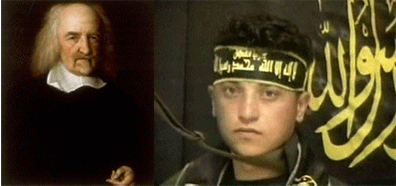
I write from the Syracuse International Airport, inside the security zone. Despite my guilty conscience, I passed the non-unionized TSA without a hitch. One guard even described my informal greeting as “the American way.” Would that other authorities so exercised their ethnographic faculties. But they do not, and recently two NYC cultural documents recalled our attention to this country’s addled take on religion, politics, and radicalism.

On Aug. 15, the NYPD published an “Intelligence Report,” which warns that Islamic radicalism is “permeating” (p. 66) New York City. Then on Aug. 19, Columbia University Professor Mark Lilla’s NY Times Magazine’s cover article ascribed the US-Islamic divide to the West’s advancement beyond, and Islam’s arrested adherence to, political theology. Continue reading NYPD.EDU

An Unbelievable White Man


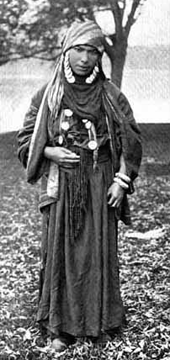
Syrian Bedouin girl at the 1893 Columbian Exposition

In his picturesque memoir of life in late 19th century Palestine, Philip J. Baldensperger recounts a number of adventures he had as a young man visiting his parent’s land with a Bedouin group. One of the foods loved by the Bedouin was the fruit of the doum palm. One day a group of Bedouin girls were surprised to see Philip’s white skin, something of a novelty at the time in rural Palestine. Here is his account:

“Being the only European, it was thought, in those days (1874), to be safer for me to wear Bedawi-clothing: a long shirt with broad, pointed sleeves hanging to the ground, a Sayé, and, on my head, a silken Kafiyé. With the exception of the girdle, which held the skirt and the Sayé together, the ‘Akal, or head-cird, wound around the Kafiyé, and a fringe of hair hanging over my forehead, in accordance with the fashion among Bedawîn youngsters, I was a figure in spotless white. In order to be able to walk more easily whilst on the march, I used to gather up the long folds of my dress and stick them in my girdle, leaving my legs bare. No wonder that one day four Bedawiyat, gathering Dôm-apples in the forest, fled with loud screams at my approach. Continue reading An Unbelievable White Man