Dreams Stifled, Egypt’s Young Turn to Islamic Fervor

By MICHAEL SLACKMAN
The New York Times, February 17, 2008

CAIRO — The concrete steps leading from Ahmed Muhammad Sayyid’s first-floor apartment sag in the middle, worn down over time, like Mr. Sayyid himself. Once, Mr. Sayyid had a decent job and a chance to marry. But his fiancée’s family canceled the engagement because after two years, he could not raise enough money to buy an apartment and furniture.

Mr. Sayyid spun into depression and lost nearly 40 pounds. For months, he sat at home and focused on one thing: reading the Koran. Now, at 28, with a diploma in tourism, he is living with his mother and working as a driver for less than $100 a month. With each of life’s disappointments and indignities, Mr. Sayyid has drawn religion closer.

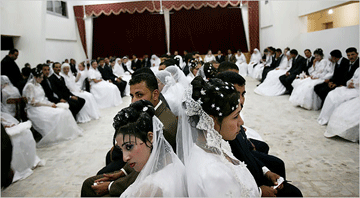
Here in Egypt and across the Middle East, many young people are being forced to put off marriage, the gateway to independence, sexual activity and societal respect. Stymied by the government’s failure to provide adequate schooling and thwarted by an economy without jobs to match their abilities or aspirations, they are stuck in limbo between youth and adulthood. Continue reading Dreams Stifled, Egypt’s Young Turn to Islamic Fervor

To Sing or to Sin? Is that the Question?

Music is alive and well in Muslim societies; Arab, Persian, Indian and Indonesian pop stars abound on the satellite channels and perform at weddings and other celebrations. There are also famous music festivals, the Baalbek Music Festival being one of the most known venues. So it should not be a surprise that the Yemeni port of Aden, long a crossroads of Muslims traveling east and west, should be the home of an Arab music festival. The Aden Festival was booked for February 14 with the Syrian singer Asalah Nasri and Egyptian star Issam Karika. As noted in an article in the current Yemen Observer, the director of the Aden cultural office, Abdullah Kudadah, considers the festival as a primary step for creating a tourism culture that will contribute to the economic and cultural renaissance of Yemen.

He further mentioned that this coming concert was among several proposed festivals for singers from different Arab states, as well as the fact that Yemen is launching four new satellite channels.

“Music is an international language. We know how the ancient Arab tribes used to celebrate their poets because they used to believe that their poets would promote the tribe. The success of a poet is the success of the whole tribe,” said Kudada. He added that Ukadh used to be the forum for all Arab poets from different Arab regions.

The director of Aden festival, Marwan al-Khalid, said the festival is the first of its kind organized by the Aden governorate. He said the festival will be held in the 22 May stadium and that more than 400 prizes will be given to the audience. In addition to 400 cell phones and one million Yemeni riyals divided amongst twenty winners, the grand prize of a Hyundai automobile will also be given away. Al-Khalid added that there would be VIP tickets costing $100 each, which include dinner and beverages. Ordinary tickets will cost YR3000 each.

Organizers have also decided to donate 30 percent of the concert proceeds to the aid of the Palestinian people in Gaza and to cancer health care in Yemen.

Al-Khalid expected a great turnout for the festival due to the fame of the Syrian singer.

Cultural expression and tourism: what could be wrong with that? The Devil, quite literally it seems, is in the details, also noted in the Yemen Observer article: Continue reading To Sing or to Sin? Is that the Question?

Strolling Through Tarlabasi


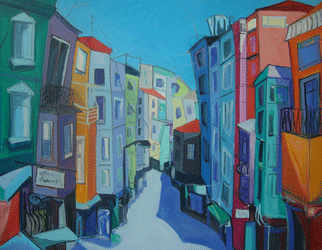
Tarlabasi, 2004, by Gamze Olgun, Oil Painting.

by Jenny White
Kamil Pasha Blog
Posted on January 24th, 2008

Tarlabasi is a district on the backside of the Beyoglu hill falling from the crest at Pera – where all the foreign embassies were in Ottoman times, now demoted to consulates – down in the direction of the Golden Horn. In The Abyssinian Proof, Kamil chases a wily criminal to his lair in Tarlabasi. The district is picturesque in the way of crumbling majesty on its last legs (a large part of Tarlabasi will be razed in 6 months, probably replaced by hotels). The steep, narrow lanes are strung with laundry, bustling with locals shopping at an outdoor market crammed into one of the lower streets. At the top of the hill near Istiklal Bouelvard are some lovely stone houses, now ruined or so shabby as to be nearly uninhabitable. A large stone house cracked down the side like an egg is posted for sale. As you walk down the hill, the houses become smaller, shabbier, sometimes outright ruins, less stone and more wood. In Ottoman times, Catholics and Greek Christians (Rum) lived near the top — shop owners, employees of the embassies — and poorer families near the bottom. Taylor Pepo’s apprentice lived in Tarlabasi with his family (The Abyssinian Proof). Today Tarlabasi is inhabited by Roma (gypsy), Kurds, the very poor, and social outcasts of various kinds. Continue reading Strolling Through Tarlabasi

Lost in the Lost Archive

The following is a reaction to the article “The Lost Archive” in The Wall Street Journal Jan 12, 2008, page 1 (US edition) by Michael Marx (marx@bbaw.de), Director of Research, Centre Corpus Coranicum (Berlin-Brandenburgische Akademie der Wissenschaften)

The lost archive, the myth of philology, and the study of the Qur’an
by Michael Marx

The belief in the myth that old manuscripts should be mysterious and powerful is part and parcel of the age of Modernity. That such expectations were operative in the discussion on the Qumran fragments is still remembered, and more recently the Da Vinci Code, in itself a quite shallow story, sold extremely well. The fact that the Wall Street Journal placed an article on the “lost Bergstrasser-film archive” of Qur’anic manuscripts on its front page on 12th of January seems to be due to the myth of “textual wars” taking place in the world. Labelled as a clash of civilizations or war of religions, conflicts today in the Middle East and Europe involving Christians, Muslims and Jews are likely to be perceived in isolation from their economical, social, or political preconditions. On September 12th 2001 a friend of mine bought a copy of the Qur’an in order to “understand what is going on”. Indeed, as if in the spirit of the protestant slogan of “sola scriptura” (= “through scripture only”), the idea of deciphering the software of “Muslim patterns of action” through the Sacred Book of Islam is tempting. As superficial as it may look, this very perception of the direct causal link between “what Muslims do” and passages of the Qur’an seems to be widespread. No article on the missing enlightenment in “Islam” without pointing to a still missing “but urgently needed” critical edition of the Qur’an. Almost no coverage on warfare in the Middle East and suicide bombings without the attempt to dig out passages from the Qur’an and pictures of praying and reciting Muslims. The cultural, social, and religious diversity of a whole region, the Middle East, that European and American history labels as the cradle of civilisation and the birthplace of Judaism and Islam appears transmuted into a “disturbing” monolithic religious monster. Continue reading Lost in the Lost Archive

Brothers of the Book

by Robert Lentz

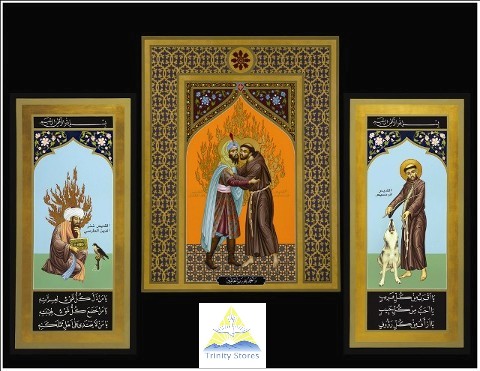
In 1219 St. Francis and Brother Illuminato accompanied the armies of western Europe to Damietta, Egypt, during the Fifth Crusade. His desire was to speak peacefully with Muslim people about Christianity, even if it mean dying as a martyr. He tried to stop the Crusaders from attacking the Muslims at the Battle of Damietta, but failed. After the defeat of the western armies, he crossed the battle line with Brother Illuminato, was arrested and beaten by Arab soldiers, and eventually was taken to the sultan, Malek al-Kamil.

Al-Kamil was known as a kind, generous, fair ruler. He was nephew to the great Salah al-Din. At Damietta alone he offered peace to the Crusaders five times, and, according to western accounts, treated defeated Crusaders humanely. His goal was to establish a peaceful coexistence with Christians.

After an initial attempt by Francis and the sultan to convert the other, both quickly realized that the other already knew and loved God. Francis and Illuminato remained with al-Kamil and his Sufi teacher Fakhr ad-din al-Farisi for as many as twenty days, discussing prayer and the mystical life. When Francis left, al-Kamil gave him an ivory trumpet, which is still preserved in the crypt of the Basilica of San Francesco in Assisi.

This encounter, which occurred between September 1 and 26, is a paradigm for interfaith dialog in our time. Despite differences in religion, people of prayer can find common ground in their experiences of God. Dialog demands that we truly listen to the other; but, before we can listen, we must see the other as a precious human being, loved by God. There is no other path to peace in this bloody 21st century. Continue reading Brothers of the Book

Politics of Piety: A Case Study in Cairo


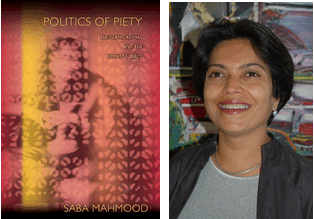
[In 2005 anthropologist Saba Mahmood published “Politics of Piety: The Islamic Revival and the Feminist Subject” (Princeton University Press). This important ethnography of the women’s mosque movement in Cairo not only presents an informative case study but challenges notions of how Muslim women’s involvement in pious movements should be analyzed in a feminist framework. The following excerpt is from the beginning of Mahmood’s book.]

Over the last two decades, a key question has occupied many feminist theorists: how should issues of historical and cultural specificity inform both the analytics and the politics of any feminist project? While this question has led to serious attempts at integrating issues of sexual, racial, class, and national difference within feminist theory, questions regarding religious difference have remained relatively unexplored. The vexing relationship between feminism and religion is perhaps most manifest in discussions of Islam. This is due in part to the historically contentious relationship that Islamic societies have had with what has come to be called “the West,” but also due to the challenges that contemporary Islamist movements pose to secular-liberal politics of which feminism has been an integral (if critical) part. The suspicion with which many feminists tended to view Islamist movements only intensified in the aftermath of the September 11, 2001, attacks launched against the United States and the immense groundswell of anti-Islamic sentiment that has followed since. If supporters of the Islamist movement were disliked before for their social conservatism and their rejection of liberal values (key among them ‘women’s freedom’), their now almost taken-for-granted association with terrorism has served to further reaffirm their status as agents of a dangerous irrationality. Continue reading Politics of Piety: A Case Study in Cairo

Art, Religion and History: The Case of Bahrain


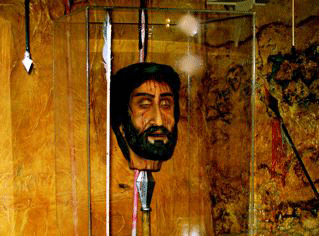
Figure 1. A Replica of the head of Imam Husayn

by El-Sayed el-Aswad
University of Bahrain

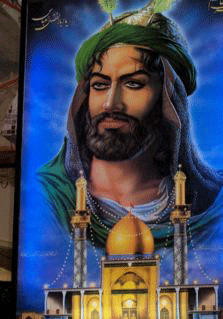
Art, in its broad meaning encompassing performance and non-performance forms of expression, plays a significant part in Bahraini imagination and folk culture. The focus here, however, will be on the innovative aspects of Shi‘a vernacular art. Among the Shi‘ti people of Bahrain there has been a shift from traditional or old-fashioned styles of mourning and commemorating the tragic events of ‘Ashura, or the tenth of Muharram (the first month of Islamic calendar in which Imam Husayn, grandson of the prophet Muhammad, was martyred) to a modern way of expression reflected mostly in the art.


Figure 2. Imaginary of al-‘Abbas, the sibling of Imam Husain

During the first ten days of Muharram, colorful forms of calligraphy, iconography, replicas (tashihat), ritual and visual representations are presented and meticulously enacted in exhibitions and in the streets of Manama, the capital city of Bahrain, as well as in most of the villages with Shi‘a majorities. Continue reading Art, Religion and History: The Case of Bahrain