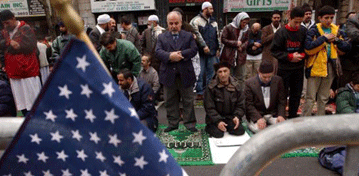
Muslims on the American Landscape

Yesterday the Pew Forum on Religion and Public Life issued a 143 page report, downloadable here, surveying the changing religious landscape of the United States. Based on interviews with some 35,000 individuals and drawing on earlier Pew research specifically on Muslims in America, this report is well worth reading. The findings are suggestive of the decline of strait-laced Puritan and venomous WASP America. Indeed, it seems that the United States is on the verge of losing its Christian Protestant edge, at least by direct affiliation. There has also been a dramatic decline in Catholicism, offset in large part by the fact that twice as many recent immigrants are Catholic rather than Protestant. One of the main findings is that Americans have taken on the habit of changing religions. “More than one-quarter of American adults (28%) have left the faith in which they were raised in favor of another religion – or no religion at all. If change in affiliation from one type of Protestantism to another is included, 44% of adults have either switched religious affiliation, moved from being unaffiliated with any religion to being affiliated with a particular faith, or dropped any connection to a specific religious tradition altogether,” conclude the authors. A full quarter of respondents between the ages of 18-20 are not affiliated with any organized religion. “Honk if you love Jesus” is being bumped off the sticker wars and overrun by “Our Father, who art in Walmart.”

To be sure, the Christian veneer of the United States will ensure “In God We Trust” on our mammon for some time to come. Over 78% of Americans self-identify as Christian, the largest block being the amorphous, and now apparently porous, Protestants and the politically courted Evangelicals constituting the largest Christian segment (26%), just a little larger than the total percentage of Catholics (24%). The 1.7 % of Americans who follow the Joseph Smith/Brigham Young (as opposed to the New Orleans) saints (that most people dub Mormons) accounts in part for the fact that Mitt Romney is not the Republican candidate this year. For a reality check on minority status, the same percentage (1.7) of Americans follow Judaism. Islam is way down the list at .06%, slightly less than the number of Buddhists (0.7%), but almost double the number of New Age enthusiasts at .04 %). Please keep in mind that these figures only refer to “adults” of the age of 18 and over. Since so many Muslims are young, there are in fact many more Muslims overall (as there are many more Christians) than this figure suggests. Continue reading Muslims on the American Landscape

About that Surge

America must be victorious, but victory is out of the question. This is the election-year paradox facing voters. Assuming Obama’s delegate count surge continues through Texas and Ohio, the national campaign will bring the surge issue front and center in the race to replace Mr. Bush, the president who started a war he cannot finish. On the Republican side, John McCain’s resurrected political fortunes will pit the man who believes he has fixed the mopping-up problem in Iraq against the man who can claim in all innocence that he was against the Iraq war from the start. Both candidates support the troops and respect General Petraeus, who came close to being Time Magazine‘s “Person of the Year.” Either McCain or Obama may grace a future cover of Time as the man who ended the war that no one no longer wants but no one also wants to lose. But this is as unpredictable as the eventual success of the “surge” as a strategy to bring about a stable Iraq.

About that surge… Republicans in the main see it as working; democrats tend to see the whole war as a unilaterally Bush diversion from the real terrorists and the surge as a desperate ploy for time, too little and too late. So is the surge working? Continue reading About that Surge

With Ratzel in North Africa

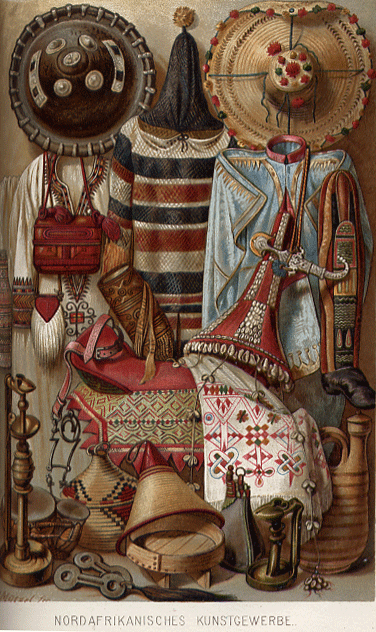
One of the most important German geographers of the late 19th century was Friedrich Ratzel (1844-1904), whose three-volume Völkerkunde (Leipzig and Vienna, Bibliographisches Institut, 1890) is one of those encyclopedia cultural accounts that circulated just as the discipline of anthropology was getting off (in this case literally “on”) the ground. While now a text for curiosity rather than critical scholarship on peoples and cultures, Ratzel’s work is still a fascinating portrayal of cultures being colonized for both revealing the biases of the day and the then-contemporary illustrations of people and material culture. My university library recently divested itself of uncirculated books in storage and one of these was an 1890 edition of the third volume on “Die Kulturvölker der Alten und Neuen Welt.” Whether it was the eye-watering althochdeutsch script of the volume or the mere fact it was written in German, no student or professor at Hofstra ever checked this volume out.

In salvaging a third of Ratzel’s opus for a mere dollar, I could not help but be drawn to the illustrations, mostly lithographs but with a few beautiful color plates. Continue reading With Ratzel in North Africa

Sufi Film on Link TV


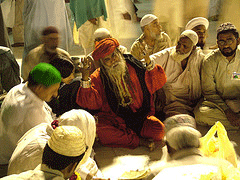
A Sufi qawall offering his devotional music in Lahore

Sufi Soul – The Mystic Music of Islam
U.K., 50 minutes

Director: Simon Broughton

Appearing on Link TV, Saturday, February 23. Visit the site for a preview.

With a dogmatic and fundamentalist view of Muslims increasingly predominant in the Western media, there has never been a more important time to show an alternative view of Islam. Sufism is the mystical dimension of Islam that preaches peace, tolerance and pluralism, while encouraging music as a way of deepening one’s relationship with God. This documentary explores Sufism and its music in different parts of the Islamic world, including Syria, Turkey, Pakistan and Morocco.

Sufi Soul reveals the views and beliefs of devotees while examining the growing threat from fundamentalist Islam and showcasing fantastic performances from some of the world’s greatest Sufi musicians.

For a review of the film, click here.

God’s Crucible Reviewed

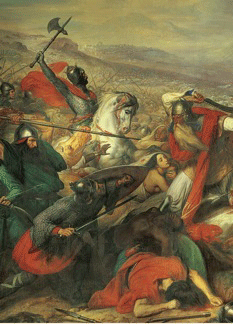
Detail of Carl von Steuben’s depiction of the Battle of Poitiers, fought in 732, the year Muslim armies crossed the Pyrenees.

A Better Place

What if the Muslim armies hadn’t been stopped at the French border?

by Joan Acocella, The New Yorker, February 4, 2008

In 610 A.D., Muhammad ibn Abdallah, a forty-year-old man from a prosperous merchant family in Mecca, repaired to a cave on nearby Mt. Hira to meditate—a retreat he had made many times. That year, though, his experience was different. An angel appeared and seized him, speaking to him the words of God. Muhammad fell to his knees and crawled home to his wife. “Wrap me up!” he cried. He feared for his sanity. But, as the voice revisited him, he came to believe that it truly issued from God. It called on him to reform his society. Poor people were to be given charity; slaves were to be treated justly; usury was to be outlawed. Muhammad’s tribesmen, the Quraysh, were polytheists, like most people in the Arabian Peninsula at that time, but this God, Allah, proclaimed that he was the only God. He was the same deity that the Jews and the Christians worshipped. Jesus Christ wasn’t his son, though. Christ was just a prophet, like the prophets of the Old Testament. Their word was now superseded by Muhammad’s, as their creeds were supplanted by this new one, Islam. Continue reading God’s Crucible Reviewed

International Conference: The New Draft Constitution of Turkey

The conference entitled “The Draft of the New Turkish Constitution” will bring together academics and politicians who have drafted the new constitution with scholars of democratic theory and comparative constitutions in a way that both side exchange critical views and share them with the public audience. The declared aim of the new constitution project is to contribute to the process of liberalization of Turkey’s political and legal systems as part of its integration to the European Union.

Monday, March 3rd: 9:00-6:30
International Affairs Building, Room 1501

This conference is sponsored by the Center for the Study of Democracy, Toleration, and Religion (CDTR) and the Institute for Religion, Culture and Public Life (IRCPL) at Columbia University, and Turkish Cultural Center (TCC).

For more information, please contact Ahmet Kuru: ak2840@columbia.edu Continue reading International Conference: The New Draft Constitution of Turkey

The Letters of Badr Shakir al-Sayyab: #15


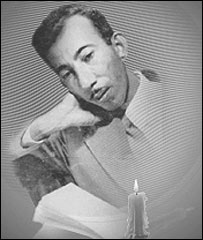
The Iraqi Poet Badr Shakir al-Sayyab

[Note: This is the 15th in a series of translations of selected letters of the noted Iraqi poet Badr Shakir al-Sayyab. For more information on the poet, click here.]

Letter #15

Basra 3/16/1962

My Dear Brother Yusuf (al-Khal),

I miss you very much, but we will meet soon, God willing. I received a telegram from Simon Jarji in which he asks me if I can be in Beirut between the 10th and the 17th of April. He also says that the International Organization for the freedom of Culture will bear the expense of my travel and lodging. I will be in Beirut between these dates, with God’s help.

I now have “21” new poems, and I will strive to find a buyer for these poems in Beirut. I am in extreme poverty and will come to Beirut carrying only a few Dinars in my pocket. Perhaps you will be able to arrange something for me while I am in Beirut. As for waiting for a month, this is extremely difficult. I will write the “The Iraq Message” for you while I am in Beirut. All the literary news is in Baghdad…I will visit Baghdad on my way and will gather from there all the news that fits to be included in the “Message.” Continue reading The Letters of Badr Shakir al-Sayyab: #15