The Bad Business of Badal

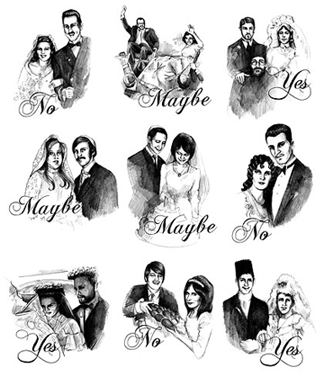
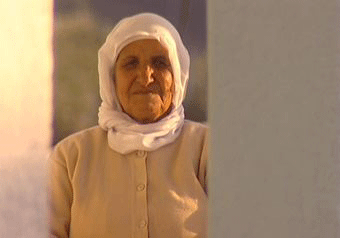
A Palestinian filmmaker, Ibtisam Mara’ana, has recently made a film on badal (exchange) marriage from her own personal experience. Although in Arabic, it has English subtitles. To watch a five-minute clip from the film, click here.

Director Ibstisam Mara’ana was predestined, like most of her relatives, to be married off through the badal, a kind of package deal in which a brother and sister from one family marry a sister and brother from another. This marriage exchange is mainly aimed at providing less marriageable daughters with a husband. Mara’ana was told that she was too old and dark, and too ugly due to a scar on her hand, and that without the godsend of the badal, she would fall by the wayside. She refused to cooperate. Instead, she made this award-winning documentary to show how women oppress women. Continue reading The Bad Business of Badal

The $2 Trillion Nightmare

By BOB HERBERT, The New York Times, March 4, 2008

We’ve been hearing a lot about “Saturday Night Live” and the fun it has been having with the presidential race. But hardly a whisper has been heard about a Congressional hearing in Washington last week on a topic that could have been drawn, in all its tragic monstrosity, from the theater of the absurd.

The war in Iraq will ultimately cost U.S. taxpayers not hundreds of billions of dollars, but an astonishing $2 trillion, and perhaps more. There has been very little in the way of public conversation, even in the presidential campaigns, about the consequences of these costs, which are like a cancer inside the American economy.

On Thursday, the Joint Economic Committee, chaired by Senator Chuck Schumer, conducted a public examination of the costs of the war. The witnesses included the Nobel Prize-winning economist, Joseph Stiglitz (who believes the overall costs of the war — not just the cost to taxpayers — will reach $3 trillion), and Robert Hormats, vice chairman of Goldman Sachs International. Continue reading The $2 Trillion Nightmare

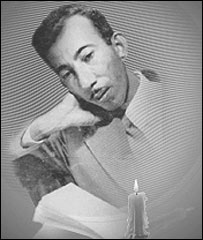
The Letters of Badr Shakir al-Sayyab: #16


The Iraqi Poet Badr Shakir al-Sayyab

[Note: This is the 16th in a series of translations of selected letters of the noted Iraqi poet Badr Shakir al-Sayyab. For more information on the poet, click here.]

Letter #16

al-Ma’qil 3/ 29/1962

My Dear Brother Mr. Jabra (Ibrahim Jabra),

Is it possible for any Iraqi to visit the beautiful Baghdad and to intentionally leave it? I will certainly try to arrange for “many visits” there in the summer beginning in June, God willing. However, this letter is devoted to business, to the story of Oxford that is long overdue, and not for chatting. The important thing is that I have a lot of new poetry that I will recite to you when we meet.

The following are my responses to the questions of Professor Hurani. I write it in Arabic so you may translate it according to how you see fit. You have the absolute right in responding as you wish:

1- Yes. I wish to study at any university other than Oxford, on the condition that I obtain an acceptance through the mediation of professor Hurani.
2- I was supposed to begin last academic year, but I postponed it until next year (next October), and I believe that it is difficult to postpone it a second time.
3- I prefer to write a thesis in the field of Arabic Studies or in Comparative Literature between Arabic and English Literature. Continue reading The Letters of Badr Shakir al-Sayyab: #16

How Do You Prove You’re a Jew?


Illustration by Elisabeth Moch for the New York Times

By GERSHOM GORENBERG, the New York Times, March 2, 2008

One day last fall, a young Israeli woman named Sharon went with her fiancé to the Tel Aviv Rabbinate to register to marry. They are not religious, but there is no civil marriage in Israel. The rabbinate, a government bureaucracy, has a monopoly on tying the knot between Jews. The last thing Sharon expected to be told that morning was that she would have to prove — before a rabbinic court, no less — that she was Jewish. It made as much sense as someone doubting she was Sharon, telling her that the name written in her blue government-issue ID card was irrelevant, asking her to prove that she was she. Continue reading How Do You Prove You’re a Jew?

An Iranian Laptop Dance

Iran Nuke Laptop Data Came from Terror Group

by Gareth Porter, from IPS

WASHINGTON, Feb 29 (IPS) – The George W. Bush administration has long pushed the “laptop documents” — 1,000 pages of technical documents supposedly from a stolen Iranian laptop — as hard evidence of Iranian intentions to build a nuclear weapon. Now charges based on those documents pose the only remaining obstacles to the International Atomic Energy Agency (IAEA) declaring that Iran has resolved all unanswered questions about its nuclear programme. But those documents have long been regarded with great suspicion by U.S. and foreign analysts. German officials have identified the source of the laptop documents in November 2004 as the Mujahideen e Khalq (MEK), which along with its political arm, the National Council of Resistance in Iran (NCRI), is listed by the U.S. State Department as a terrorist organisation.

There are some indications, moreover, that the MEK obtained the documents not from an Iranian source but from Israel’s Mossad. Continue reading An Iranian Laptop Dance

The Problem with “Fundamentalism”

[This is an excerpt from my article, “The tragedy of a comic: fundamentalists crusading against fundamentalists,” published in Contemporary Islam (2007, Vol. 3, #1).]

The issue of religious fundamentalism has been raised both in the popular media and by academicians as one of the most critical global challenges to a smooth transition into the third millennium. The Y2K alarm over cyberspace as the clock turned over 2000 was only the Book of Revelation in digital imagination. Debating the death of God, especially in the halls of Academe, has had little impact on the perpetual panopticon of apocalyptic scenarios literally decoded out of the Bible. The Catholic church and mainline Protestant denominations have largely left behind the baggage of prophecy as contemporary politics, though in the past Christian clerics of all persuasions had no trouble conjuring enemies, including the Ottoman Turks, as anti-christened candidates. In Christianity biblical literalists today are often, and erroneously, dismissed in blanket condemnation as “Fundamentalists” because of what they reject rather than what they believe. The problem with being a “Bible believer” is that this implies rejecting rationalism, modern science and theological reform. The problem with being labeled a “Fundamentalist” is that most people fit into the category do not use or accept the term.

“Fundamentalism” as a term should be of interest to scholars who study the phenomenon not only because of what it is said to represent, but also because it is “our” term – a word coined almost a century ago within American Protestantism to define a self-proclaimed conservative religious movement contra a liberal shift in mainline denominations.(1) Continue reading The Problem with “Fundamentalism”

An American in Baghdad

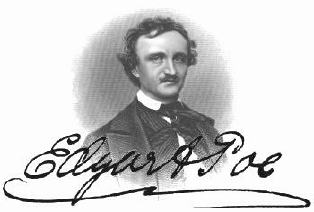
Editor’s Note: The Baghdad I am referring to is that of the Arabian Nights fantasy and the American is the extraordinary man of letters, Edgar Allen Poe. Among his humorous short stories is a tale called “The Thousand-and-Second Tale of Scheherezade,” archived online at http://www.online-literature.com/poe/45/. Here is a taste of the tale, but I suggest you read the whole story online.


Truth is stranger than fiction.
Old saying.

HAVING had occasion, lately, in the course of some Oriental investigations, to consult the Tellmenow Isitsoornot, a work which (like the Zohar of Simeon Jochaides) is scarcely known at all, even in Europe; and which has never been quoted, to my knowledge, by any American — if we except, perhaps, the author of the “Curiosities of American Literature”; — having had occasion, I say, to turn over some pages of the first — mentioned very remarkable work, I was not a little astonished to discover that the literary world has hitherto been strangely in error respecting the fate of the vizier’s daughter, Scheherazade, as that fate is depicted in the “Arabian Nights”; and that the denouement there given, if not altogether inaccurate, as far as it goes, is at least to blame in not having gone very much farther.

For full information on this interesting topic, I must refer the inquisitive reader to the “Isitsoornot” itself, but in the meantime, I shall be pardoned for giving a summary of what I there discovered. Continue reading An American in Baghdad

Style in the Dawn of Civilization


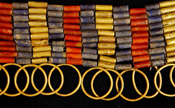
Belt made of lapis lazuli, gold and carnelian worn by Queen Pu-abi, who was buried in the Royal Tombs of Ur.

The frenzy caused by New York Fashion Week and red-carpet style at the Oscars may give the impression that contemporary society is particularly clothes-obsessed, but the research of Aubrey Baadsgaard, an anthropology doctoral student at Penn, shows that the concept of fashion is as old as human history itself. Baadsgaard is writing her dissertation on how clothing and ornamentation both reflected and helped construct gender and gender roles in ancient Mesopotamia during the Early Dynastic Period (circa 2900 – 2100 B.C.), considered to be one of the ‘cradles of civilization.’

For the rest of this article, with pictures, click here.