
Muscat Harbor, ca 1677, attributed to the Flemish painter Jan Peeters (1624-ca 1677)
No Room at the Mosque
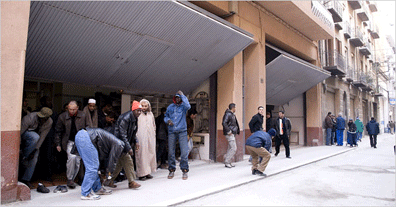
In Lleida, Spain, Muslims gathering in front of a cramped, converted garage that serves as a mosque. The congregation has grown to 1,000 members from 50 over the past five years.
Spain’s Many Muslims Face Dearth of Mosques
By VICTORIA BURNETT, The New York Times, Sunday, March 16, 2008
LLEIDA, Spain — As prayer time approached on a chilly Friday afternoon and men drifted toward the mosque on North Street, Hocine Kouitene hauled open its huge steel doors.
As places of worship go, the crudely converted garage leaves much to be desired, said Mr. Kouitene, vice president of the Islamic Association for Union and Cooperation in Lleida, a prosperous medieval town in northeastern Spain surrounded by fruit farms that are a magnet for immigrant workers. Freezing in winter and stifling in summer, the prayer hall is so cramped that the congregation, swollen to 1,000 from 50 over the past five years, sometimes spills onto the street.
“It’s just not the same to pray in a garage as it is to pray in a proper mosque,†said Mr. Kouitene, an imposing Algerian in a long, black coat and white head scarf. “We want a place where we can pray comfortably, without bothering anybody.â€
Although Spain is peppered with the remnants of ancient mosques, most Muslims gather in dingy apartments, warehouses and garages like the one on North Street, pressed into service as prayer halls to accommodate a ballooning population. Continue reading No Room at the Mosque
Bernard Lewis Gets It Wrong
[Editor’s Note: I include this article not because I agree with its spin, but due to the irony of someone attacking Bernard Lewis for being soft on terrorism in the name of Islam.]
By Andrew G. Bostom
FrontPageMagazine.com | Friday, March 14, 2008
Last week (March 6, 2008) The Jerusalem Post published an interview with historian Bernard Lewis that touched on a range of subjects, from Lewis’ own cultural identity, to his views on feminism and jihad.
Writer Rebecca Bynum has commented aptly on Lewis’ remarks about feminism, and the condition of women; I will confine my own analysis to Lewis’ remarkable statements on the jihad.
Lewis’ Claim (1):
What we are seeing now in much of the Islamic world could only be described as a monstrous perversion of Islam. The things that are now being done in the name of Islam are totally anti-Islamic. Take suicide, for example. The whole Islamic theology and law is totally opposed to suicide. Even if one has led a totally virtuous life, if he dies by his own hand he forfeits paradise and is condemned to eternal damnation. The eternal punishment for suicide is the endless repetition of the act of suicide. That’s what it says in the books. So these people who blow themselves up, according to their own religion – which they don’t seem to be well-acquainted with – are condemning themselves to an eternity of exploding bombs.
Doctrinal and Historical Reality (1):
But Lewis conflates “suicideâ€â€”as the tragic outcome, for example, in modern parlance, of clinical psychiatric depression, which is impermissible in Islam—with “martyrdom,†which is extolled.
“Martyrdom operations†have always been intimately associated with the institution of jihad. Professor Franz Rosenthal, in a seminal 1946 essay (entitled, “On Suicide in Islamâ€), observed that Islam’s foundational texts sanctioned such acts of jihad martyrdom, and held them in the highest esteem: Continue reading Bernard Lewis Gets It Wrong
Iraq Goes Pastafarian
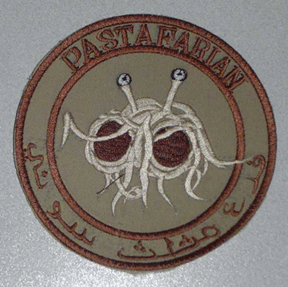
For readers interested in new religious movements, whether pasta, prego or in da futura, it should be noted that the FSM Pastafarian Movement now has a chapter in Iraq. So, while the DOD could find no evidence of a link between Saddam Hussein and Osama bin Laden, it can now be stated al dente that the spaghetti has indeed hit the fan, regardless of the Surge.
Luke R. E. Publican
Georgetown Conference on Alternative Perspectives of the Gülen Movement
CALL FOR PAPERS
ISLAM IN THE AGE OF GLOBAL CHALLENGES:
Alternative Perspectives of the Gülen Movement
October 17 – 18, 2008
Georgetown University
Georgetown University President’s Office, Alwaleed bin Talal Center for Muslim Christian Understanding at Georgetown University, The Institute of Turkish Studies, and Rumi Forum would like to invite you to participate in a conference that explores alternative perspectives of the Gülen Movement within the larger framework of Islam in the Age of Global Challenges. The conference will take place at the Georgetown University on October 17 – 18, 2008. Continue reading Georgetown Conference on Alternative Perspectives of the Gülen Movement
Opening the Quran

Note: The Qur’an can be divided into thirty equal parts. One part takes only twenty-four reading minutes, and the whole Book requires 12 reading hours. There are 114 chapters, and 6,236 Arabic verses (Abu ‘Amr Al-Dani in his book Al-Bayan), containing 77,439 Arabic words (reported by Al-Fadl bin Shadhan) made up of 371,180 Arabic letters (Abdullah b. Kathir reporting Mujahid, although there are different accounts). By contrast the King James Version of the Christian Bible (OT and NT) has 783,137 words and 3,566,480 letters. Muslims believe the Quran in Arabic is the actual Word of God given to Muhammad through a series of revelations from 610-632 C.E. and not written down as a “book†until after Muhammad died.
Given the general ignorance in American society of Islam, especially the theology based on the teachings in the Quran, it is important to go back to the beginning, the essence, the opening, the words that are by definition significant to all Muslims. This eloquent key is the opening (fatiha) of the text, a set of verses as repeated by Muslims daily as the Lord’s Prayer is by Christians. Continue reading Opening the Quran
Deoband’s Anti-Terrorism Convention: Some Reflections
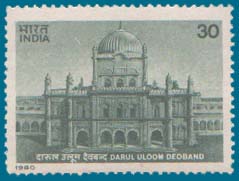
by Yoginder Sikand, March 11, MADRASA REFORMS IN INDIA
The mammoth ‘Anti-Terrorism Convention’ organised at Deoband late last month, which brought together ulema from all over the country, has received wide media coverage. While smaller conventions of this sort have been organized by other ulema bodies in recent years, this one, unlike others, caught the attention of the media particularly because it was organized by the Dar ul-Ulum Deoband, probably the largest traditional madrasa in the world, which large sections of the media have been unfairly berating as the ‘hub’ of ‘terrorism’.
The speeches delivered at the convention have been considerably commented on in the press. By and large, the non-Muslim press has focused almost wholly on the resolutions that were passed that labeled ‘terrorism’ as ‘anti-Islamic’, leaving out other crucial issues that were raised by numerous ulema who spoke on the occasion, particularly about Western Imperialism and Zionism as major factors behind global ‘terrorism’, and the hounding of Muslim youth and mounting Islamophobic offensives across the world, including India, in the name of countering ‘terror’. Muslim papers have dealt with these issues fairly extensively, but, following most of the speakers at the convention, they have placed the blame for ‘terrorism’ almost entirely on what they identify as ‘enemies of Islam’, thus presenting a very one-sided picture. In short, media reporting about the convention, by both the Muslim and non-Muslim media, has been inadequate and somewhat imbalanced. The same can be said of several of the speeches made at the convention. Continue reading Deoband’s Anti-Terrorism Convention: Some Reflections
The Letters of Badr Shakir al-Sayyab: #17
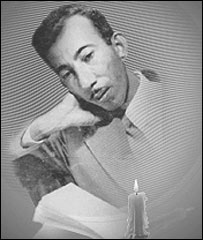
The Iraqi Poet Badr Shakir al-Sayyab
[Note: This is the 17th in a series of translations of selected letters of the noted Iraqi poet Badr Shakir al-Sayyab. For more information on the poet, click here.]
Letter #17
Basra…..(1)
My Brother Jabra (Ibrahim Jabra),
Only yesterday I received your letter dated, 4/ 29/1963. I was overjoyed especially because your news has been disrupted for a while now. In a letter to me from Taoufik Sayigh, he inquires about the reason for your absence from him and from “Hiwar.†I hope you will write to him.
I continue to improve, but at the same slow pace. I am still waiting for my improvement to reach a certain stage so I can come to Baghdad and remain for a week or two.
Bahij ‘Uthman has not yet sent me my personal copies of “ al-Ma’bid al-Ghariq†and “Manzil al-Aqnan.†Perhaps they will arrive soon, and then I will send you your two copies.
Enclosed with this letter, you will find two new poems which I hope will earn your approval. I am ready to translate any article you send. Continue reading The Letters of Badr Shakir al-Sayyab: #17