Me without my hijab

Removing my head covering changed how I saw myself and the world.
By Zainab Mineeia, Los Angeles Times, June 8, 2008

When I came to this country, I took off my hijab. It wasn’t an easy decision. I worried at night that God would punish me for it. That’s what I had been taught would happen, and it filled me with fear.

I was 27, coming from my home country of Iraq to study in California. I hoped that by taking off the hijab I had been wearing for eight years, I would be able to maintain a low profile. In Baghdad, you keep a low profile to stay alive. But in the United States, I merely wanted not to be judged.

Still, I was filled with anxiety. As I flew toward the United States, I wondered how I would feel when the moment came to appear with my head uncovered. Continue reading Me without my hijab
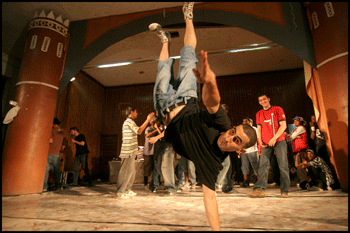
Hip hop subculture gets spotlight in Sana’a


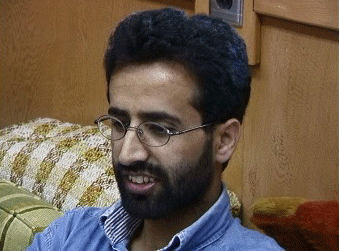
One of the competing breakdancers, Khaled Sinjab, performs complicated dance
moves for his crew “Blast Boyz.”

By Fares Anam, Yemen Observer, Apr 26, 2008

An enthralling show performed by Arab youth was held Wednesday night at the Yemeni Center for Studies and Research. Enlivened by hip hop music, these students studying in Yemen competed to be recognized as the best dancers and singers in Sana’a.

The hip hop festival, titled “Common Ground,” brought this unique American art form together with Arab youth by offering music and dance to the capital. The hip hop party was organized by the French Culture Center in cooperation with the German House, under the control of the Arbitration Commission. The event was supervised by French dancers Romo, Gohen and Fred Burki, in addition to DJ Malik and the Yemeni-American singer, Haggagi. Continue reading Hip hop subculture gets spotlight in Sana’a

What Krauthammer is Missing

In yesterday’s Real Clear Politics, the Washington Post and anti-Obama pundit Charles Krauthammer showed off his rhetorical disdain for anything resembling accuracy in reporting on the war in Iraq. According to this armchair theory spinner, the war in Iraq has already been won — shades of Henry Kissenger’s disengenuous claim about Vietnam before a previous election. Here is what Krauthammer said:

We know Obama hasn’t been to Iraq in more than two years, but does he not read the papers? Does he not know anything about developments on the ground? Here is the “nothing” that Iraqis have been doing in the last few months: Continue reading What Krauthammer is Missing

Arabic ‘Threatens’ Israeli Supremacy


HEBREW FIRST: File photo of Limor Livnat speaking to the media in the United States in 2000: “In these times, when there are radical groups of Israeli Arabs trying to turn the State of Israel into a bi-national state, it is most urgent to put into law the unique status of the language of the Bible – the Hebrew language,” Livnat has argued. (Newscom)

By MEL FRYKBERG Middle East Times, June 10, 2008

JERUSALEM — In a move that has outraged both Arab Israelis and some progressive Jewish Israelis, a new bill was presented to the Israeli Knesset or parliament last week to relegate Israel’s other official language Arabic to that of a secondary language, leaving Hebrew as the only official language.

The bill was drafted by Likud Member of the Knesset (MK) Limor Livnat, a renowned right-winger, and was seconded by MKs Yuli Edelstein from Likud, Otniel Schneller from Kadima and Ya’acov Margi from the ultra-Orthodox Shas party.

Should this move be approved by the Knesset, then Arabic would be downgraded to the same level as English, a language native to only a small percentage of Israeli immigrants, and taught in schools primarily for the purpose of communicating with the international community.

Arabic is the native language of Arab Israelis or 20 percent of Israel’s population. Russian is spoken by 1 million people, out of a total comprising just over 7 million, with the remainder of the population speaking Hebrew as its first language. Continue reading Arabic ‘Threatens’ Israeli Supremacy

All in the name of War on Terror

by Fahad Faruqui, Yemen Times

Detainee number 063, Mohamed Al-Kahtani, was one of the many hundreds housed in the Guantanamo (known as “Gitmo”) Bay detention camps who was subjected to 20 hours of interrogation on only four hours of sleep.

The Haynes memo, which approved controversial and harmful interrogation techniques, was signed by Donald Rumsfeld, the former United States Secretary of Defense, in early December of 2002. Entitled, “Counter-Resistance Techniques,” this was the memo that opened the door for partial drowning (called water boarding), along with humiliation, mental destabilization and other illegal methods of obtaining information from detainees.

Al-Kahtani, a citizen of Saudi Arabia, is the alleged 20th hijacker, but the U.S. Military Commissions dropped key 9/11 suspect charges against him on May 11 this year. Continue reading All in the name of War on Terror

The changing face of American Islam


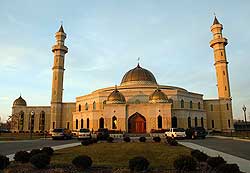
The Islamic Centre America in Dearborn, Michigan

by IMTIYAZ YUSUF, Bangkok Post, June 8, 2008

I recently got back to Thailand after a one-and-a-half month stay in the United States, where I was a student of Islamic Studies at Temple University in Philadelphia, and where I spent seven years during the 80s and 90s. The tour revealed to me a very different Islam in the post-9/11 United States. In the face of widespread bias and prejudice, personal attacks, deep suspicion and misinformation about Islam marked by the prevalence of Islamophobia in the American mindset, Muslim society in the US has undergone a tremendous internal transformation, with the aim being to prove loyalty to the American nation by undertaking steps towards political, social and civil integration. The seven million-strong American Muslim community is emerging and evolving as both an integral part of the American socio-political milieu and a distinct section of the worldwide Muslim community. Continue reading The changing face of American Islam